Jens Hepper
Independent researcher, Northeim, Germany.
Email: jens.hepper (at) rlsb (dot) de
Pop culture increasingly provides the metaphors—and sometimes the scripts—that shape public conversations about geopolitics, technology, and corporate power. This article foregrounds the geek angle by first showing how ideas from science fiction and gaming (especially the cyberpunk genre) seep into everyday discourse; then it introduces the genre’s signature trope of the all‑powerful megacorporation. Against this backdrop, it presents German motor and arms manufacturer Rheinmetall’s unusual announcement to deploy its own air‑defence assets to protect a manufacturing plant in Ukraine as a real‑world case study of “cyberpunk leaking into the timeline.” Using grounded theory and qualitative content analysis of large social‑media discussions, this study finds predominantly positive audience sentiment and frequent, sophisticated comparisons to cyberpunk universes (e.g., Shadowrun and Cyberpunk).
Geek Metaphors in Common Speech
Comic books, films, and video games have long supplied shorthand for complex ideas. ‘Superman’, ‘the Dark Side’, or even ‘zombie apocalypse’ now function as everyday metaphors to discuss ethics, corruption, resilience, or societal breakdown (Tatsumi, 2006). Memes accelerate this transfer: a vivid fictional frame makes abstract or technical issues legible and emotionally engaging. These references are not mere jokes; they shape how people think and argue. When a debate invokes ‘Skynet’, ‘red pills’, or ‘Weyland‑Yutani’, it pulls in narrative gravity from entire fictional canons—characters, moral alignments, and world‑rules arrive pre‑packaged (Singer, 2002). So, what some dismiss as “just pop culture” can structure public reasoning about serious topics, including war and corporate power.
Cyberpunk Megacorps
At the heart of most cyberpunk stories is the megacorporation: a private actor so large that it blurs traditional lines between state and market. These firms maintain private security forces, project power across borders, and sometimes operate as if above the law. In fiction, megacorps are often coded as antagonists, being efficient, amoral, and ubiquitous. Famous game settings (originally tabletop, now also videogames) such as Shadowrun (originally by FASA, 1989) and Cyberpunk (originally by R. Talsorian Games, 1988) depict corporate enclaves with their own rules, corporate military assets, and forms of “extraterritoriality” (Brozek, 2013; Pondsmith, 2020). German‑language sourcebooks helped cement these tropes for local audiences, with Saeder‑Krupp and MET2000 becoming touchstones for corporate militarisation (FanPro, 1992; Pegasus Spiele, 2011).
This genre-specific grammar matters because readers bring it with them when encountering real‑world events. When news breaks that a defence company plans to protect its overseas assets with its own air‑defence systems, many immediately reach for the cyberpunk playbook (Roxl, 2023).

Case Study
In July 2023, following public threats by Russian officials toward a planned production facility in Ukraine, Rheinmetall’s CEO signalled the intent to deploy company‑owned air‑defence to protect the site (Roshchina, 2023). Regardless of legal nuance or ultimate implementation, that message—i.e., a corporation publicly proposing to defend its foreign factory with its own military equipment—landed online like a plot beat from Shadowrun or Cyberpunk. The episode became a memetic touchstone: social-media users debated corporate sovereignty, invoked megacorp lore, and compared Rheinmetall to fictional counterparts (Chaudhuri & Israel, 1991; Pondsmith, 2020; Roxl, 2023).
Methodology
Given the scarcity of prior research on pop culture framing in defence‑industry discourse, a grounded‑theory approach was adopted (Strauss & Corbin, 1994; Tolhurst, 2012). Source threads were located via platform search (Twitter/X, Facebook, Reddit, 9gag, Instagram, TikTok) and reverse‑image/keyword queries (in German and English). Individual posts were coded iteratively for sentiment, themes, and explicit cultural references. Engagement metrics (likes/upvotes vs. dislikes/downvotes) were tallied to complement qualitative codes.
Results
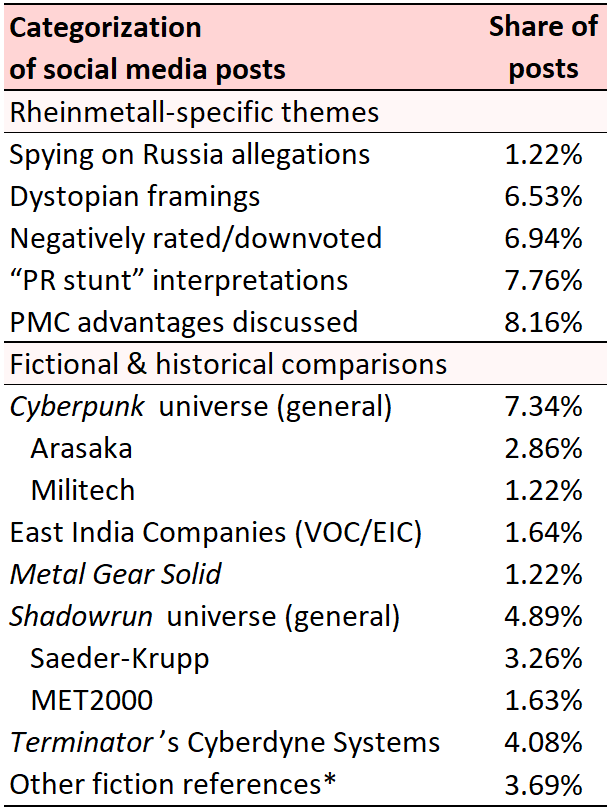
Across a corpus of 245 threads (total 19,804 posts; Table 1), audience sentiment was notably positive toward Rheinmetall’s stance. The ratio of likes to dislikes on initial posts reporting the announcement was ≈13.8:1, and approving comments substantially outnumbered critical ones (≈6.7:1). Many threads explicitly mapped the event onto cyberpunk worlds (Table 1), referencing Shadowrun (including Saeder‑Krupp and MET2000) and Cyberpunk (Arasaka, Militech) (FanPro, 1992; Pegasus Spiele, 2011; Brozek, 2013; Pondsmith, 2020). Historical analogies to the Dutch and British East India Companies also appeared, typically in more critical contexts (Chaudhuri & Israel, 1991).
Discussion
Looking at the results, the first question one should ask is “Why did the geek lens skew positive?”. Three interacting dynamics help explain the upbeat reception. Firstly, moral compression via genre: cyberpunk habituates audiences to corporate militarisation as a narrative given; in that grammar, a firm moving to protect its assets feels “on brand” and, thus, not shocking (Brozek, 2013; Pondsmith, 2020). Secondly, geopolitical priors: post‑2022 negative public attitudes toward Russia in the West likely shaped baseline sympathies (Darczewska et al., 2015; Beardsworth, 2022). Third, platform dynamics and memetics: threads remixing the story with recognisable IPs are more legible and shareable; referencing Saeder‑Krupp or Arasaka supplies instant context and in‑group signalling (Roxl, 2023).

A historical counter‑frame, i.e., comparisons to the VOC/EIC, correlated with more critical stances (Chaudhuri & Israel, 1991). The coexistence of celebratory cyberpunk mappings and cautionary historical analogies suggests that pop culture frames can both normalize as well as problematize corporate power, depending on which canon a community mobilises.
There are some implications for media literacy and digital citizenship to be extracted here. Pop culture seems to be an input into public reasoning about war and related corporate power, media literacy must explicitly teach how fictional frames can bias interpretation: frame‑spotting, lore vs. law, and evidence hygiene (Krugman, 2022). For instance, classroom modules can juxtapose genre tropes (e.g., megacorps being above the law) with actual legal constraints on companies and PMCs (private military companies) in particular (Singer, 2002), while highlighting engagement incentives that privilege memetic clarity over nuance.
The present dataset integrates different platforms and languages, with uneven moderation norms and bot activity. Sentiment proxies (likes/upvotes) are platform‑specific and can be stacked. Future work should combine API‑based sampling with network analyses to detect coordination, and extend coding to image macros to capture visual frames (e.g., screenshots pairing headlines with Cyberpunk 2077 imagery) (Statista, 2022).
REFERENCES
Beardsworth, J. (2022) Russians abroad: blamed for a regime they sought to escape. The Moscow Times. Available from: https://www.themoscowtimes.com/2022/03/04/russians-abroad-blamed-for-a-regime-they-sought-to-escape-a76762 (Date of access: 06/Sep/2025).
Brozek, J. (2013) Shadowrun. Core Rulebook. 5th ed. Catalyst Game Labs, Seattle.
Chaudhuri, K.N. & Israel, J. (1991) The English and Dutch East India Companies and the Glorious Revolution of 1688–9. In: Israel, J. (Ed.) The Anglo‑Dutch Moment: essays on the Glorious Revolution and its world impact. Cambridge University Press, Cambridge. Pp. 407–438.
Darczewska, J.; Żochowski, P.; Todd, J. (2015) Russophobia in the Kremlin’s strategy. Ośrodek Studiów Wschodnich, Warsaw.
FanPro (Eds.). (1992) Deutschland in den Schatten. Fantasy Productions, Berlin.
Garver, R. (2023) Global public perception of Russia’s leadership eroded sharply in 2022.VOA News. Available from: https://www.voanews.com/a/global-public-perception-of-russia-s-leadership-eroded-sharply-in-2022/7064927.html (Date of access: 06/Sep/2025).
Krugman, P. (2022) Does ChatGPT mean robots are coming for the skilled jobs? The New York Times. Available at: https://www.nytimes.com/2022/12/06/opinion/chatgpt-ai-skilled-jobs-automation.html (Date of access: 06/Sep/2025).
Pegasus Spiele (Eds.). (2011) Rhein‑Ruhr‑Megaplex (Shadowrun Sourcebook). Pegasus Spiele, Friedberg.
Pondsmith, M. (2020) Cyberpunk RED. R. Talsorian Games, Phoenix.
Roshchina, O. (2023) Deutscher Panzer-Chef pfeift auf Putin-Drohung. Bild. Available from: https://www.bild.de/politik/ausland/politik-ausland/russen-wollen-seine-fabrik-bombardieren-deutscher-panzer-chef-pfeift-auf-putin-d-84756842.bild.html (Date of access: 06/Sep/2025).
Roxl, R. (2023) Cyberpunk 2077: Arasaka Corporation lore. GameRant. Available from: https://gamerant.com/cyberpunk-2077-things-didnt-know-arasaka-corporation/ (Date of access: 06/Sep/2025).
Singer, P.W. (2002) Corporate warriors: the rise of the privatized military industry and its ramifications for international security. International Security 26(3): 186–220.
Statista (Eds.). (2022) Lifetime unit sales generated by Cyberpunk 2077 worldwide as of September 2022. Available at: https://www.statista.com/statistics/1305749/cyberpunk-2077-sales-worldwide/ (Date of access: 06/Sep/2025).
Strauss, A. & Corbin, J. (1994) Grounded Theory methodology: an overview. In: Denzin, N. & Lincoln, Y. (Eds.) Handbook of Qualitative Research. SAGE, Thousand Oaks. Pp. 273–284.
Tatsumi, T. (2006) Full metal Apache: transactions between cyberpunk Japan and avant‑pop America. Duke University Press, Durham.
Tolhurst, E. (2012) Grounded Theory method: sociology’s quest for exclusive items of inquiry. Forum: Qualitative Sozialforschung 13(3): 26.
Acknowledgements
ChatGPT (GPT‑5 Thinking, OpenAI) was used to improve the writing style of this article. The author reviewed, edited, and revised the ChatGPT‑generated texts to his own liking and takes ultimate responsibility for the content of this publication.
About the author
Dr. Jens Hepper is an educator and wildlife/forestry specialist based in Lower Saxony. He leads federal‑level vocational training for professional gamekeepers/professional hunters in Germany and lectures on forest ecology, wildlife biology, and sustainability pedagogy. He is an independent lecturer and researcher and serves as an adjunct lecturer in pedagogy at two universities. Outside the classroom, he has been a pen‑and‑paper role‑player for many years—formerly Shadowrun, in recent years Cyberpunk—and he is a long‑time Star Trek fan.


 Journal of Geek Studies