Nicolas Méra
Independent researcher. Auvergne, France.
Email: contact (at) fildelhistoire (dot) com
https://doi.org/10.5281/zenodo.10644091
“Why do we fall, Bruce? So that we can learn to pick ourselves up.”
Batman Begins (Warner Bros., 2005)
A multimillionaire playboy who disguises himself as a bat to beat Gotham’s underworld to a pulp by night: at first glance, the Batman is nothing more than an eccentric, neurotic superhero with a penchant for latex. Yet the story of his birth reminds us of one of the darkest chapters in American history.
The date is October 24, 1929, a day that would go down in history as ‘Black Thursday’. With 9 billion dollars going up in smoke in the space of one hour and a half, the resounding crash of the Wall Street stock market precipitated the ruin of numerous small shareholders. Overnight, thousands of households found themselves penniless. “When Wall Street took that tail spin, you had to stand in line to get a window to jump out of, and speculators were selling spaces for bodies in the East River,” a satirical New York newspaper reported. It was widely believed that bankers and ruined investors had climbed to the top of Manhattan’s skyscrapers, ready for the great plunge that mimicked the American economy’s… But actually, the only figure haunting the rooftops of New York at that time, preparing for his sensational entrance, was wearing a black mask with pointed ears.
Black Thursday was just the beginning. The crisis soon seeped through the rest of the planet like a poison. The United States were hit by the Great Depression, which would only end in 1933 following the revival efforts of President Franklin D. Roosevelt. Despite the hesitant economy recovery (a quarter of the population was still unemployed), the country did not regain the optimism that had electrified it a few years earlier. For the majority of the American population, an alternative to the prevailing doldrums was to be found in the entertainment industry. Here, too, the damage was serious: Hollywood was almost broke, the major studios had collapsed, the national baseball league had had to get rid of fourteen teams for lack of sufficient funds… But the country pulled itself together by playing Monopoly, introduced in 1935 (fictitious bankruptcy was still better than real ruin), swing dancing in cafés and listening to radio soap operas. In cinemas, musicals and comedies triumphed, led by the audacity of the Marx Brothers, and The Wizard of Oz dazzled audiences in Technicolor. Less pastel-coloured but just as popular, the gangster made his entrance on the screens as a familiar figure, cousin of the underprivileged – some sort of Robin Hood with a porkpie hat and a machine gun…
All in all, the fears and hopes of the time were inevitably reflected in the entertainment industry. Comic books were no exception.

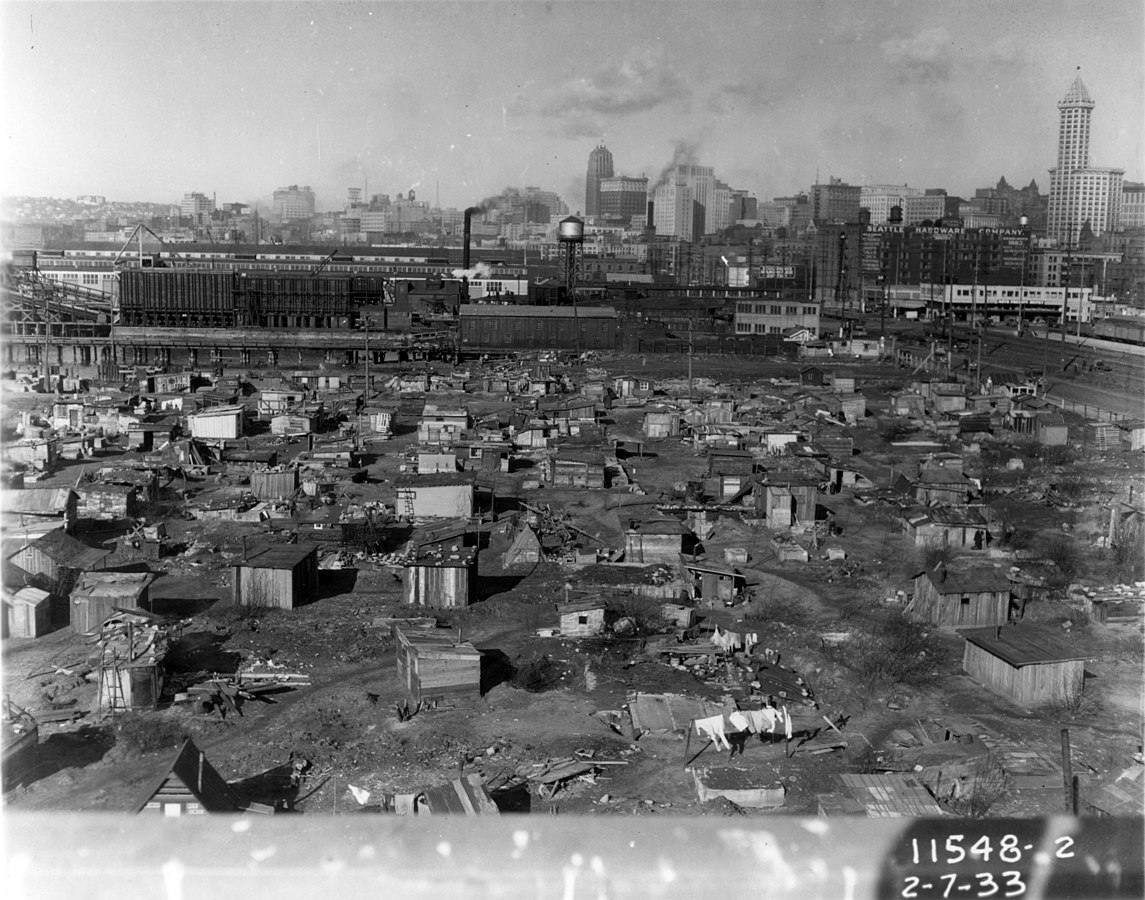
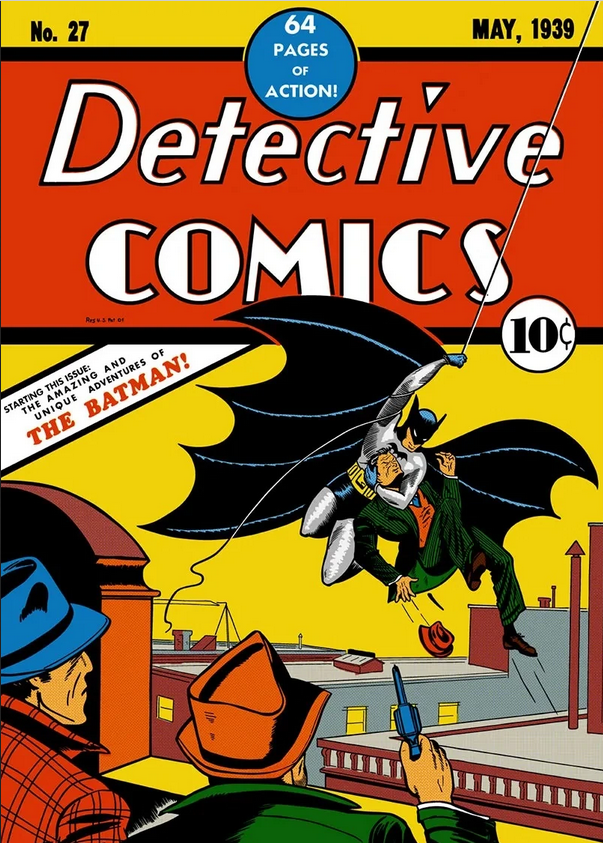
Bat-Man – as he was known in his early days – was a child of these times of misery. He appeared in March 1939 (Detective Comics #27) in a wound opened wide by the Great Depression that was still festering: a character tormented by his past, bitter and violent, whose distress was not material but moral. Orphaned at the age of ten, he matured too quickly amid the brambles of a scarred childhood; he became a bitter, solitary adult, fading into the shadows of his hometown. His favourite hunting ground, like the bats he has made his emblem, is the Gotham nightlife, especially its winding alleys teeming with murders and trafficking of all kinds. The very structure of the fictional city reflects an unhappy, disaster-stricken era, a sort of evil double of the sprawling megacities that were beginning to mushroom across America, with their strips of reinforced concrete stretching as far as the eye can see. In the centre of Gotham, the disreputable Narrows district, bristling with shanty towns, is reminiscent of the makeshift architecture of ‘Hooverville’, a tin district built by the dispossessed during the Great Depression, and named after the president of the time, Herbert Hoover. The parallel with the Big Apple, the city hardest hit by the crisis, is obvious: Gotham has been its unofficial nickname since 1807. The name was borrowed from an eponymous town in Nottinghamshire, England, which was the scene of a semi-legendary incident in the early 13th century: in order to spare themselves a visit from King John, its inhabitants were said to have feigned madness… It was enough to inspire the creators of the Batman, who imagined a metropolis on the brink of chaos. “We didn’t call it New York because we wanted everyone, whatever their city, to identify with it,” the magazine’s scriptwriter, Bill Finger, admitted. And it worked: in people’s minds, Gotham became a refuge for the unfortunate, a hornet’s nest where everyone could project their terrors and frustrations.
Keep in mind that the Batman was not the first-born of this universe: a year earlier, Superman had made a cataclysmic arrival on American newsstands. Inserted carelessly between the pages of Action Comics #1 – today considered the most valuable comic book in the genre – he was immediately embraced by his readership. The story of an extraterrestrial performing miracles in the service of planet Earth reached the heart of many a morose American: in order to build on this success, his publishers launched the Batman into the breach a few months later. But the differences between the two works are pretty clear. While Superman, his alter-ego of light, protects the weak and defenceless with his X-ray vision and overdeveloped hearing, the Batman plunges into the night armed only with his thirst for vengeance. Incidentally, in the first issue where the dark knight is featured, he ruthlessly throws a criminal into a vat of acid.
Here’s another interesting point of divergence between the two works: Superman is an extraterrestrial, a product of the science-fiction repertoire with biblical overtones (his baptismal name, Kal-El, means ‘the voice of God’ in Hebrew). Less colourful, the Batman is a film noir detective, modelled on the short stories of Poe or Conan Doyle, who shares, through his original trauma, the suffering of millions of Americans. Unsurprisingly, the original inspiration for Batman came from Zorro, the archetypal outlaw acclaimed by the masses, and owes a great deal to Douglas Fairbanks’ performance in The Mark of Zorro (United Artists, 1920). In his early days, the Batman was blond and borrowed his red tights from his colleague Superman… After spotting a sketch of the flying machine imagined by Leonardo da Vinci in the 15th century, scriptwriter Bill Finger gave him a bit of sobriety by dressing him up as a bat.
Despite their differences, both characters represent the culmination of the American dream. They were imagined by immigrants or descendants of immigrants: it is no coincidence that their heroes transcend the difficulties of their past – the destruction of Krypton for one, the murder of his parents for the other – and distance themselves from their roots to fight their own battles. In doing so, they mimic the mindset of many Americans left behind by the Great Depression. The dual identities of Bruce Wayne/Batman and Clark Kent/Superman make this sublimation possible: considered ordinary individuals in civilian life, they become extraordinary characters under the anonymity of the cape. This elevation looks like a challenge addressed to all the working classes convalescent from the 1929 crisis.
The Batman’s ideal of vigilantism, even more than that of his tights-wearing counterpart, reflected the peak of crime registered in American megacities throughout the Prohibition. In the 1920s, the ban on the sale of alcohol boosted smuggling and trafficking: big shots like Al Capone, John Dillinger, Machine Gun Kelly, Clyde Barrow, and Bonnie Parker became famous through these troubled times, often regarded with indulgence and even affection by the public. The Batman disagreed: “Criminals are a superstitious cowardly lot, so my disguise must be able to strike terror into their hearts. I must be a creature of the night, black, terrible.” He thus decided to cut the evil at the root by untying the criminal knots that strangled the city. In this, he is reminiscent of the police crusade undertaken by President Roosevelt, who gave full powers to the FBI in the early 1930s to lock up the underworld of New York, Chicago and elsewhere. The five crime lords mentioned above were all imprisoned or eliminated before 1935, and both the general public and the cinema started to glorify the ‘G-Men’, government agents led with an iron fist by John Edgar Hoover, FBI’s director (who, incidentally, made several appearances alongside the good guys in the comic universe, sharing a cover with the Batman in January 1942). Through the caped crusader, the country reconciled itself with its authorities and cherished the hope of a new-found civil peace… Even though the world was heading for war.
Like the Bat-Signal piercing the darkness of Gotham, the character of the Batman is a beam of light cutting the night of the Great Depression. It is – and remains – the popular expression of a hope that comes from the gutter and never dies, whispering to the masses: sleep tight, everything will be better tomorrow. The Black Knight keeps watch.
REFERENCES
Brooker, W. (2000) Batman Unmasked: analyzing a cultural icon. Bloomsbury, London.
Cantrell, A. (2022) A Cold War on the Dark Knight: Batman and American Culture 1939-1975. University of Southern Mississippi, Hattiesburg. [Unpublished Honors Thesis.]
Jones, S. (2019) Batman and FDR: Alter Egos. Medium: Populiteracy. Available from: https://medium.com/populiteracy/batman-and-fdr-alter-egos-fe2cc0c9f161 (Date of access: 28/Jul/2023).
Lagarde, Y. (2022) Batman, à l’origine, plus un détective de polar qu’un super-héros. Radio France: France Culture. Available from: https://www.radiofrance.fr/franceculture/batman-a-l-origine-plus-un-detective-de-polar-qu-un-super-heros-5358101 (Date of access: 28/Jul/2023).
Malson, L. & Kantor, M. (2013) Superheroes! Capes, cowls, and the creation of comic book culture. Crown, New York.
Olson, J. S. (2001) Historical Dictionary of the Great Depression, 1929-1940. Greenwood Press, Westport.
Rogers, W. (1929) Y. New York, Oct, 25. Elmira Star-Gazette 25/Oct/1929: 1.
Weldon, G. (2017) The Caped Crusade: Batman and the rise of nerd culture. Simon & Schuster, New York.
Winckler, M. (2003) Super Héros. E.P.A. Editions, Paris.
About the author
After working some time in business and communication, Nicolas Méra quit everything to follow his sheer passion for science popularization. Learning the ropes of historical investigation at a local preventive archaeology department in Chartres, France, he now writes history books and publishes pop science articles for various print and online magazines. Which is why, he thinks, he’s been sent to Earth in the first place.



 Journal of Geek Studies