Alberto Cortés Navarrete & Dulce M. Morales
Independent researchers. Groningen, The Netherlands.
Emails: albertocortesnavarrete (at) gmail (dot) com; dules_bast (at) hotmail (dot) com
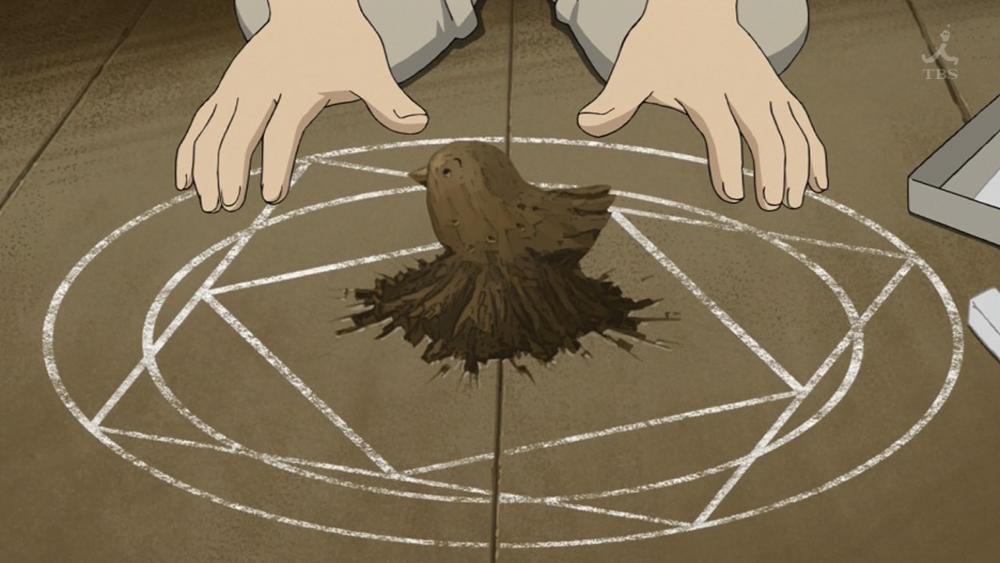
Full Metal Alchemist is a work of fiction, both in manga and anime, about two young alchemists, Alphonse Elric and Edward Elric. The story explores the Law of Equivalent Exchange (等価交換, tōka kōkan), which is explained by the brothers in the following words: “Most people think that alchemy can do anything and create whatever you want, but in reality, there are certain concrete laws. A substance can only be created from the same type of substance”, says Alphonse. Edward continues: “In other words, the basics of alchemy is the ‘equivalent exchange’! That means that to obtain something, something of equal value must be lost” (Arakawa, 2001). Throughout the story, the brothers demonstrate a clear grasp of the scientific understanding of this law. Several instances can be found where they use available material to produce what they want. For example, Edward uses alchemy to transform floor material into a wooden bird (Ōnogi & Miyake, 2009; Fig. 1) or into a stone shield (Tsuchiya & Ikehata, 2009). Thus, the brothers are able to predict which components, and in which amount, are required for achieving a given alchemical result.
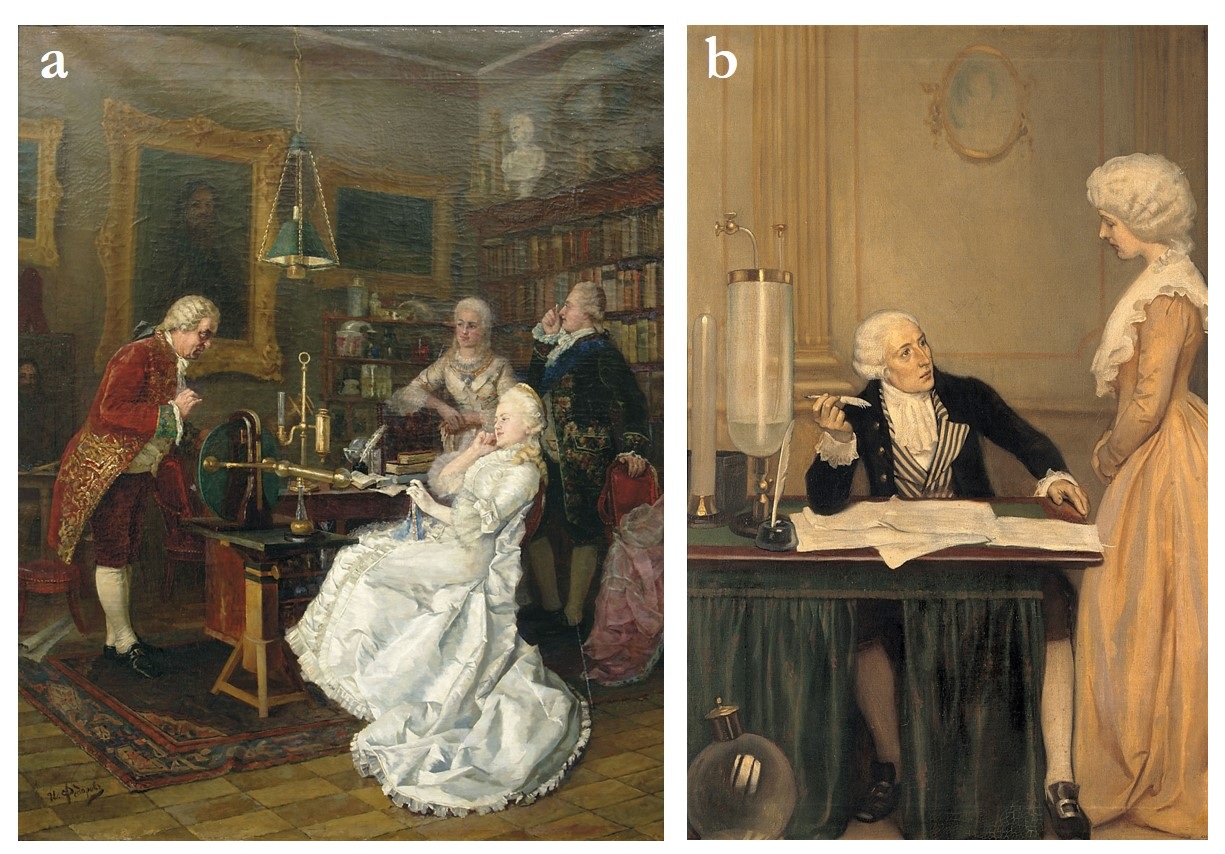
An analogue of Equivalent Exchange is found in the field of natural sciences under the name of the Conservation Laws. One of its first known formulations dates back to 1748 in a letter from the Russian scientist Mikhail Vasilyevich Lomonosov (Fig. 2a) to the Swiss mathematician and physicist Leonhard Euler: “Every change that takes place in nature occurs in such a way that if something is added to something else, the same is subtracted from another body. Thus, matter added to one body is lost by another. The number of hours I sleep is subtracted from the time I am awake, and so on. Since this is a universal law of nature, it also governs the rules of motion: a body which jolts another body to move loses as much of its motion as it imparts to the one it started moving” (Pavlova & Fedorov, 1984). A version of this law which focuses on mass is widely attributed to the French chemist Antoine-Laurent de Lavoisier (Fig. 2b) as stated in his textbook Traité Élémentaire de Chimie: “We may lay it down as an incontestable axiom, that, in all the operations of art and nature, nothing is created; an equal quantity of matter exists both before and after the experiment; the quality and quantity of the elements remain precisely the same; and nothing takes place beyond changes and modifications in the combination of these elements. Upon this principle the whole art of performing chemical experiments depends” (Lavoisier, [1965]).
The Law of Conservation of Mass is the foundation of Quantitative Chemistry which enabled the progression from alchemy to modern chemistry. Full Metal Alchemist appears to follow this law with a clear and strong scientific affinity. Yet, the interpretation of this law throughout the story reveals a wider conception of ‘equivalence’ that calls into question the completeness of the scientific principle.
Herein, we explore Equivalent Exchange as a notion that, on the one hand, is intuitively prevalent in human life, and on the other hand, serves as the foundation of the scientific formulations of the Conservation Laws. We discuss examples that show a variety of ways in which Equivalent Exchange manifests itself. We propose that Full Metal Alchemist is a work of fiction that splendidly illustrates the limitations of the Conservation Laws in the broader, intuitive understanding of Equivalent Exchange.
METHODOLOGY
To investigate the notion of Equivalent Exchange in both a broad, intuitive sense, and a strictly scientific form, a variety of sources were consulted and carefully examined. The selected sources covered topics of mythology, history, religion, philosophy, science and pop culture, in which various forms of Equivalent Exchange are manifest. The results of this examination were used as the basis for our interpretation and discussion of Full Metal Alchemist’s representation of Equivalent Exchange.
DISCUSSION
The Law of Conservation of Mass in its quantitative form is presently well-known and universally accepted as an accurate scientific description of macroscopic reality. Nonetheless, there is a recognizable, non-scientific intuition of the nature of Equivalent Exchange that serves as the basis for the formulation of the Conservation Laws. Indeed, it has manifested itself so vastly throughout history, that it encompasses almost every aspect of human life.
Firstly, let us look at religious rituals in which something perceived as highly valuable is offered to deities in exchange for their favor. This is the case of sacrifice. For example, for the ancient Greeks, the sacrifice of animals was a common practice. In the Iliad, shortly before the conquest of Troy, a plague assailed the Greek army. In response, they offered the life of “a hundred beasts” together with other retributions to appease Apollo, God of Sickness and Health (Homer, [1996]). Sacrificial rituals have also been recorded as part of Norse paganism, as registered in the Poetic Edda (Bellows, 1923a), and, more recently, broadly represented by famous TV shows such as Vikings (Hirst, 2013–2020). The episode ‘Warrior’s fate’ shows shield-maiden Lagertha offering the life of a bull to Frey, God of Plenty (Fig. 3a), bidding him “With the blood of this sacrifice, nourish and make fecund mother earth” (Hirst et al., 2015). Even today, animal sacrifice is practiced as part of Santería rites since it is believed that animal blood contains spiritual power that strengthens a connection between the santero (the priest) and his Ocha (the deity) (Cañizares, 1999). In the Abrahamic religions, the reward of forgiveness is often achieved through penance (Paul, [2021]), which can also be conceived as a form of sacrifice.
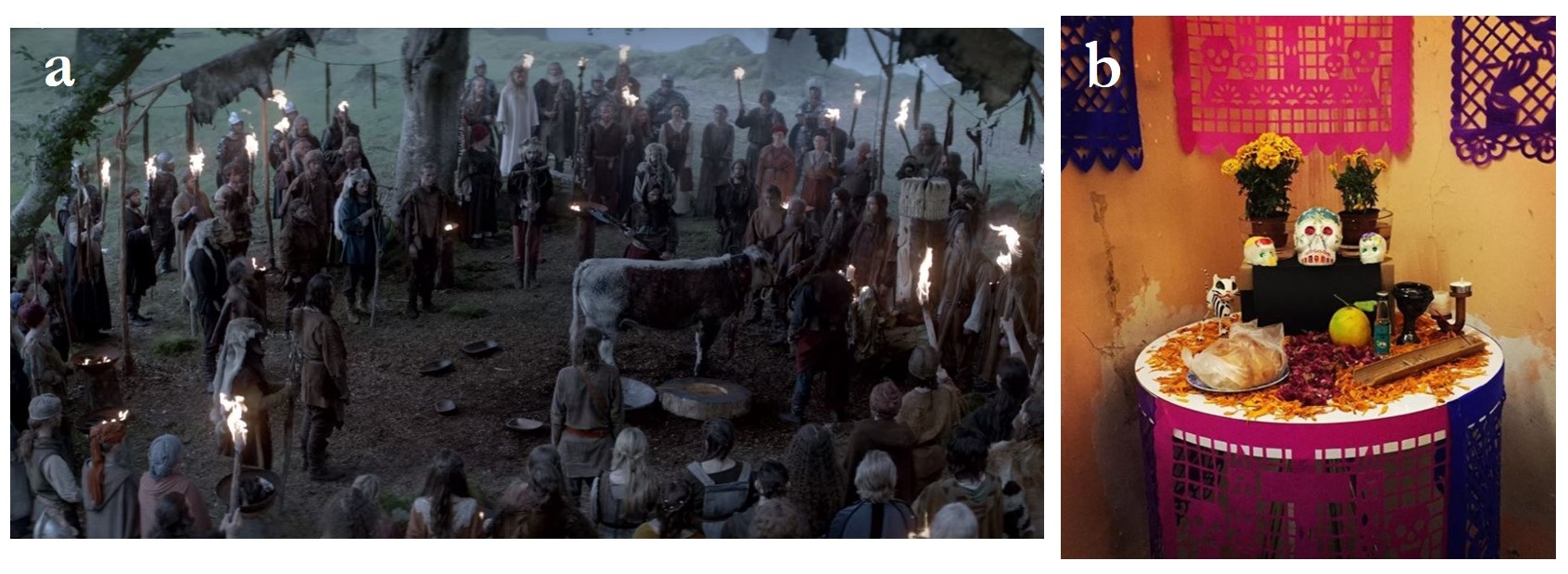
The notion of Equivalent Exchange often appears in the form of “the larger the sacrifice, the larger the reward.” For the Aztecs, a small retribution was expected from personal expense. For instance, a self-inflicted small wound made with a bone needle would confer an animal virtue to the one making the sacrifice (Beaudez, 2013). On the other hand, the offering of many children’s lives meant abundant rain, which was regarded as a reward of the greatest magnitude since everyone’s lives depended on it (de Sahagún, [1829]). Even the gods were believed to make sacrifices themselves in order to secure the preservation of the universe, human existence or both, not only within the Aztec cosmology (León-Portilla, 1983), but also in other cultures and religions (Bellows, 1923b; Benard, 2010; John, [2021]).
Another form of Equivalent Exchange can be observed in traditional festivities and practices involving offerings and tributes. A prime example is found in the pre-Hispanic origin of the famous Mexican holiday Día de Muertos (Day of the Dead), colorfully depicted in the animated film Coco (Molina et al., 2017). According to the U.S. American anthropologist Hugo G. Nutini, “Part human and part divine, the dead were a natural link between man and the gods. […] Thus, one can conceive the cult of the dead as a means through which humans used these demigods as mediators in their innumerable supplications to the gods during the annual cycle” (Nutini, 1988). Some of these ritualistic practices have been preserved through private celebrations of Día de Muertos (Nutini, 1988), including setting up household altars in which flowers, food, and other goods are offered to the spirits of family members and friends who passed away (Fig. 3b).
There is an expectation of equality (or conservation) whenever an exchange takes place. This is not limited to our relationship with the divine. In human social interactions, for any given occurrence a commensurable response is anticipated. Barter, for example, is understood as the practice of acquiring goods and services by directly exchanging other goods and services. The reciprocity of the trade exhibits the traders’ consent to a notion of equivalence in the value of exchangeable objects. This means that whenever an object shares an apprehensible—not necessarily quantifiable—correspondence with another object, the desired state of things can be achieved through their exchange (Humphrey & Hugh-Jones, 1992; Fig. 4). It could be argued that our present-day fiat money markets do not differ essentially from barter in regards to the tendency towards this conception of Equivalent Exchange.
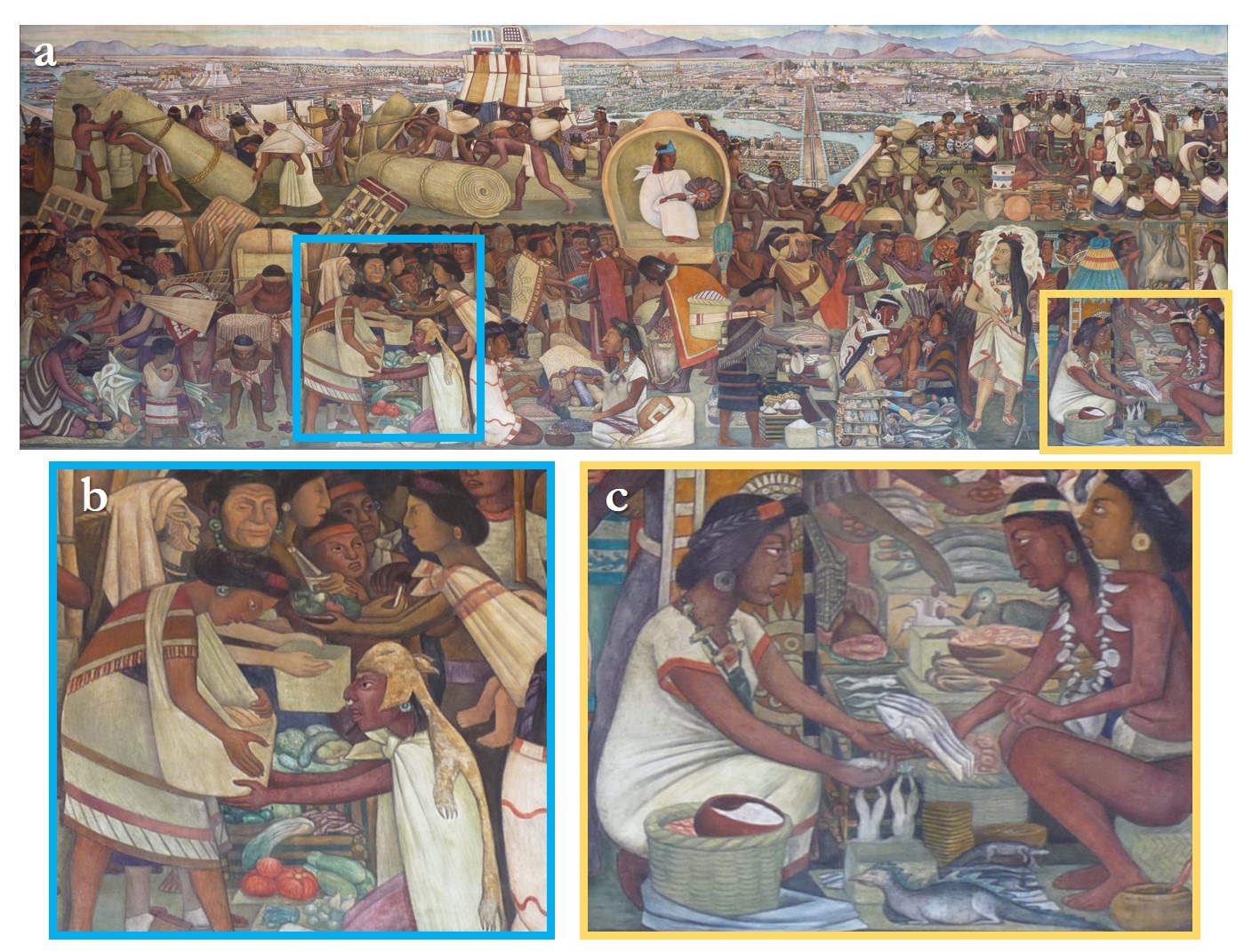
Figure 4. (a) Panoramic photograph of La Gran Tenochtitlán by Diego Rivera (1945). (b,c) Amplifications of selected portions illustrating barter during pre-Hispanic times in the Valley of Mexico. Source: Wikimedia Commons, CC BY-SA 3.0.
Another instance is found in the common practice of gift-giving. In the eloquent words of The Big Bang Theory’s character, Dr. Sheldon Cooper, “the foundation of gift-giving is reciprocity”. He tells his neighbor Penny, who intends to give him a Christmas present, “You haven’t given me a gift, you’ve given me an obligation. […] The essence of the custom is that now I have to go out and purchase for you a gift of commensurate value and representing the same perceived level of friendship as that represented by the gift you’ve given me” (Pradi et al., 2008). Works such as those of the French anthropologist and sociologist Marcel Israël Mauss and the American anthropologist and activist David Rolfe Graeber, propose that gift-giving was the basic mechanism of early economies: in small communities, neighbors or groups of individuals would be indebted to each other through reciprocal gift exchange (Mauss, 2002; Graeber, 2012).
The aforementioned conditions of correspondence are also expected from political activity in the many facets concerning justice. An intuition of equality is manifest among actions, words and goods throughout political practices. This is attested abundantly in proverbs and other forms of popular wisdom such as “what you do not wish for yourself, do not do to others” (Confucius, [1893]); “whose soul that has known bitter pains, inflicts pains upon others?” (Tiruvaḷḷuvar, [1962]); and “the measure you give will be the measure you get back” (Luke, [2021]). Aristotle observed that cases of just allocation of material and immaterial goods may be expressed in terms of proportionality of commensurable parts. He distinguished two forms of allocation: distribution and retribution (Aristotle, [2002]). Getting a set amount of grain proportional to work done in favor of the community would exemplify a just distribution. Giving a proportional fine for an excess amount of grain that someone might have taken without merit would exemplify a just retribution. Moreover, whenever an exchange happens without the consent or knowledge of one of the parties involved, a judge may be called in to restore the balance, “evening things up, just as, when a line has been cut into unequal parts, one takes away the part by which the greater segment exceeds the half, and adds this to the smaller segment” (Aristotle, [2002]).
The balance in giving and receiving is symbolized by the Greek Titaness of justice, Themis, typically represented carrying the famous ‘scales of justice’ (Fig. 5). These illustrate that, underlying the notion of balance, there is the intuition that every event is reciprocally linked to another, like a cause is linked to an effect. Themis also carries a sword: the famous formulation of the principle of retaliation “an eye for an eye, a tooth for a tooth” (Disputed authorship, [2021]) assumes that reciprocity is achieved whenever an injurer receives an injury of equal measure as punishment for the harm done. Since this form of Equivalent Exchange is widely prominent in human society, there is an inherent expectation that justice be met in this form, even in cases where the terms of an exchange are incommensurable. This leads to difficulties in deciding how to act with justice. For example, capital punishment may be expected to balance out the harm of murder; however, the first life lost will not be restored by the loss of a second one.
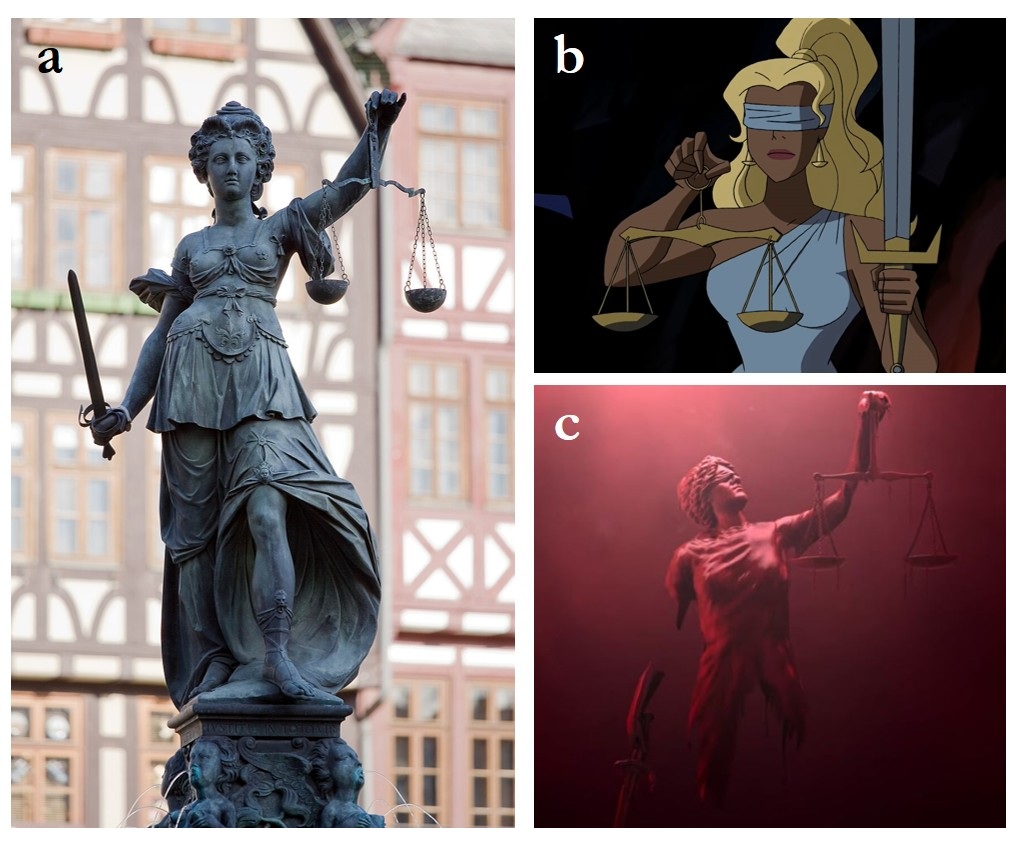
In several cultures the notion of Equivalent Exchange may go as deep as explaining the whole fabric of the universe. This is the case of the Yin and the Yang, a duality of elementary forces that manifests in the contraries and complements of the world. When there is augmentation or diminution among them, they counteract each other on a measured basis of Equivalent Exchange: to some light corresponds the same amount of darkness, to a degree of warmth the same degree of cold, and so forth (Needham, 1956). An important element of the Vodun religious practices is the belief in a multitude of spirits that inhabit the entirety of the world. The greatest of these are the creators of life, and are usually seen as the complementary principles of female and male, Mawu and Lisa, who restore balance when disastrous or fortunate events occur. “When Lisa punishes, Mawu forgives” (Parrinder, 2014). Lastly, the concept of karma in Indian religions presents a relationship of equality too, so that acting in a certain way has, as an exchange for the quality of the action, a consequence that shares in the same quality (Vyasa, [2013]).
The desire to express Equivalent Exchange in measurable, quantitative terms took shape within the natural sciences as the Conservation Laws, of which those related to mass and energy provide the best-known instances. As discussed in the introduction, the French chemist Lavoisier proposed in 1789 that “an equal quantity of matter exists both before and after the experiment” (Lavoisier, [1965]). In the case of energy, the Italian astronomer, physicist and engineer Galileo Galilei (Fig. 6a) demonstrated in the 17th century that there is a proportional relationship between the height and the motion of bodies (Galilei, [1914]). Based upon that idea, the German polymath Gottfried Wilhelm Leibniz (Fig. 6b) proposed the conservation of two quantifiable forces within a system, ‘vis mortua [death force]’ and ‘vis viva [living force]’ (Leibniz, 1686). These works in turn laid the basis for the present understanding of potential and kinetic energies, respectively. Another great example is the concept of the mechanical equivalent of heat (Mayer, 1842, 1851; Joule, 1850), discovered independently by the German physician, chemist and physicist Julius Robert von Mayer (Fig. 6c), and by the English physicist, mathematician and brewer James Prescott Joule (Fig. 6d). It states that “the quantity of heat produced by the friction of bodies, whether solid or liquid, is always proportional to the quantity of force expended” (Joule, 1850). These observations of seemingly separate phenomena were eventually recognized as parts of the same principle, as noted in the work of the German physicist and physician Hermann von Helmholtz (Fig. 6e), On the Conservation of Force (von Helmholtz, 1847), and the Scottish mathematician and physicist William Rankine’s (Fig. 6f) articulation of one all-encompassing law: “The law of the Conservation of Energy is already known—that is, that the sum of all the energies of the universe, actual and potential, is unchangeable” (Rankine, 1853). This principle eventually became known as the First Law of Thermodynamics, which states that “energy can be neither created nor destroyed during a process. It can only change forms.” (Cengel & Boles, 2015). Interestingly, the Second Law of Thermodynamics involves a property that cannot be conserved: ‘entropy’ which may be understood as “a measure of molecular disorder (or randomness)”. Every process generates entropy. Being closely related to energy, it appears as if the First Law is contradicted by the Second Law, yet the Second Law is concerned with the quality of the energy and not its quantity. While the quantity remains always equivalent (the First Law), the quality always decreases accompanied by an increase in entropy (the Second Law) (Cengel & Boles, 2015). Moreover, in the 20th century mass and energy were recognized as being equivalent to one another. The most famous equation of the German-born theoretical physicist Albert Einstein, E=mc2, derived for the first time in the paper ‘Does the inertia of a body depend upon its energy-content?’, is an expression of this equivalence which unifies both Laws of Conservation of Mass and Energy: “the mass of a body is a measure of its energy content” (Einstein, 1923).
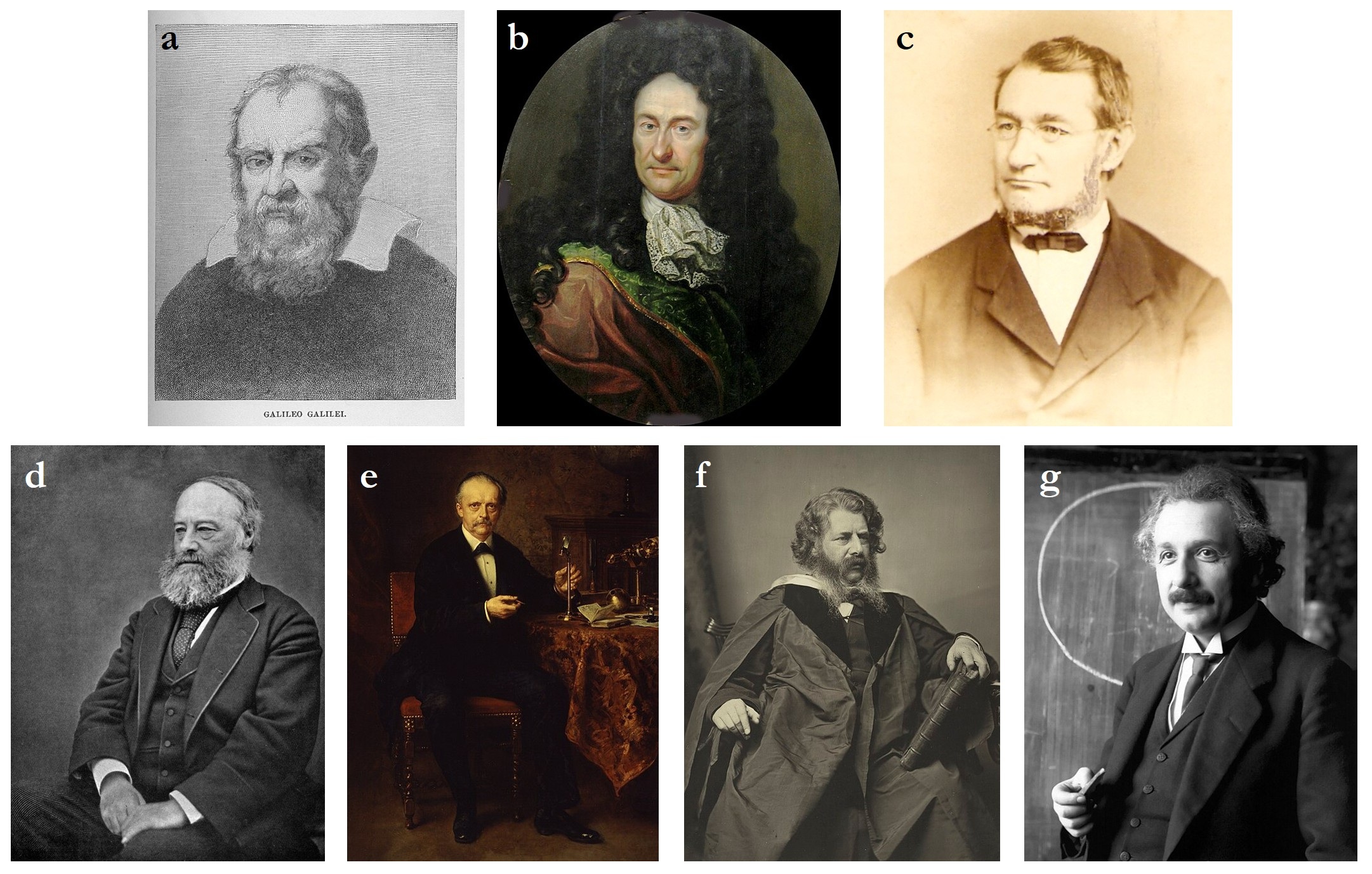
All of the aforementioned are examples of a notion of Equivalent Exchange, ranging from the intuitive to the scientific understanding, underlying a wide array of human experiences. Therefore, it is not surprising that its representations in the realm of fantasy are treated as normal features of the fictional world. Whenever the intuition of Equivalent Exchange is represented through supernatural occurrences, we may observe two different—often mutually exclusive—conceptions which reflect either incommensurable or commensurable terms of Equivalent Exchange. In the first case, fantastic beings, worlds and happenings are largely unexplained. In the second case, magical phenomena are attributed, partially or totally, to scientific principles in an attempt to make them quantifiable.
Let us discuss the first case. In his essay ‘On Fairy-Stories’, English writer and philologist John Ronald Reuel Tolkien illustrates the inexplicability of the magical world. Faërie, as he calls it, is “the realm or state in which fairies have their being”. Tolkien says “I will not attempt to define that, nor to describe it directly. It cannot be done. Faërie cannot be caught in a net of words; for it is one of its qualities to be indescribable, though not imperceptible. It has many ingredients, but analysis will not necessarily discover the secret of the whole. […] Faërie itself may perhaps most nearly be translated by Magic—but it is magic of a peculiar mood and power, at the furthest pole from the vulgar devices of the laborious, scientific, magician” (Tolkien, 1984). In works of fiction that agree with this form of indescribable realm, laws and principles are not established in scientific (or quantitative) terms, but are rather perceived intuitively.
Examples of Equivalent Exchange in its intuitive form related, for instance, to the use of magic, are present in a vast number of this kind of fantastic universes. In the second episode of the streaming television show The Witcher, based on the works of Polish writer and essayist Andrzej Sapkowski, sorceress Tissaia de Vries demonstrates that the use of magic has a cost, explaining that “there is no conjuring something from nothing. There is a give and take” (Klein & Sakharov, 2019; Fig. 7a). Thus, it is difficult to conceive a world where magic can be used without limits. Indeed, limits are set for instance in terms of exhaustion, as illustrated in Cardcaptor Sakura’s episode ‘Sakura and the Panicky Bike’, where the protagonist Sakura faints after casting several consecutive spells to transform magical cards (Ohkawa & Takase, 1999; Fig. 7b). For this, her companion Kero scolds her: “Sakura! What recklessness was that? If you change all the cards at once with what little magic you have, of course you collapse, Sakura!” In other imaginary universes, the limits of magical power are set in terms of a maximum number of magical events. For instance, genies grant a total of 3 wishes to their masters according to Western pop culture (Anonymous, [1909]; Perrault, 1993; Musker et al., 1992; Brändström & Koorse, 2019), and wizards in Dungeons & Dragons can only perform a certain number of spells per day (Gygax & Arneson, 1983).
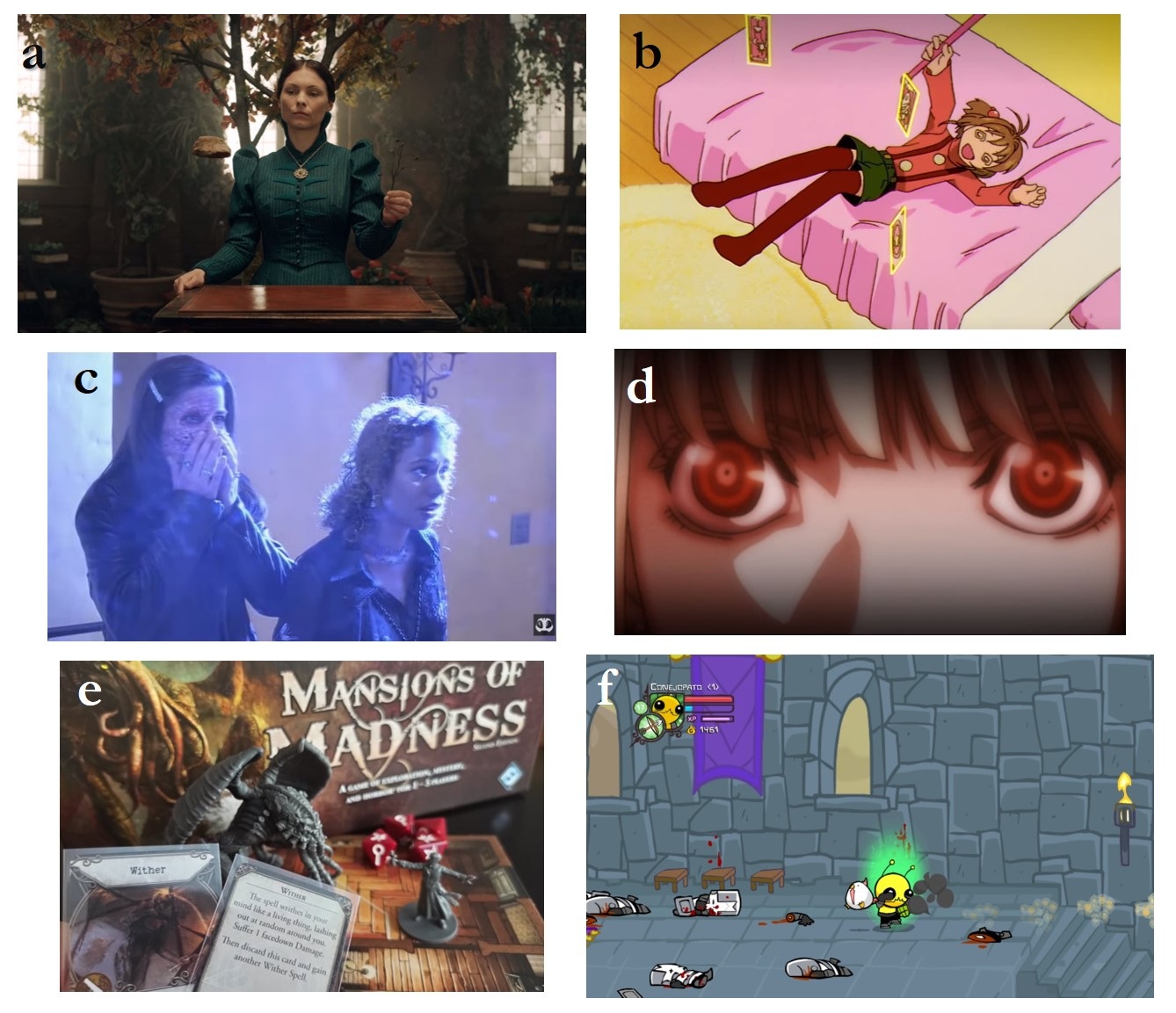
Other examples of intuitive Equivalent Exchange involve some sort of payment in exchange for the ability to perform magic. It may be paid upfront, for instance, by consuming magical power–sometimes referred to as ‘mana’, which is typically found in numerous board games and video games (Fig. 7f). An illustrative instance is the ‘Shinigami Eyes Deal’ presented in Death Note’s episode ‘Assault,’ where the character Misa Amane is granted the ability of knowing the names and lifespans of other people in exchange for half of her remaining lifespan (Inoue & Tsuchiya, 2006; Fig. 7d). The payment may also be collected after the transaction. For example, in Mansions of Madness, an app-assisted board game (Valens, 2016) based on the works of the U.S. American writer Howard Phillips Lovecraft, whenever an investigator (a player) casts a spell, in addition to the desired effect there will be an unknown consequence, the nature of which is only revealed after the spell is cast (Fig. 7e).
In contrast to the intuitive conception of Equivalent Exchange, let us now discuss the second case, in which magical phenomena are attributed, partially or totally, to scientific principles. A beautiful example of such a setting is found in The Kingkiller Chronicle series authored by the U.S. American writer Patrick Rothfuss. In this work, the arcane art known as ‘sympathy’—“you’d probably call it magic”—is explained in terms of transfer of energy. In the words of Kvothe, the protagonist, “In sympathy, most of what you are doing is redirecting energy. Sympathetic links are how the energy travels” (Rothfuss, 2011). In the books, energy transfer phenomena related to sympathy are explicitly subjected to “the Law of Conservation, which says ‘energy cannot be destroyed nor created’” (Rothfuss, 2011). This refers to the actual scientific Law of Conservation of Energy that we discussed earlier.
When Conservation Laws are used to explain magical phenomena in scientific terms, they serve as the basis of a commensurable (and thus, quantitative) Equivalent Exchange. Conversely, whenever magical phenomena are left unexplained, they express an incommensurable form of Equivalent Exchange. However, there are fictional works in which the foundations of equivalence appear to be ‘quantifiable,’ and yet remarkably not ‘equal.’ An example is found in the film The Craft (Filardi & Fleming, 1996). In the film, occult shop’s owner Lirio Santana warns the young witches “Whatever you send out, you get back times three”. This refers to the Threefold Law, a “basic tenet of Witchcraft” according to the bestselling author Lisa Chamberlain’s Wicca for Beginners: A Guide to Wiccan Beliefs, Rituals, Magic and Witchcraft: “Also known as ‘The Rule of Three’ and ‘The Law of Return,’ this principle states that whatever witches send out into the Universe as intent, whether positive or negative, will come back to them three times as great” (Chamberlain, 2014). Such a law might be interpreted as a quantitative ‘Unequivalent Exchange’ (in a 1:3 ratio). That interpretation, however, has an inherent flaw: it assumes that it is possible to measure and triplicate the consequences of the witches’ actions. But this is clearly not the case. During The Craft’s climax, the protagonist Sarah shows coven members Rochelle and Bonnie terrifying illusions of themselves suffering the consequences of abusing their magical power (Fig. 7c), but these consequences are not strictly the result of multiplying their actions by three. Here, “getting back times three” is not taken as a quantifiable measure of action, but rather as an expression of amplified consequences.
We propose that principles such as The Threefold Law illustrate that actions are often followed by greater, yet unquantifiable, results. Moreover, although this seems to point to a notion of Unequivalent Exchange, the proportionality of The Threefold Law is indeed intended as an expression of equality. Here, the apparent inequality is accounted for by the unquantifiable nature of its elements, just like in the examples of fiction with incommensurable phenomena of equivalence. Incommensurable as this magnitude may be, it is perceivable, which leads to the intuition that there is something more to the Equivalent Exchange than meets the eye. Hence, we further propose that the intuitive (or non-quantitative) notion of Equivalent Exchange is more comprehensive than its scientific expression.
Clearly, there is a universal intuition of the Law of Equivalent Exchange in an unquantifiable form that entails limitations for its scientific understanding. In Full Metal Alchemist, the main catalyst of the story adeptly demonstrates the extent of these limitations: Alphonse and Edward Elric fail trying to return their mother from death because, contrary to their original assumptions, the Law of Equivalent Exchange cannot be expressed as a scientific quantitative relation. The procedure they attempt, called a ‘human transmutation’, is presented as a reaction through which an alchemist creates (or recreates, in this case) a human being according to the Law of Equivalent Exchange. The procedure includes a precise calculation of the ingredients that form an average human adult body (cheap and readily found, as Edward points out) in alignment with the Law of Conservation of Mass: “Water, 35 liters; carbon, 20 kilograms; ammonia, 4 liters; lime, 1.5 kilograms; phosphorus, 800 grams; salt, 250 grams; saltpeter, 100 grams; sulfur, 80 grams; fluorine, 7.5 grams; iron, 5 grams; silicon, 3 grams; and traces of 15 other elements” (Arakawa, 2001). Yet, despite utmost precision in these calculations, the transmutation fails. Interestingly, Alphonse and Edward do not conclude from their failure that the procedure is not governed by the Law of Equivalent Exchange, but rather, that they do not fully understand what that law truly means. The story revolves around the progression from asking what was missing in their human transmutation attempt, to asking why it is impossible in principle. Ultimately, they realize that science cannot thoroughly encompass the Law of Equivalent Exchange.
The shortcomings of the scientific comprehension of the Law of Equivalent Exchange are presented in Full Metal Alchemist in the form of a question: why does human life defy being measured? This question forces a paradox on the Elric brothers: on the one hand, human life is clearly more valuable than common pursuits like power and wealth; on the other hand, human life is essentially invaluable. The first side of the paradox is presented, for example, through the war between the peoples of Ishval and Amestris. The story shows that the war was purposefully fueled by the antagonists, the ‘homunculi’, each of which is named after a traditional Christian sin, such as pride or lust. These sins illustrate human inclinations towards goods which, whenever treated as more valuable than human life, turn into evils. The second side of the paradox is mainly explored through the search for the ‘philosopher stone’. This legendary item is allegedly impervious to the Law of Equivalent Exchange and would thus allow its user to create, among other things, human life out of nothing. The homunculi are revealed to have come from such an artifact. But, as it turns out, the philosopher stone is only a fraud, and the creatures generated by it are less than human (as suggested by the etymology of homunculi, little humans). This shows that the assumption that there can be a quantitative measure of human lives which would solve the equation of creation is flawed.
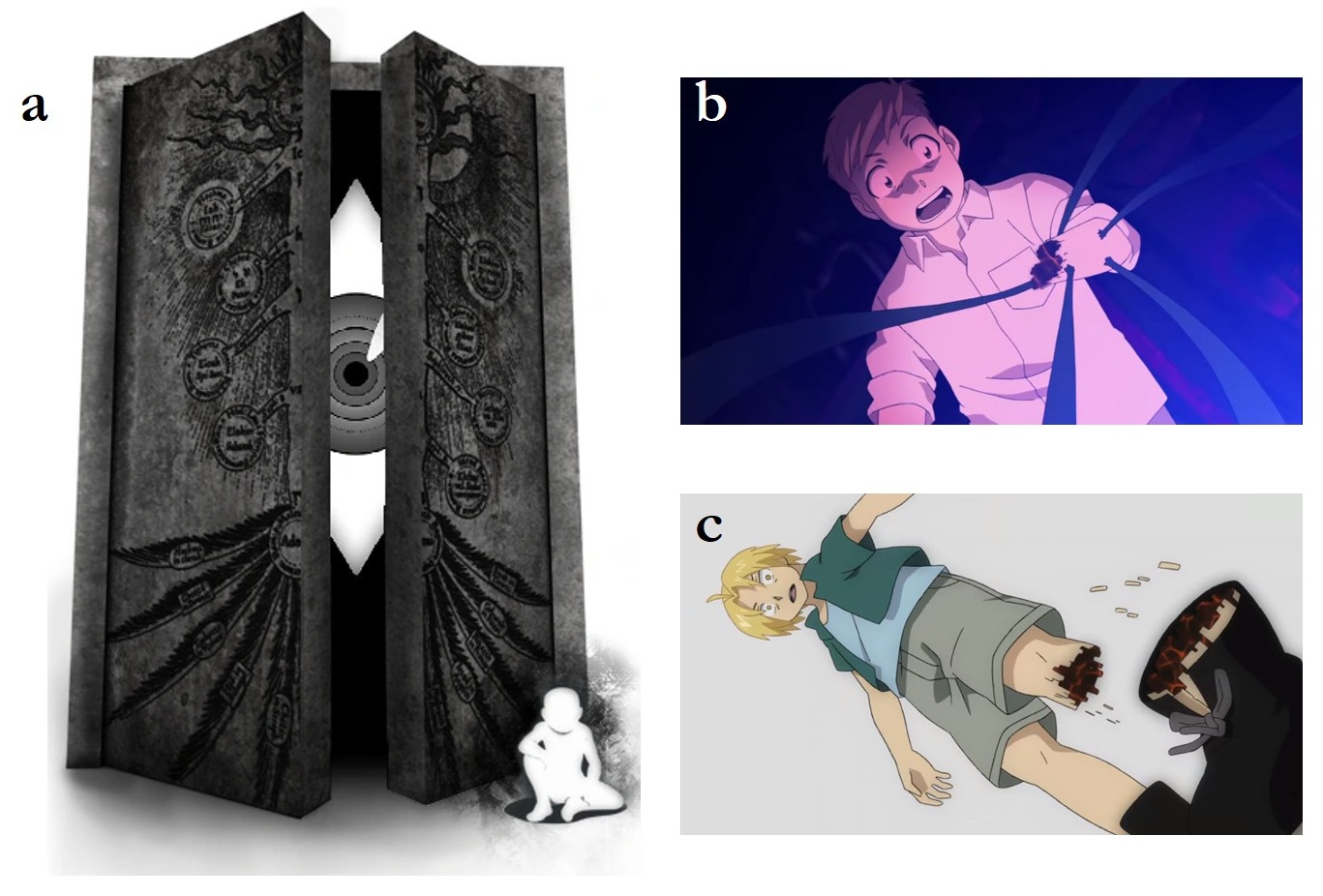
Hence, Edward and Alphonse learn that human life is both of a value comparably greater than material possessions, power or any other such pursuit, and yet, of an incalculable value that cannot be compared with anything else. In the story, when alchemists attempt a human transmutation, they are brought in front of ‘The Gate’, a mysterious set of stone doors in a place where the overarching balance of the world is guarded. All the knowledge of the universe is said to lie behind The Gate, kept by an entity called ‘Truth’ (Fig. 8a). Those who acquire some of this knowledge have to pay something dear in exchange. The story is intentionally vague as to the measure of these exchanges, since the impossibility to express them in quantitative terms is precisely the point. Any knowledge earned through The Gate is not communicable, and thus, not scientific, and yet it allows alchemists to understand the world better and make use of their power to perform alchemical exchanges. Edward and Alphonse Elric, for instance, gain the ability to perform alchemy without drawing transmutation circles, something impossible for other alchemists, no matter how talented (Ōnogi & Miyake, 2009; Fig. 8b,c). Yet, at the end of the story, even this great power, for which a dear price had to paid, proves incomparable to human life: Edward chooses to give up his entire ability to use alchemy in exchange for his brother Alphonse recovering his body. After what the brothers learned throughout their journey, Edward gladly pays this price.
According to our interpretation, the story makes use of this unresolved impasse to showcase that the prevalent intuition of Equivalent Exchange acts as the foundation of scientific understanding but ultimately transcends it.
CONCLUSIONS
In this work, we discussed the notion presented in Full Metal Alchemist as the ‘Law of Equivalent Exchange’. We showed its prevalence as an intuition throughout human experience, exemplified through religious rituals and sacrifices, economic practices, social norms and justice, as well as cosmological conceptions. The scientific expression of this notion provides an instance of special importance, since its aim is to communicate the different forms of equivalence in quantitative, commeasurable terms. Hence, we examined the relation between the Law of Equivalent Exchange and the Conservation Laws.
Furthermore, we recognized that fictional works tend to represent this underlying principle of equivalence in any of two modalities, either adopting the scientific view of Equivalent Exchange when their principles are commensurable, or a view that exceeds the scientific perspective, by establishing that these equivalence principles are incommensurable. Thus, we examined Full Metal Alchemist as belonging to the second case, providing an excellent illustration of the limitations of the scientific conception of Equivalent Exchange. According to our interpretation, the subject explored by the fictional narrative of Full Metal Alchemist is the limitations of the scientific conception and its consequences. These finally lead to the insight that the value of human life is the epitome of the incommensurable in any relation of Equivalent Exchange, and thus, falls beyond science’s purview.
REFERENCES
Alex Raven. (2019) Morir no es desaparecer, es transformarse. Bienvenidos :). Instagram. Available from: https://www.instagram.com/alexravenmx/ (Date of access: 30/Dec/2020).
Anonymous. [1909] The Story of the Fisherman and the Genie. In: Wiggin, K.D. & Smith, N.A. (Eds.) The Arabian Nights. Charles Scribner’s Sons, New York. [Note: The collections known as Arabian Nights or One Thousand and One Nights contain different tales of anonymous origin and a diversity of places and times from the Arab-speaking world, not always within the same pieces nor in the same order. The first English-language edition from the 18th century gave it the title The Arabian Nights’ Entertainments.]
Arakawa, H. (2001) Full Metal Alchemist. Monthly Shōnen Gangan 1(1).
Aristotle. [2002] (probably 335–322 BCE) Book V, Justice. In: Nicomachean Ethics. Translated by Joe Sachs. Focus Publishing, Newburyport. Pp. 79–101.
Baudez, C.F. (2013) El Dolor Redentor. El autosacrificio prehispánico. UNAM, Merida.
The Behemoth. (2015) Castle Crashers. Remastered.
Bellows, H.A. (1923a) Guthrunarkvitha II, Vv. 41–44. In: The Poetic Edda, Scandinavian Classics, Vols XXI and XXII. The American-Scandinavian Foundation, New York. P. 463. [Note: the original poems in this collection are of anonymous composition with diverse and debated dates of origin, probably from around the IX and X centuries, compiled by the Icelander scholar, poet and knight Snorri Sturluson in the XIII century.]
Bellows, H.A. (1923b) Grimnismol. In: The Poetic Edda, Scandinavian Classics, Vols XXI and XXII. The American-Scandinavian Foundation, New York. Pp. 84–106. [Note: the original poems in this collection are of anonymous composition with diverse and debated dates of origin, probably from around the IX and X centuries, compiled by the Icelander scholar, poet and knight Snorri Sturluson in the XIII century.]
Benard, E.A. (2010) Chinnamasta: The Aweful Buddhist and Hindu Tantric Goddess. Motilal Banarsidass, Dehli.
Brändström, C. & Koorse, S. (2019) Bottled Appetites. In: The Witcher. Season 1. Netflix.
Cañizares, R. (1999) Cuban Santeria: Walking with the Night. Inner Traditions, Rochester.
Cengel, Y.A. & Boles, M.A. (2015) Thermodynamics: An Engineering Approach. 8th Ed. McGraw-Hill Education, New York.
Chamberlain, L. (2014) Wicca for Beginners: A Guide to Wiccan Beliefs, Rituals, Magic, and Witchcraft. CreateSpace Independent, Online.
Confucius. [1893] The Analects. Book 12, Chapter 2. In: Legge, J. (Tr.) The Chinese Classics: with a Translation, Critical and Exegetical Notes, Prolegomena, and Copious Indexes. Clarendon, Oxford. P. 251.
Dini, P. & Riba, D. (2004) This Little Piggy. In: Justice League Unlimited. Warner Bros. Animation.
Disputed authorship. [2021] Book of Exodus, 21: 23–25. In: Holy Bible: New Revised Standard Version. Friendship Press, Washington, D.C.
Einstein, A. (1923) Does the Inertia of a Body Depend Upon Its Energy Content? In: The Principle of Relativity. English translation by W. Perrett and G.B. Jeffery from Das Relativätsprinzip (1922). Methuen and Company, London.
Filardi, P. & Fleming, A. (1996) The Craft. Columbia Pictures.
Fullmetal Alchemist Wiki. (2026) The Gate. Available from: https://fma.fandom.com/wiki/The_Gate (Date of access: 08/Mar/2026).
Galilei, G. [1914] Dialogues Concerning Two New Sciences. Translated from Italian and Latin into English by Henry Crew and Alfonso de Salvio. New York, Macmillan.
Graeber, D. (2012) Where did Money REALLY Come from? Available from: https://davidgraeber.org/videos/where-did-money-really-come-from/ (Date of access: 03/Abr/2026).
Gygax, G. & Arneson, D. (1983) Magic-user. In: Players Manual. Revised edition by Frank Mentzer from the original edition (1974). TSR Hobbies, U.S.A. Pp. 37–39.
Goddard, D. (2015–2018) Opening title. In: Daredevil. Netflix.
Hirst, M. (2013–2020) Vikings. History, Shaw Media, TM Productions, Octagon Films, MGM Television & Take 5 Productions.
Hirst, M.; Woolnough, J.; Wakefield, S.; Thomson, K. (2015) Warrior’s Fate. In: Vikings, Season 3. History, Shaw Media, TM Productions, Octagon Films, MGM Television & Take 5 Productions.
Homer. [1996] (ca 750 BCE) Book 1, v. 99. In: Nuño, R.B. (Tr.) Ilíada. UNAM, Mexico City.
Howze, T. (2012) Is each transmutation circle unique? Science Fiction & Fantasy Stack Exchange. Stack Exchange Network. Available from: https://scifi.stackexchange.com/questions/27676/is-each-transmutation-circle-unique (Date of access: 08/Mar/2026).
Humphrey, C. & Hugh-Jones, S. (1992) Barter, Exchange and Value: An Anthropological Approach. Cambridge University Press, New York.
Inoue, T. & Tsuchiya H. (2006) Dealings. In: Death Note. Madhouse Studio.
Inoue, T. & Yoneda, M. (2006) Confession. In: Death Note. Madhouse Studio.
John. [2021] (ca. 90–100 CE) Gospel of John, 3:16. In: Holy Bible: New Revised Standard Version. Friendship Press, Washington, D.C.
Joule, J. P. (1850) On the Mechanical Equivalent of Heat. Philosophical Transactions of the Royal Society of London 140: 61–82.
Klein, J. & Sakharov, A. (2019) Four Marks. In: The Witcher, Season 1. Netflix.
Lavoisier, A. [1965] (1789) Chapter XIII. In: Elements of Chemistry. Translated by Robert Kerr from Traité élémentaire de chimie (1789). Dover, New York.
Leibniz, G.W. (1686) Brief Demonstration of a Notable Error of Descartes’s and Others Concerning a Natural Law. Acta Eruditorium. [Note: In this work, Leibniz did not use the concepts of ‘vis mortua’ nor ‘vis viva.’ He used this explicit distinction later when he published “Species Dynamicum” in Acta Eruditorium (1695). In neither work did he use the concept of ‘energy.’]
León-Portilla, M. (1983) Los Antiguos Mexicanos a través de sus Crónicas y Cantares. 5th Ed. Fondo de Cultura Económica, Mexico City.
Luke. [2021] (ca 80–90 CE) Gospel of Luke, 6:37-39. In: Holy Bible: New Revised Standard Version. Friendship Press, Washington, D.C.
Mauss, M. (2002) The Gift. Translated from French by Cohen & West. Routledge, London and New York.
Mayer, J.R. (1842) Bemerkungen über die Kräfte der unbelebten Natur. Annalen der Chemie 42(2): 233–240.
Mayer, J.R. (1851) Bemerkungen über das mechanische Aequivalent der Wärme. Landherr, Heilbronn.
Molina, A.; Aldrich, M.; Unkrich, L. (2017) Coco. Walt Disney Pictures, Pixar Animation Studios.
Musker, J.; Clements, R.; Elliott, T.; Rossio, T. (1992) Aladdin. Walt Disney Pictures.
Needham, J. (1956) Science and Civilisation in China Vol. 2: History of Scientific Thought. Cambridge University Press, Cambridge.
Nutini, H.G. (1988) Pre-hispanic component of the syncretic cult of the dead in Mesoamerica. Ethnology 27(1): 57–78.
Ohkawa, N. & Takase, S. (1999) Sakura and the Panicky Bike. In: Cardcaptor Sakura. Madhouse.
Ōnogi, H. & Miyake, K. (2009) The First Day. In: Full Metal Alchemist: Brotherhood. Bones.
Parrinder, E. (2014) West African Religion; a study of the beliefs and practices of Akan, Ewe, Yoruba, Ibo, and kindred peoples. Wipf & Stock, Oregon. [Note: This edition comes from a significantly revised 1961 edition of the work, which was originally published in 1949.]
Paul. [2021] (ca 51–58 CE) Romans, 2:1-11. In: Holy Bible: New Revised Standard Version. Friendship Press, Washington, D.C.
Pavlova, G.E. & Fedorov, A.S. (1984) Mikhail Vasilievich Lomonosov: His Life and Work. Mir, Moscow. [Translated by A. Aksenov. A transcript of the original letter from Michael Lomonosov to Leonhard Euler (1748) is available from: https://www.hs-augsburg.de/~harsch/Chronologia/Lspost18/Lomonosov/lom_ep03.html (Date of access: 08/Mar/2026).]
Perrault, C. (1993) The Foolish Wishes. In: Simborowski, N. & Philip, N. (Trs.) The Complete Fairy Tales of Charles Perrault. Clarion Books, New York. [This is a translation from the French Histoires ou contes du temps passé (1697).]
Pradi, B.; Rosenstock, R.; Cendrowski, M. (2008) The Bath Item Gift Hypothesis. In: The Big Bang Theory, Season 2. CBS.
Rankine, W.J.M. (1853) On the General Law of the Transformation of Energy. Proceedings of the Philosophical Society of Glasgow 3(5): 276–280.
Rothfuss, P. (2011) Enough Rope. In: The Name of the Wind. Gollancz, London.
de Sahagún, B. [1829] Book 2, Chapter 1. In: Historia General de las Cosas de Nueva España. Imprenta del ciudadano Alejandro Valdés, Mexico City. [Note: This edition was done by Carlos María de Bustamante from the original Florentine Codex (1540–1585).]
Tiruvaḷḷuvar. [1962] On Virtue, Chapter 32, 318. In: Tirukkuraḷ. Translated by Balusabramaniam, T. K. M. Manali Lakshmana Mudaliar, Madras (now Chennai).
Tolkien, J.R.R. (1984) On Fairy-Stories. In: Tolkien, C. (Ed.) The Monsters and the Critics and Other Essays. Houghton Mifflin Company, Boston.
Tsuchiya, M. & Ikehata, H. (2009) Rain of Sorrows. In: Full Metal Alchemist: Brotherhood. Bones.
Valens, N. (2016) Mansions of Madness, 2nd edition. Fantasy Flight Games.
von Helmholtz, H. (1847) Über die Erhaltung der Kraft: eine physikalische Abhandlung, vorgetragen in der Sitzung der physikalischen Gesellschaft zu Berlin. G. Reimer, Berlin.
Vyasa, K-D. [2013] (4th century CE) Shanti Parva. Book 12, 291. In: The Mahabharata. Translated by Ganguli, K. M. Bottom of the Hill Publishing, Memphis.
Acknowledgements
The authors are grateful to the members of the Writers’ Guild of Groningen for their encouragement, and particularly to Youp van den Beld for his valuable insights on the historical importance of gift-giving. We also thank Alex Raven for generously allowing us to use her artwork in this article.
About the authors
Alberto Cortés Navarrete has a PhD in Philosophy. He thinks about magic much more than he should.
Dulce M. Morales has a PhD in Electrochemistry. She applies the Laws of Conservation in her daily work.