Abraham U. Morales-Primo
Facultad de Medicina, Universidad Nacional Autónoma de México, Hospital General de México, Mexico City, Mexico.
Email: aump.puma (at) gmail (dot) com
Silk is one of the most extensively studied and highly valued biomaterials, with applications in the textile industry, as well as in the biomedical and engineering fields. This biopolymer is produced by various arthropods in response to different functional demands, such as prey hunting, protection, and nesting, among others. Silk is a remarkable material due to its unique biochemical and physical properties, which make it extremely durable, tough, extensible, and strong (Ebrahimi et al., 2015). Indeed, silk’s molecular structure grants it tensile strength that can match that of high-strength steel (Kono et al., 2021; Greco et al., 2022). Among silk-producing arthropods, we find the most well-known examples in spiders and silk moths, as well as other animals such as webspinners, crickets, beetles, and flies (Sehnal & Sutherland, 2008).
Owing to these properties, silk has an interwoven relationship with human civilization as it has been the epicentre of historical trade routes and, more recently, holds molecular and biomedical potential due to its biocompatibility and influence on cellular behaviour (Kochhar et al., 2021; Greco et al., 2022). Beyond its biotechnological relevance, silk has also been depicted in multiple artistic and cultural outlets. From Charlotte’s Web to Spider-Man comics and musical metaphors, silk is most often depicted alongside its primary producers, namely spiders, and commonly embedded in narratives that resonate with melancholic, ominous atmospheres and hopeful or heroic undertones. Video games are no exception to this trend, incorporating silk both through adaptations of popular characters and original, silk-adjacent designs that integrate silk into gameplay mechanics and narrative. Notably, however, few games position silk as the main narrative and gameplay cornerstone to the extent that Hollow Knight: Silksong does.
Hollow Knight: Silksong (hereafter referred to as Silksong) (2025) is the sequel to the critically acclaimed Hollow Knight (2017), developed by Team Cherry. The game features Hornet, a spider-like being who wields a needle weapon and can manipulate silk.
Silksong takes place in a long-forgotten, derelict kingdom whose inhabitants (mostly bugs) undertake pilgrimages to the Citadel, seeking purpose and a way to serve their community. Notably, The Citadel’s society revolved around a special kind of silk used for medicine, engineering, music, and even granted immortality to those bound to it. This silk, however, is produced by a dormant higher being known as the Grand Mother Silk, whose influence eventually corrupted the kingdom, leading to its downfall. Within this context, Hornet ventures into the Citadel to sever the connection between its inhabitants and the silk deity, aided by her own silk-based abilities.
Despite the fictional nature of Silksong’s setting, the silk-based dynamics portrayed in the game share remarkable similarities with real-world examples of silk production and function. In the following sections, I explore and contextualize these parallels through biological lenses.
SILK BIOLOGY
Silk is a type of polymer biomaterial made of fibrous proteins, such as fibroins and spidroins, found in insects and spiders, respectively. The emergence of silk production represents an example of convergent evolution, having independently evolved several times within the phylum Arthropoda. Virtually all major arthropod clades produce some form of silk, including chelicerates such as spiders, insects, myriapods, and even certain less-studied crustaceans (McKim & Turner, 2024).
Silk synthesis and secretion involve a highly regulated process that begins in specialized glands, where soluble protein precursors are stored at high concentrations. These proteins are then syphoned through a spinning duct, during which changes in pH, ion concentration, and shear forces induce their alignment and assembly into a hydrophobic strand (Römer & Scheibel, 2008). The final physical and mechanical properties of the silk thread, however, are also dependent on the manipulation during the extrusion and weaving processes (Ebrahimi et al., 2015).
Biologically, silk serves several functions, including shelter construction, reproduction, prey capture, structural support, and dispersal (Craig, 1997).
SILKSONG
In-game, Hornet is portrayed in lore as a hybrid being, half weaver (spider-like) and half wyrm (worm-like), who employs her silk for protection, healing, and combat. While some of her silk usage are overtly mystical (like rune and spellcasting), others resemble real biological applications of silk. Moreover, Hornet is not the only silk-producing/weaving being in the game; additional characters deploy their silk in distinct ways, reflecting the functional diversity observed among real-world arthropods.
Prey capturing and combat
As an action game, Silksong equips Hornet with a versatile arsenal designed to dispatch both minor enemies and formidable foes. Her primary weapon is the needle, a long, bladed, sewing-like instrument used for slashing and piercing attacks. As the game progresses, Hornet discovers special abilities that increase her control over silk, referred to as ‘Silk Skills’ (Fig. 1). In total, there are six such skills, which, although clearly fantastic in mechanics, four of them can theoretically be interpreted as exaggerated or symbolic representations of real biological silk applications.
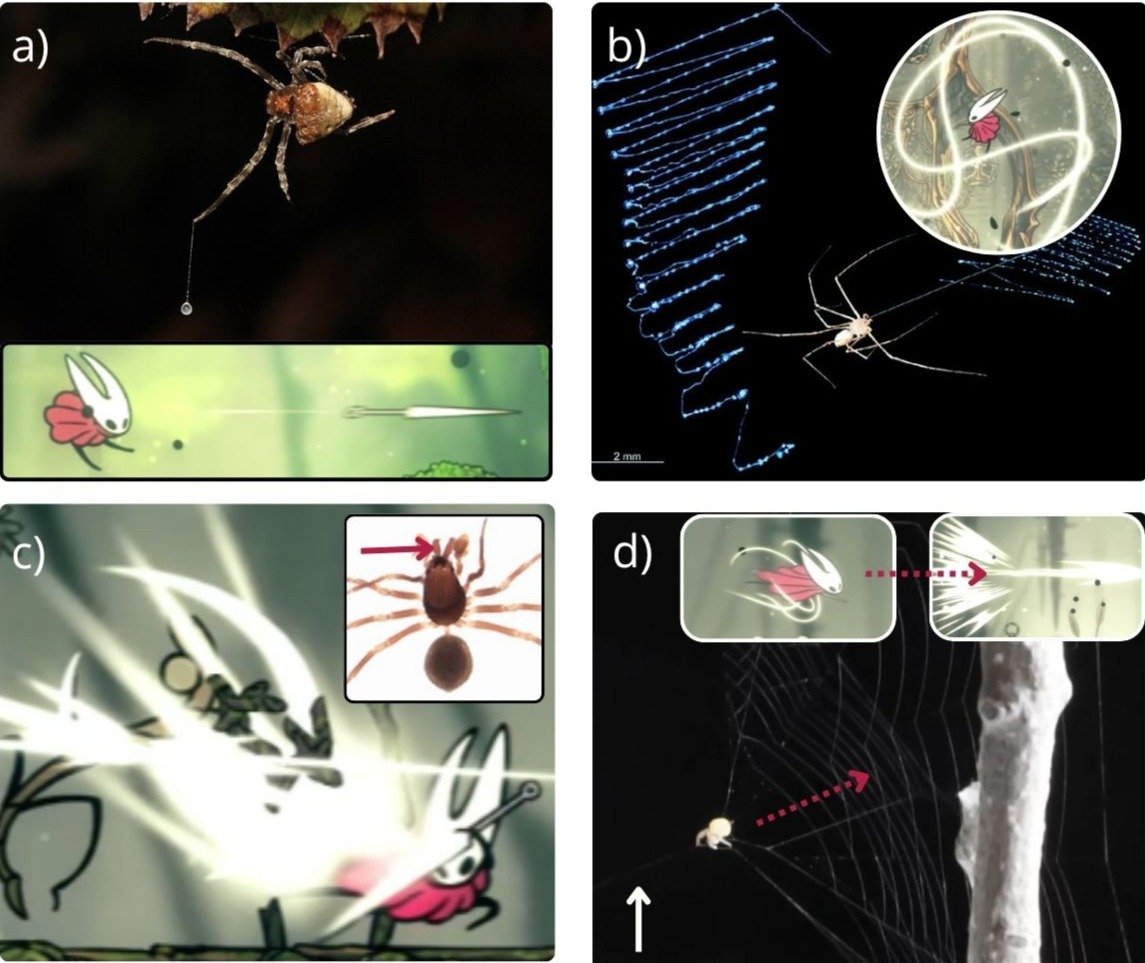
Silkspear, for instance, involves throwing a silk-coated needle in a straight line, piercing enemies, followed by the weapon’s retrieval by pulling it back along the silk filament (Fig. 1a). Among spiders, few species can shoot their silk and/or recover it afterward. One notable example is the spitting spiders (Scytodes spp.), which are capable of spraying a mixture of silk and venom, serving both as a defensive and hunting strategy (Zobel-Thropp et al., 2014). Unlike most spiders, spitting spiders expel silk from their fangs, rather than only from their abdomens, and this silk is highly adhesive and toxic, rapidly immobilizing their targets. However, spitting spiders rarely reel their prey toward themselves; instead, they approach and tether the prey to nearby substrates before feeding (Zobel-Thropp et al., 2014).
In contrast, bolas spiders employ a markedly different silk-based hunting strategy. Rather than constructing webs, they produce a bolas: a single silk filament ending in a viscous droplet that is swung toward flying prey, particularly to lure and capture moths (Fig. 1a) (Diaz & Long, 2022). Upon successful contact, bolas spiders actively reel in the captured prey using the tensile strength of the silk filament. Unlike spitting spiders, bolas spiders do not project silk from a distance, as the bolas are constructed and deployed directly from the abdomen. Taken together, when performing the Silkspear skill, Hornet combines the web-shooting abilities of spitting spiders to throw her needle and the reeling power of bolas spiders to retrieve it.
Interestingly, these two previous spider taxa provide a useful biological framework to contextualize the next silk skill. Thread Storm is a ability in which Hornet casts her Needle in a rapid whirl around herself, lashing surrounding enemies (Fig. 1b). Spitting spiders serve as a useful example for multi-directional silk deployment, as they rapidly eject their silk in a zigzag pattern, optimizing prey immobilization (Fig. 1b) (Zobel-Thropp et al., 2014). Despite this irregular release pattern, spitting spiders expel their silk predominantly in forward and lateral directions. Similarly, some bolas spiders notably swing their silk bolas in a manner reminiscent of a flail weapon; however, this behaviour is restricted to a downward arc beneath the spider rather than a full rotational sweep. In this context, Hornet’s Thread Storm can be interpreted as an exaggeration of both the bolas spider and spitting spider hunting strategies, in which the silk-attached Needle analogously emulates a roped blade, being swirled around her for crowd control.
The Cross Stitch is a unique silk skill because, in the game’s lore, it is a deflective technique that involves wrapping the Needle in silk to deflect incoming attacks, and then quickly counter striking (Fig. 1C). Although no known silk-producing arthropod uses such advanced combat techniques, various biophysical silk properties and spider sensory systems offer a plausible basis for this ability. Silk has been shown to act as an efficient energy dissipator (Alencastre et al., 2015), reducing the force during impulsive loading. At the same time, spiders exhibit anticipatory behaviours and rapid reflexes during prey capturing and escaping, modulated by highly sensitive mechanoreceptors, such as trichobothria sensilla, hair-like structures that detect vibrations (Barth, 2021). For example, trap-jaw spiders are millimetre-sized spiders that snap their modified chelicerae at remarkable speeds of approximately 0.12 milliseconds (Fig. 1c) (Wood et al., 2016). Contextualizing, when an enemy hits Hornet’s defensive stance, the silk absorbs the impact energy while vibrations traveling through the Needle are detected by Hornet’s mechanoreceptors, prompting a quick counterattack against the attacker.
Lastly, according to the game’s lore, the Sharpdart skill allows Hornet to “Pierce through enemies in a blur of blade and Silk”, effectively granting her the ability to dash through opponents (Fig. 1d). While no known arthropod wraps itself in silk to traverse its environment in this manner, certain spiders employ silk-mediated tension mechanisms to propel themselves forward. Ray spiders (family Theridiosomatidae) construct cone-shaped webs that are stretched and anchored to nearby substrates using a tension line (Fig. 1d). When prey approaches, the spider releases this line, causing the stored elastic energy to project both the web and the spider forward, ensnaring the target (Han & Blackledge, 2024). By analogy, Sharpdart can be interpreted as an extrapolation of this tension-based propulsion strategy, in which Hornet, coated in silk, harnesses stored elastic energy to dash forward, damaging enemies in the process.
Altogether, Hornet’s combat techniques draw inspiration from multiple spider species. This thematic alignment is fitting, as spiders are highly efficient predators, whose diverse silk-based strategies provide a compelling biological foundation for the game’s combat.
Traversal and movement
Hornet also employs her silk for traversal. For instance, the Clawline and Silk Soar tools resemble the popular fictional depiction of spiders (and spider-people) shooting webs to swing or propel themselves toward distant surfaces; however, no known silk-producing animal possesses such precise grappling-like abilities. Ray spiders, discussed previously, provide the closest biological analogue of silk-mediated projection. These spiders construct tensioned webs capable of launching both the web and the spider toward passing prey, generating accelerations of up to 504 ms-2 (Han & Blackledge, 2024).
There is, however, a traversal utility employed by Hornet that is broadly represented across many spider species: the Drifter’s Cloak (Fig. 2). Hornet’s cloak can be upgraded to the Drifter’s Cloak by the Seamstress, a figure who abandoned her fighting days for a peaceful life of sewing. She stitches spines into Hornet’s cloak, granting her the ability to ride wind updrafts, increasing her vertical mobility (Fig. 2a) and allowing her to puff her dress outward to glide slowly through the air (Fig. 2b). This mechanic closely resembles the phenomenon of ballooning.
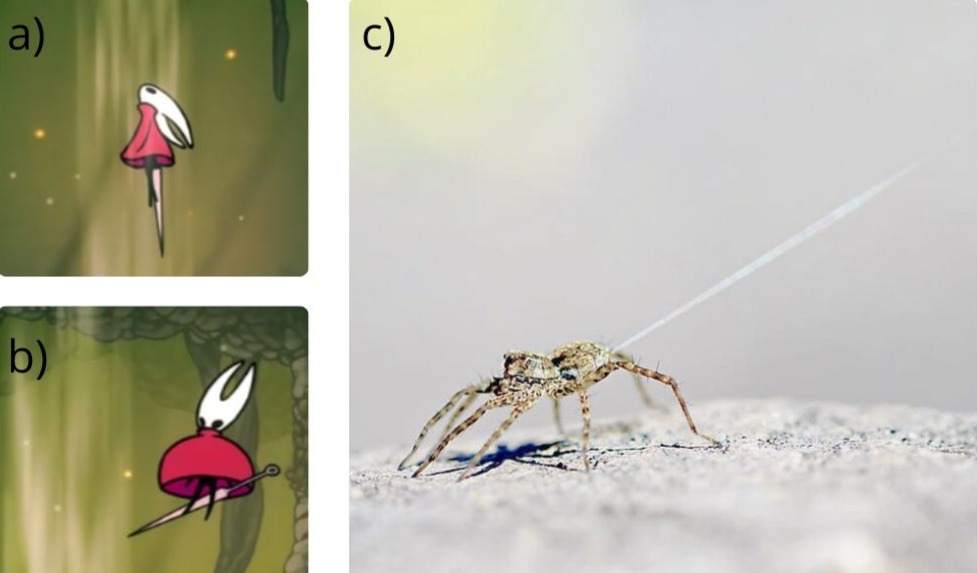
Ballooning is an aerial dispersal strategy performed primarily by spiderlings, although some adult spiders also exhibit this behaviour. During ballooning, spiders position themselves on elevated substrates and release silk threads that interact with wind and atmospheric forces, enabling passive aerial transport (Cho et al., 2018) (Fig. 2c). Interestingly, it has been hypothesized that spiders evaluate environmental conditions with their front legs and wait for ascending air currents before launching themselves (Cho et al., 2018), similar to Hornet riding updrafts.
Healing
Another feature of Hornet’s silk is its ability to heal her wounds. During combat, Hornet collects silk threads that she coils onto a spool. When injured, she can invest some of these threads to recover a portion of her health. This in-game mechanic, known as ‘Binding’, involves Hornet focusing so that the silk threads revolving around her fuse with her body, restoring her vitality in the process (Fig. 3a).
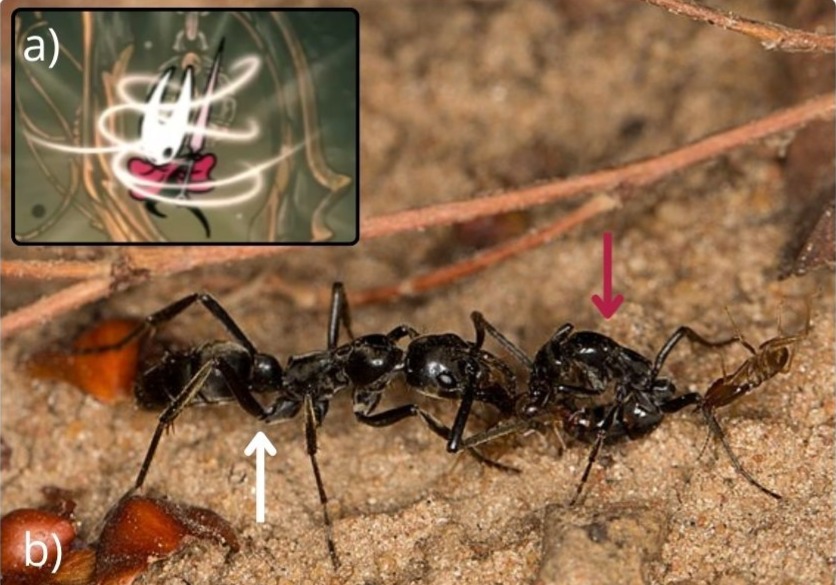
In nature, wound-treating behaviour is very rare, having been observed primarily in primates such as orangutans and chimpanzees and, more recently, in ants (Frank et al., 2023; Laumer et al., 2024). Although they do not produce silk, Megaponera analis, a species of ant, can detect chemical signals emitted by injured nestmates and carry them back to the colony. There, “nursing” ants tend to the injured individuals by applying antimicrobial secretions to their wounds, greatly increasing their chances of survival (Frank et al., 2023) (Fig. 3a).
While ants rely on antimicrobial secretions rather than silk, these behaviours suggest that wound treatment in animals can involve biochemical compounds that prevent infection and promote recovery.
In a similar vein, silk itself has been investigated for its biomedical properties. Indeed, silk sericin (SS), a protein found in the cocoons of silk moths, has been studied for its antimicrobial activity and its potential role in promoting wound healing (Wang et al., 2024). These properties provide a plausible biological analogue for Hornet’s Binding ability, where silk not only protects but also facilitates recovery.
Music
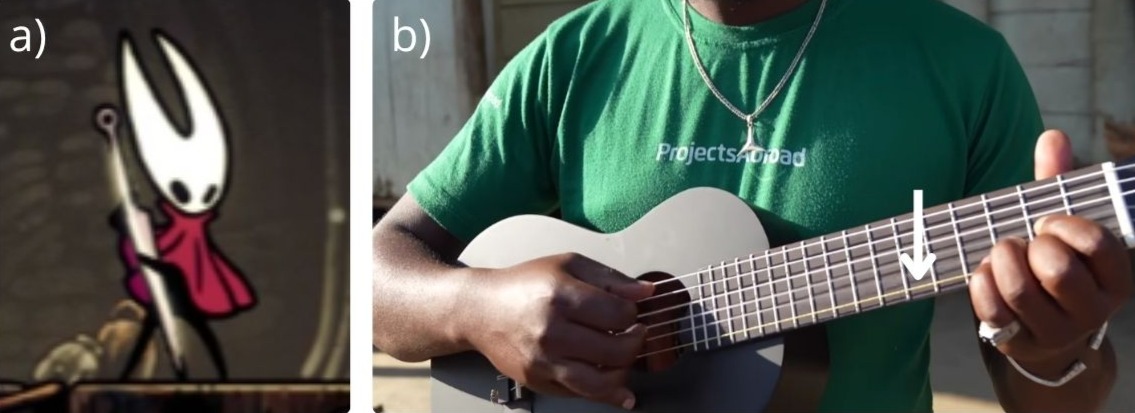
One last remarkable ability that Hornet possesses is using her needle as a harp-like instrument. To do so, she attaches silk strings to the base of her needle and plucks them, resembling the playing technique of instruments such as the lyre or the cello. The sound produced by the Needolin, the name given to this tool, allows access to certain passages, incites nearby inhabitants to sing and pray, and calls upon small creatures known as Bell Beasts that transport her to the most recent fast-travel point visited. Overall, this tool is critical for communication through music (Fig. 4a).
Zoomusicology is a field that studies the music-like bases of animal communication. Many animals produce sounds that resemble musical structures, including birds, humpback whales, and even arthropods such as crickets (Doolittle & Gingras, 2015). Spiders, however, although capable of producing sounds, communicate primarily through chemical signals and vibrations. Indeed, web-plucking is a mechanism used by spiders to recognize potential partners (Uetz & Roberts, 2002). Similarly, the webs built by orb-weaver spiders function as antennae that capture airborne vibrations across frequencies ranging from 100 to 10,000 Hz, including biological signals such as the flutter of hymenopterans and bird chirps (Zhou et al., 2022).
This evidence suggests that the sound produced by spider webs is largely irrelevant to spiders themselves, as the biologically meaningful signal lies in the vibrations transmitted through the web. Nevertheless, some enthusiasts have attempted to explore the acoustic potential of spider silk, even producing guitar strings from real spider filaments. To achieve this, they “milk” spiders for silk and weave it on a loom to create a filament. Producing a single string requires approximately 6 km of silk. After multiple attempts, the filament was mounted onto a small guitar, tuned, and played (Krantz, 2024) (Fig. 4b). Although highly inefficient, this demonstration showed that spider silk can indeed produce sound and even be used to play music, lending a degree of plausibility to Hornet’s Needolin.
CONCLUSION
Silk is a biomaterial that shapes the survivability of the organisms that produce it. It can function as a structural scaffold, a trapping device, and an environmental transducer. Despite this remarkable versatility, silk is often overshadowed by its producers, particularly spiders. For this reason, it is unusual for silk itself to take centre stage in cultural depictions. The critically acclaimed Hollow Knight: Silksong revolves both thematically and mechanically around silk, portraying its protagonist, Hornet, as a virtuous silk weaver. Although many of Hornet’s abilities are clearly fictional, they often represent imaginative extrapolations of real biological processes. In this way, Silksong highlights how a natural material that evolved in multiple arthropod lineages can inspire mechanics and narrative elements in modern media. By drawing attention to silk itself rather than solely to its producers, the game inadvertently showcases the remarkable biological versatility behind one of nature’s most fascinating materials.
REFERENCES
Alencastre, J.; Mago, C.; Rivera, R. (2015) Determination of energy dissipation of a spider silk structure under impulsive loading. Frontiers of Mechanical Engineering 10: 306–310.
Barth, F.G. (2021) A spider in motion: facets of sensory guidance. Journal of Comparative Physiology A 207: 239–255.
Cho, M.; Neubauer, P.; Fahrenson, C.; Rechenberg, I. (2018) An observational study of ballooning in large spiders: nanoscale multifibers enable large spiders’ soaring flight. PLoS Biology 16: e2004405.
Craig, C.L. (1997) Evolution of arthropod silks. Annual Review of Entomology 42: 231–267.
Diaz, C. & Long, J.H. (2022) Behavior and bioadhesives: how bolas spiders, Mastophora hutchinsoni, catch moths. Insects 13: 1166.
Doolittle, E. & Gingras, B. (2015) Zoomusicology. Current Biology 25: R819–R820.
Ebrahimi, D.; Tokareva, O.; Rim, N.G.; et al. (2015) Silk – its mysteries, how it is made, and how it is used. ACS Biomaterials Science & Engineering 1: 864–876.
Frank, E.T.; Kesner, L.; Liberti, J.; et al. (2023) Targeted treatment of injured nestmates with antimicrobial compounds in an ant society. Nature Communications 14: 8446.
Greco, G.; Mirbaha, H.; Schmuck, B.; et al. (2022) Artificial and natural silk materials have high mechanical property variability regardless of sample size. Scientific Reports 12: 3507.
Han, S.I. & Blackledge, T.A. (2024) Directional web strikes are performed by ray spiders in response to airborne prey vibrations. Journal of Experimental Biology 227: jeb249237.
Kochhar, D.; DeBari, M.K.; Abbott, R.D. (2021) The materiobiology of silk: exploring the biophysical influence of silk biomaterials on directing cellular behaviors. Frontiers in Bioengineering and Biotechnology 9: 697981.
Kono, N.; Nakamura, H.; Tateishi, A.; et al. (2021) The balance of crystalline and amorphous regions in the fibroin structure underpins the tensile strength of bagworm silk. Zoological Letters 7: 11.
Laumer, I. B.; Rahman, A.; Rahmaeti, T.; et al. (2024) Active self-treatment of a facial wound with a biologically active plant by a male Sumatran orangutan. Scientific Reports 14: 8932.
Krantz, M. (2024) I milked 1000 spiders to make guitar strings!! YouTube. Available from: https://www.youtube.com/watch?v=1DzTHI-n7-E (Date of access: 07/Apr/2026).
McKim, S.A. & Turner, T.L. (2024) The evolution of silk production in Crustacea. Journal of Crustacean Biology 44: ruae056.
Römer, L. & Scheibel, T. (2008) The elaborate structure of spider silk: structure and function of a natural high performance fiber. Prion 2: 154–161.
Sehnal, F. & Sutherland, T. (2008) Silks produced by insect labial glands. Prion 2: 145–153.
Uetz, G.W. & Roberts, J.A. (2002) Multisensory cues and multimodal communication in spiders: insights from video/audio playback studies. Brain, Behavior and Evolution 59: 222–230.
Wang, S.L.; Zhuo, J.J.; Fang, S.M.; et al. (2024) Silk sericin and its composite materials with antibacterial properties to enhance wound healing: a review. Biomolecules 14: 723.
Wood, H.M.; Parkinson, D.Y.; Griswold, C.E.; et al. (2016) Repeated evolution of power-amplified predatory strikes in trap-jaw spiders. Current Biology 26: 1057–1061.
Zhou, J.; Lai, J.; Menda, G.; et al. (2022) Outsourced hearing in an orb-weaving spider that uses its web as an auditory sensor. PNAS 119: e2122789119.
Zobel-Thropp, P.A.; Correa, S.M.; Garb, J.E.; Binford, G.J. (2014) Spit and venom from Scytodes spiders: a diverse and distinct cocktail. Journal of Proteome Research 13: 817–835.
Acknowledgments
This work was partly supported by using Grammarly for grammar and style suggestions. The author reviewed, edited, and revised the texts and suggestions to his liking and takes ultimate responsibility for the content of this publication.
About the author
MSc. Abraham U. Morales-Primo is a Mexican biologist and science communicator specializing in the role of NETs in leishmaniasis. A proud geek, he explores the biological mechanisms of video game-related phenomena (and sometimes real-world ones). When he’s not singing along with Sherma, he’s dreaming up new ways to blend science with video game culture, all in the company of his wife and their beloved puppy.