Patrizio Raffa
ENTEG Institute, Faculty of Science and Engineering, University of Groningen, Groningen, The Netherlands.
Email: p.raffa (at) rug (dot) nl
Since its release in 1990 by Lucasfilm Games, The Secret of Monkey Island has become a classic of point-and-click adventure games. Many players who grew up in the 1990s will be familiar with the adventures of the aspiring mighty pirate (or was it a flooring inspector?) Guybrush Threepwood. Among the many perils he encounters and the dangerous concoctions prepared by the Voodoo Lady, few substances rival grog for sheer menace. This beverage, beloved by pirates in all the Tri-Island area, is remarkable not only for its questionable ingredients but also for its ability to corrode metallic objects rapidly. It is first introduced to the player by the pirate leaders at the SCUMM bar on Mêlée Island. According to their description, grog is the most caustic, volatile substance known to man; it is a secret mixture containing one or more of the following: kerosene, propylene glycol, artificial sweeteners, sulfuric acid, rum, acetone, red dye No. 2, SCUMM, axle grease, battery acid, and/or pepperoni. The most interesting property of grog from a chemical perspective is not its composition, however, but its remarkable corrosivity. In fact, they also explain that it readily eats through metal, much to the dismay of the chef, who spends a fortune on mugs. The game itself is the primary source for the dialogue and puzzle described here (Lucasfilm Games, 1990).
During the game, to cleverly solve one of the puzzles, Guybrush collects grog in pewter mugs. The container progressively deteriorates, forcing the player to transfer the liquid repeatedly into fresh mugs while travelling from the SCUMM bar to the jail. The grog can then be poured onto the lock of a prison cell, destroying it and freeing the prisoner Otis, who will become a crew member for Guybrush’s trip to Monkey Island (or… will he?).
This raises an obvious question for the chemically inclined player: what would grog actually have to contain to behave this way? The present work addresses this question semi-quantitatively. Rather than starting from possible formulations, we treat the game’s observation as an inverse problem: we use the apparent rate of mug deterioration to estimate the proton supply required by a simplified corrosion model. The objective is not to propose an experimentally reproducible formulation of grog, an endeavour that would be both inadvisable and potentially disappointing to pirates, but to determine which chemical characteristics are necessary to reconcile its behaviour with known corrosion science.
BOUNDARY CONDITIONS AND ASSUMPTIONS
To formulate the model, we need estimates of the time required for grog to eat through the mug, as well as the mug’s wall thickness and material composition.
Time
Anyone who has played the game repeatedly, including the author, will have learned to time the mug-swapping manoeuvre carefully to reach the jail and pour the contents onto Otis’s cell lock. How frustrating! Although the game does not provide a physical clock, a mug’s lifetime can be measured “experimentally” by having Guybrush fill it, waiting until it dissolves completely, and recording the elapsed time.
The author timed the puzzle near the end of Act 1, after completing the three trials to become a pirate. The version used was The Secret of Monkey Island: Special Edition, released in 2009 by LucasArts and distributed through Steam (LucasArts, 2009). Using a stopwatch, the author measured a mug lifetime of approximately 35 seconds, which is adopted as the characteristic perforation time in the model. As a further simplification, perforation of the model wall is taken to correspond to complete in-game dissolution.
Given the approximations involved in the model, greater precision in the measured time is outside the scope of this work.
Material
The mug resembles a traditional tavern tankard (Fig. 1): it has a dull grey metallic colour, a rounded shape, and no obvious ceramic glaze or wood grain.

Historically, such tankards were commonly made from pewter, a malleable alloy consisting predominantly of tin (The Pewter Society, n.d.). The game supports this identification: if the player waits long enough after filling the mug, it changes from a “melting mug” to a “pewter wad” (Fig. 2) before dissolving completely.
Pewter composition has varied over time, and historical alloys could contain lead. Modern pewter is generally tin-rich. Because the mug’s exact alloy composition is unknown, it is treated here as pure tin.

Thickness
The game provides no wall-thickness measurement. Historical pewter drinking vessels provide context for the choice of material (The Pewter Society, n.d.), but do not establish the thickness of the fictional mug. A thickness of 2 mm is therefore adopted as a ballpark value, rather than a measured property.
Expected composition and properties of grog
Here things get interesting. Table 1 lists the potential components of grog, their chemical composition (where available), and their possible contributions to tin corrosion. These provide a starting point for considering corrosion mechanisms. Not all components are necessarily present, however: the pirate leaders specify “one or more of the following”.
Table 1. Components of grog, chemical composition, and potential corrosivity towards tin.
| Component | Chemical composition / formula | Potential corrosivity towards tin |
| Kerosene | Mixture of hydrocarbons | Unlikely to attack tin directly; a hydrocarbon layer could impede contact with the acid. |
| Propylene glycol | 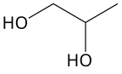 | Unlikely to attack tin directly; increased viscosity could slow mass transport. |
| Artificial sweeteners | Not specified | No clear direct acid-corrosion role; effects depend on the sweetener. |
| Sulfuric acid | H2SO4 | Potential proton-driven corrosion; concentrated acid may also act as an oxidant. |
| Rum | Typically about 40% ethanol by volume in water, with minor organic constituents. | Weak organic acids may contribute; the water dilutes sulfuric acid and changes its oxidising behaviour. |
| Acetone |  | No clear direct proton-driven corrosion role. |
| Red dye No. 2 (identified as amaranth) | 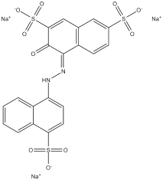 | No clear direct proton-driven corrosion role. |
| SCUMM | Unknown | Unknown; chemically undefined in the game. |
| Axle grease | Lubricating oil plus a thickener (often metal soaps) | Unlikely to attack tin directly; may impede acid–metal contact, as with kerosene. |
| Battery acid | Typically 30–40 wt.% H₂SO₄ in water | Potential acid corrosion; another source of sulfuric acid and water. |
| Pepperoni | Complex mixture of proteins, fats, water, NaCl, spices and fermentation products, including organic acids | Dissolved salts and organic acids may affect corrosion; the effect depends on solution and surface chemistry. |
Considering appreciable amounts of each of the listed ingredients, and neglecting potential effects of the mysterious SCUMM ingredient, grog might exhibit the characteristics summarised in Table 2. These predictions are composition-dependent. Interestingly, none of the listed ingredients seem to be able to provide an obvious explanation for the intense green colour seen in the game.
Table 2. Plausible characteristics of a mixture of the listed ingredients.
| Appearance | Initially reddish from the dye, with grease droplets and pepperoni particles possibly suspended. Strong acid could subsequently change the colour and degrade organic material, potentially producing a darker mixture. May produce fumes or bubbles, as the various components react with each other. |
| Homogeneity | Likely to separate into phases: an aqueous, acid-rich phase and an oily phase containing kerosene and grease. Kerosene is insoluble in water and less dense, so it would tend to float. Ethanol and acetone could improve mutual solubility, making the extent of separation composition-dependent. |
| Texture | Could range from a relatively mobile liquid to a greasy slurry, depending on relative amounts of the ingredients. Glycol and grease could thicken it, while acetone, ethanol and water would tend to dilute it. |
| Smell | A strong combination of petroleum, acetone and alcohol, with a hint of food-derived odours from the pepperoni. |
| Chemical stability | The organic components could undergo acid-catalysed reactions and degradation; the liquid’s composition would evolve. Concentrated sulfuric acid can react strongly with organic materials. |
| Flammability | Potentially flammable because of acetone, ethanol and kerosene. |
| Drinkability | Only fictional pirates could drink it. Completely unsuitable for human consumption. |
Analysing the composition, sulfuric acid stands out as the clearest candidate for proton-driven tin corrosion among the identified ingredients. No separate strong oxidant is explicitly listed. The model therefore initially treats grog as an aqueous acid solution. Concentrated sulfuric acid can also act as an oxidant, but water introduced with rum and battery acid would dilute it to an extent determined by the unknown mixing proportions, possibly negating the oxidation ability.
MODEL AND CALCULATIONS
Assumptions
Based on the assumptions established in Section 2, the problem is reduced to acid-only dissolution of an idealised tin tankard wall, with a thickness of 2 mm and a perforation time of 35 seconds. The schematic reaction is:
Mori et al. (2002) discuss the resistance of pure tin to non-oxidising acids, associated with sluggish hydrogen evolution, and investigate corrosion in oxygen-saturated sulfuric and nitric acids. Dissolved oxygen provides an alternative cathodic reactant; these experiments therefore do not establish that reaction (1) would proceed rapidly in grog. Here, rapid proton-driven dissolution is deliberately assumed as an idealised limiting case.
The model neglects limitations from hydrogen-evolution kinetics and surface passivation. These assumptions favour proton-driven dissolution by allowing the interfacial reactions in equation (1) to proceed sufficiently rapidly for proton supply to control the rate. The surface is treated as a perfect sink for protons, whose surface concentration approaches zero. This maximises the concentration gradient for the prescribed bulk concentration and transport geometry. Diffusion control is a simplifying assumption, not an inference about real tin corrosion.
Metal loss and required proton flux
We can first calculate the metal loss and proton supply required by this scenario. The required average values follow from geometry and stoichiometry. Let denote the initial metal tankard thickness, L(t) the remaining thickness at a time t, and v the speed at which the inner surface recedes. For constant recession speed (or for the average speed over the full perforation interval),
where td is the dissolution time. This assumes one-sided attack and uniform recession over the area considered. Perforation occurs when the remaining thickness reaches zero. The following value is the required average recession speed; it does not imply constant instantaneous speed in the transient model introduced below:
For an exposed area A, the volume removed in a time interval dt is Av dt. Multiplication by the metal density ρ gives the mass removed; division by molar mass M gives the amount in moles. Thus, the metal molar flux JSn, meaning moles removed per unit area per second, is
Using tin density and molar mass
The corresponding mass flux is , approximately . For comparison, the tin-corrosion data discussed in the appendix correspond to mass-loss rates of roughly 1 mg cm⁻² h⁻¹ under the conditions studied by Mori et al. (2002). The required average flux of 41.8 mg cm⁻² s⁻¹ is approximately 1.50 × 10⁵ times larger. This is an order-of-magnitude comparison: the experiments used dilute acid (0.05 M), different specimens and oxidizing conditions, rather than the hypothetical conditions assumed for grog. Nonetheless, this already shows that grog must be pretty powerful stuff!
Required acid concentration
The diffusion boundary layer is a region in the liquid adjacent to the metal. Its thickness δ is distinct from the initial metal wall thickness . In a simple film approximation, proton concentration decreases linearly from bulk concentration to surface concentration . Immediate consumption at the surface gives . Fick’s first law then gives the inward flux magnitude, taking the coordinate to increase towards the metal, so that (Laborda et al., 2024):
For a stagnant liquid, the equivalent diffusion-layer thickness changes with time. For ideal planar diffusion to a stationary absorbing surface in a semi-infinite solution that is initially uniform, it can be shown that the transient thickness is (Laborda et al., 2024), so the flux is not constant with time. We obtain the average proton flux by integrating J(t) over the dissolution interval and dividing by its duration, obtaining:
Solving the integral gives:
Interestingly, the exact same expression of (8), appears in the diffusion-based adsorption treatment discussed by Staszak (2016), who modelled surfactant absorption at a fluid/fluid interface. Combining equations 3 and 4 of his paper, with the assumption of perfect sink (), provides our equation (8). This does not imply that surfactant adsorption and metal corrosion share the same interfacial chemistry, both it shows that the two diffusion-limited models share the same law, reinforcing the statements of the present work. The stationary-plane approximation also neglects motion of the dissolving boundary, finite liquid volume and ionic migration. At 35 seconds, is approximately 1.0 mm, compared with 2 mm of wall recession, so boundary motion is not a small correction and the result is only a scale estimate.
Substituting the average proton flux into the stoichiometric relation and using equation (4), gives:
For this illustrative calculation, the proton diffusion coefficient in dilute water at room temperature is taken as D = 9.3 × 10⁻⁹ m² s⁻¹ (Muñoz-Santiburcio, 2022). Substitution into equation (9) gives:
Validity of the results
For scale, taking the density of 98 wt.% sulfuric acid as approximately 1.84 g cm⁻³ and its molar mass as 98.1 g mol⁻¹ (NIOSH, 2019) gives about 36.8 mol L⁻¹ of stoichiometric proton equivalents, calculated as . The required concentration is about ten times this value. Proton equivalents are not the same as free-proton concentration or activity in concentrated acid, and the dilute-water diffusion coefficient cannot be extrapolated quantitatively to that regime. The calculation therefore indicates that ordinary aqueous acid chemistry cannot explain the observed rate within this stagnant diffusion model; it does not exclude an oxidative mechanism. It is entirely possible that SCUMM is a voodoo-powered oxidant, after all. Extending the present proton-diffusion model to this case would require proton consumption to remain necessary for dissolution and proton transport to remain rate-limiting, with the stoichiometry adjusted accordingly. These conditions cannot be assumed without knowing the reaction mechanism.
The stagnant-liquid treatment also neglects fluid motion caused by possible hydrogen evolution through reaction (1), as well as sloshing while Guybrush frantically carries the mugs to the jail. Such motion could enhance mass transport and reduce the proton concentration required for a given dissolution rate. Repeated play shows no noticeable change in mug lifetime when Guybrush moves, but this is a feature of the game and cannot establish that convection would be negligible in a real liquid. The calculation should therefore be read as a stagnant-liquid reference case.
We should also address the observation that, while a pewter tankard can resist when filled with grog for about 35 seconds, the jail lock, presumably made of some iron alloy, melts in less than two seconds. Fortunately for the model, opening a lock does not require dissolving its entire mass. Localized attack on a thin part of it could be sufficient to release the mechanism. Under otherwise identical conditions, the transient diffusion model predicts that dissolved thickness scales with the square root of time (see equation (A.1) in the appendix). Thus, in two seconds, grog could attack approximately of the thickness removed in 35 seconds, which is about 0.5 mm of the assumed 2 mm mug wall. This comparison, however, does not take into account the different material and geometry of the lock. Nevertheless, a vulnerable internal component offers a possible explanation for its rapid failure. Alternatively, Mêlée Island’s prison authorities may simply have been scammed by the shopkeeper when they purchased their locks, and maybe they are not made of such a sturdy material.
Having developed the model, one might reasonably ask: why not test it against real-world corrosion data? More precisely, can a model based on proton diffusion reproduce metal losses measured under stagnant conditions? The appendix explores this question by comparing the model’s predictions with published experimental data. Given the simplifying assumptions, the agreement is surprisingly good, although it may not establish proton diffusion as the controlling mechanism.
CONCLUSIONS
The pirate leaders certainly have grounds for calling grog one of the most caustic substances known to man. Within the idealised stagnant diffusion model, perforating a 2 mm tin wall in 35 seconds would require a proton concentration of approximately 383 M, far beyond a plausible aqueous acid concentration. Ordinary acidity therefore cannot explain the observed rate under these assumptions. This conclusion is specific to the transport model: convection, different cathodic reactions and the unknown chemistry of SCUMM remain outside its scope.
So, is the model completely useless? Perhaps not: it shows just how demanding the puzzle is for ordinary acid chemistry. In any case, it was fun contributing a little chemistry to the fantastic world of Monkey Island. The practical advice remains unchanged: don’t drink that swill!
REFERENCES
Laborda, E.; González, J.; Molina, A. (2024) A reasoned general explanation about the concepts of diffusion and reaction layers. Journal of Solid State Electrochemistry 28: 1259–1271.
LucasArts. (2009) The Secret of Monkey Island: Special Edition. LucasArts, San Francisco.
Lucasfilm Games. (1990) The Secret of Monkey Island. Lucasfilm Games, San Francisco.
Mori, M.; Miura, K.; Sasaki, T.; Ohtsuka, T. (2002) Corrosion of tin alloys in sulfuric and nitric acids. Corrosion Science 44: 887–898.
Muñoz-Santiburcio, D. (2022) Accurate diffusion coefficients of the excess proton and hydroxide in water via extensive ab initio simulations with different schemes. Journal of Chemical Physics 157: 024504.
NIOSH, National Institute for Occupational Safety and Health. (2019) Sulfuric acid. NIOSH Pocket Guide to Chemical Hazards. Available from: https://www.cdc.gov/niosh/npg/npgd0577.html (Date of access: 14/Sep/2026).
Osarolube, E.; Owate, I.O.; Oforka, N.C. (2008) Corrosion behaviour of mild and high carbon steels in various acidic media. Scientific Research and Essay 3: 224–228.
Reusch, W. (n.d.) Ionization constants of inorganic acids. Virtual Textbook of Organic Chemistry, Michigan State University. Available from: https://www2.chemistry.msu.edu/faculty/reusch/VirtTxtJml/acidity.htm (Date of access: 15/Sep/2026).
Staszak, M. (2016) A linear diffusion model of adsorption kinetics at fluid/fluid interfaces. Journal of Surfactants and Detergents 19: 297–314.
The Pewter Society. (n.d.) Pewter for drinking. Available from: https://pewtersociety.org/about-pewter/pewter-drinking (Date of access: 15/Sep/2026).
Acknowledgements
ChatGPT (GPT-6, OpenAI) was used to improve the writing style of this article, the formatting, to extract data from articles, and to double-check model and calculations. The author reviewed, edited, and revised the ChatGPT-generated texts to his own liking and takes ultimate responsibility for the content of this publication.
About the author
Dr Patrizio Raffa is an Associate Professor in Smart and Sustainable Polymeric Products at the University of Groningen. This paper brings together his interests in chemistry and point-and-click adventure games.
APPENDIX
This appendix compares the transient diffusion model with literature corrosion data for tin and mild steel. The comparison tests the scale and trends of the predictions; it does not independently identify the rate-limiting step.
Mori et al. (2002) report cumulative tin loss per unit area in dilute sulfuric and nitric acids. Generalizing equation (9) to dissolution as a cation of charge z, with z protons consumed per metal atom under the assumed hydrogen-evolution mechanism, gives the dissolved thickness . Let denote the numerical proton concentration in mol L⁻¹, so that in mol m⁻³. Using M in kg mol⁻¹, ρ in kg m⁻³, D in m² s⁻¹ and t in seconds:
The corresponding cumulative mass loss per unit exposed area is given by equation (A.2) in kg m⁻², which can be expressed in mg cm⁻², as in the source paper, by multiplying by 100.
Figure A1 compares the literature data with predictions using z = 2, M = 0.11871 kg mol⁻¹ and D = 9.3 × 10⁻⁹ m² s⁻¹. For 0.05 M H₂SO₄, complete first dissociation and the concentration approximation Kₐ₂ = (0.05 + x)x/(0.05 − x) = 0.010 (Reusch, n.d.) give x = 0.00742 M and cH ≈ 0.0574 M. Activities are approximated by concentrations; this is not an exact speciation calculation. The model curve for nitric acid uses cH = 0.05 M, as assumed for the data comparison in this manuscript.
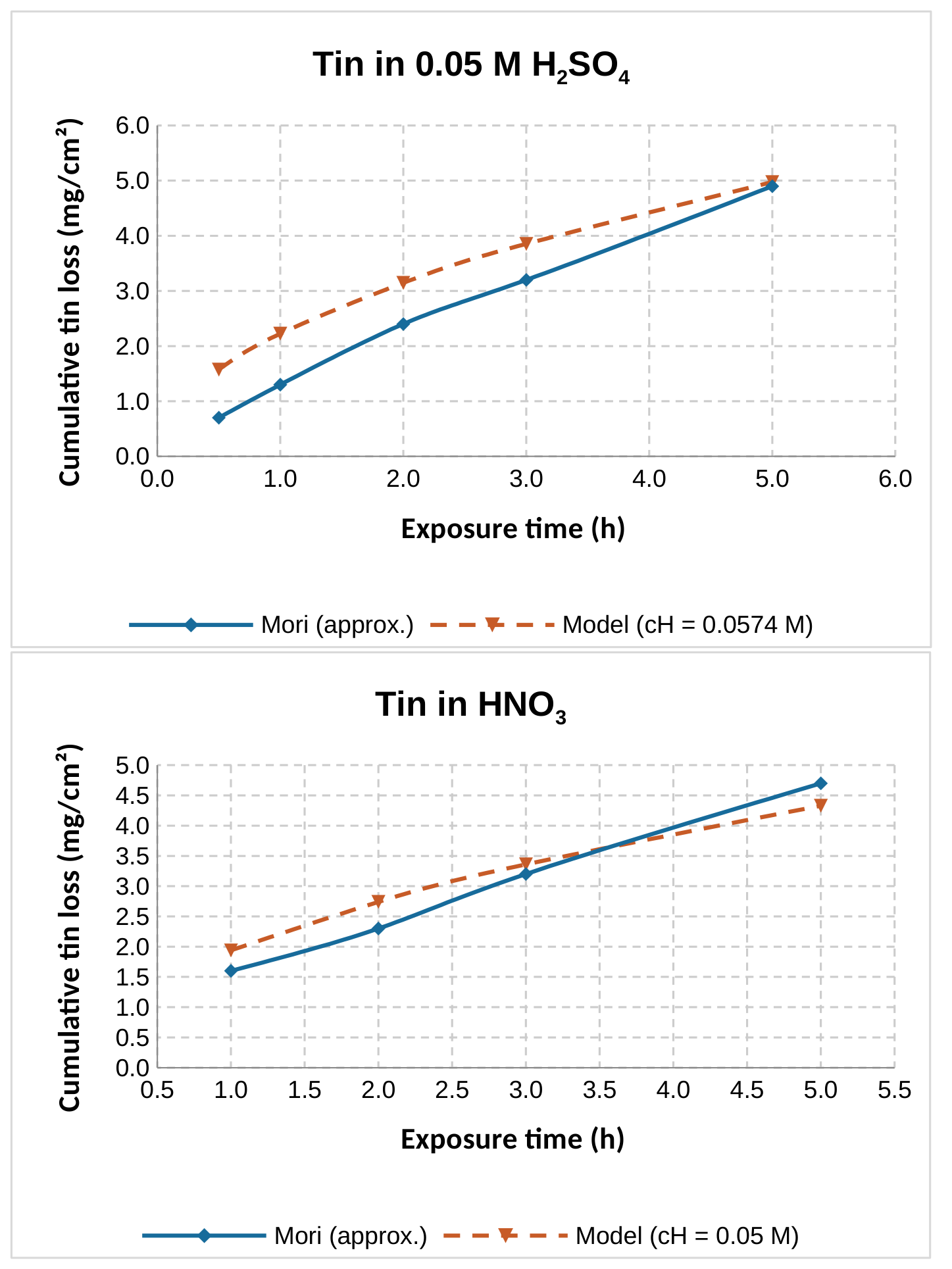
The predictions reproduce the order of magnitude of the plotted tin losses without fitting parameters. Numerical agreement alone does not establish proton-diffusion control: oxygen reduction, nitrate reduction and surface processes may affect corrosion under the experimental conditions. In particular, using the proton-consumption stoichiometry of equation (1) for oxidising acids is an illustrative comparison, not a demonstrated reaction mechanism. Nonetheless, rather than being merely a coincidence, this result suggests that the process may be very close to one where proton diffusion is the rate-limiting step, or it has comparable kinetics.
Figure A2 compares the mild-steel mass-loss data attributed to Osarolube et al. (2008) with model predictions after 1 day in HCl and HNO₃. The specimen dimensions used are 5 × 5 cm with a thickness of 1 mm. If both faces and all four edges are exposed, A = 52 cm² = 0.0052 m². Treating steel as iron dissolving to Fe²⁺ gives z = 2 and M = 0.055845 kg mol⁻¹. Equation (A.2), multiplied by A and by 1000 to convert kilograms to grams, gives . With t = 86,400 s, D = 9.3 × 10⁻⁹ m² s⁻¹ and cH approximated by the HCl molarity, the prediction is m(1 day) ≈ 4.64cH g. The calculation assumes a constant exposed area, negligible bulk depletion and independent planar diffusion at each surface.
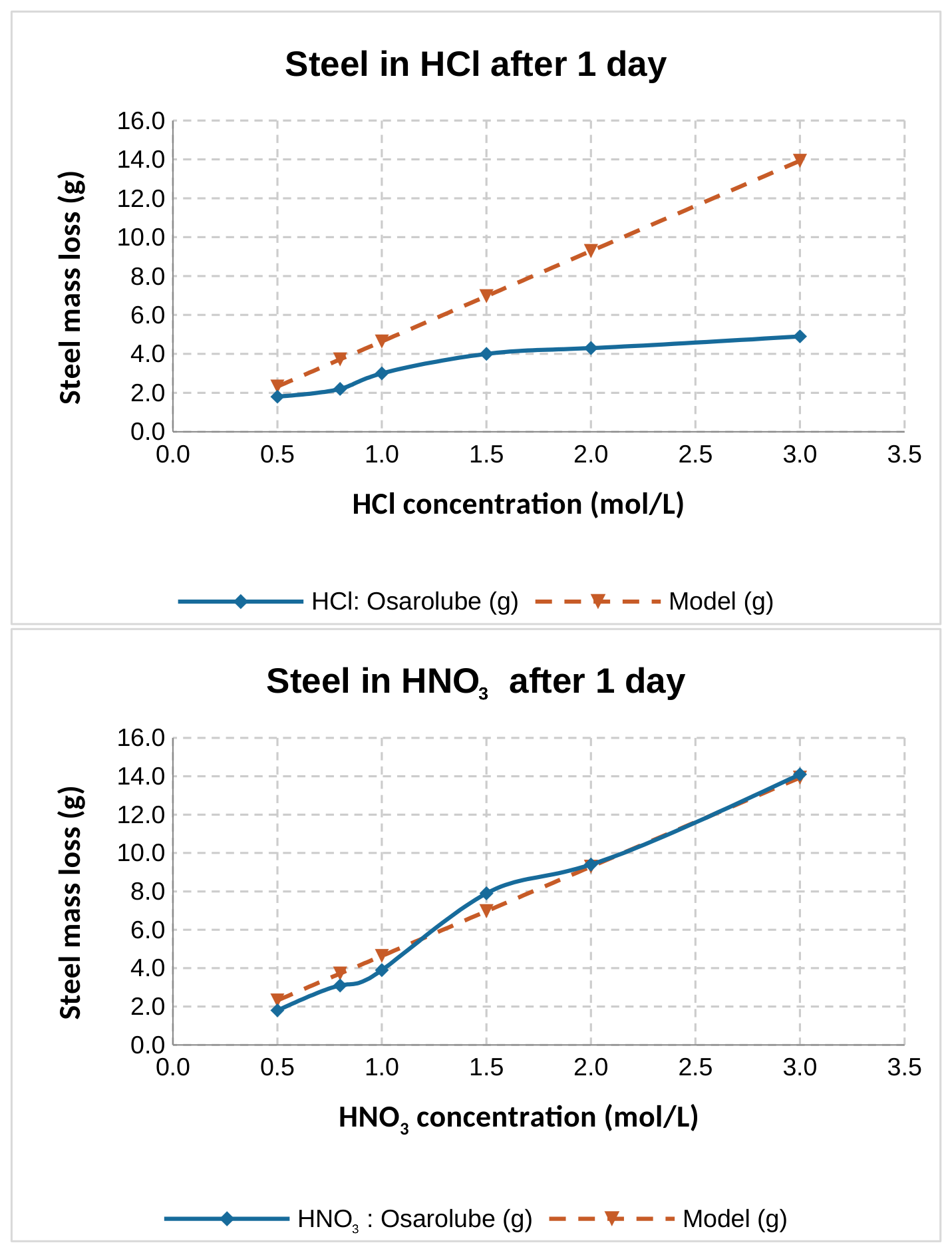
The prediction is remarkably close to the plotted HNO₃ values but agrees with the HCl data mainly at lower acid concentrations. Nitric acid can support cathodic pathways other than hydrogen evolution, so this agreement does not validate the assumed proton stoichiometry. Thus, the simple proportionality between mass loss and acid concentration does not describe the entire plotted range for HCl. This departure alone does not demonstrate a transition away from diffusion control. Surface kinetics, concentration-dependent transport, ionic migration, evolving surface condition and changes in solution composition may all affect the comparison. In addition, the equivalent diffusion-layer thickness after 1 day is approximately 5 cm, comparable to the specimen dimensions, so the independent planar, semi-infinite approximation becomes questionable.
In conclusion, the appendix provides an illustrative comparison, rather than a validation of the model across these conditions. However, it is remarkable that such a simplified model may describe experimental data with such a level of accuracy without the use of adjustable parameters, and it may encourage further investigation.