Francisco Seco Costa dos Santos Silva
Independent researcher, Leiria, Portugal.
Email: fs.seco (at) outlook (dot) com
“Hey Digimon, hey Digimon,
Monster friends to the boys and girls.
Hey Digimon, hey Digimon,
Champions of the Digital World!”
– Excerpt from “Hey Digimon”, an insert song for the English dub for Digimon Adventure, by Paul Gordon (1999).
Digimon, or Digital Monsters, are a product created by Bandai in the 90’s with the goal of targeting a slightly different demographic from their companion toy brand Tamagotchi (Watanabe, 2018). What began as a set of 16 by 16-pixel arrangements on tiny virtual pet screens has since evolved into a multimedia franchise that spans videogames, animated series, merchandise, novelizations and trading card games.
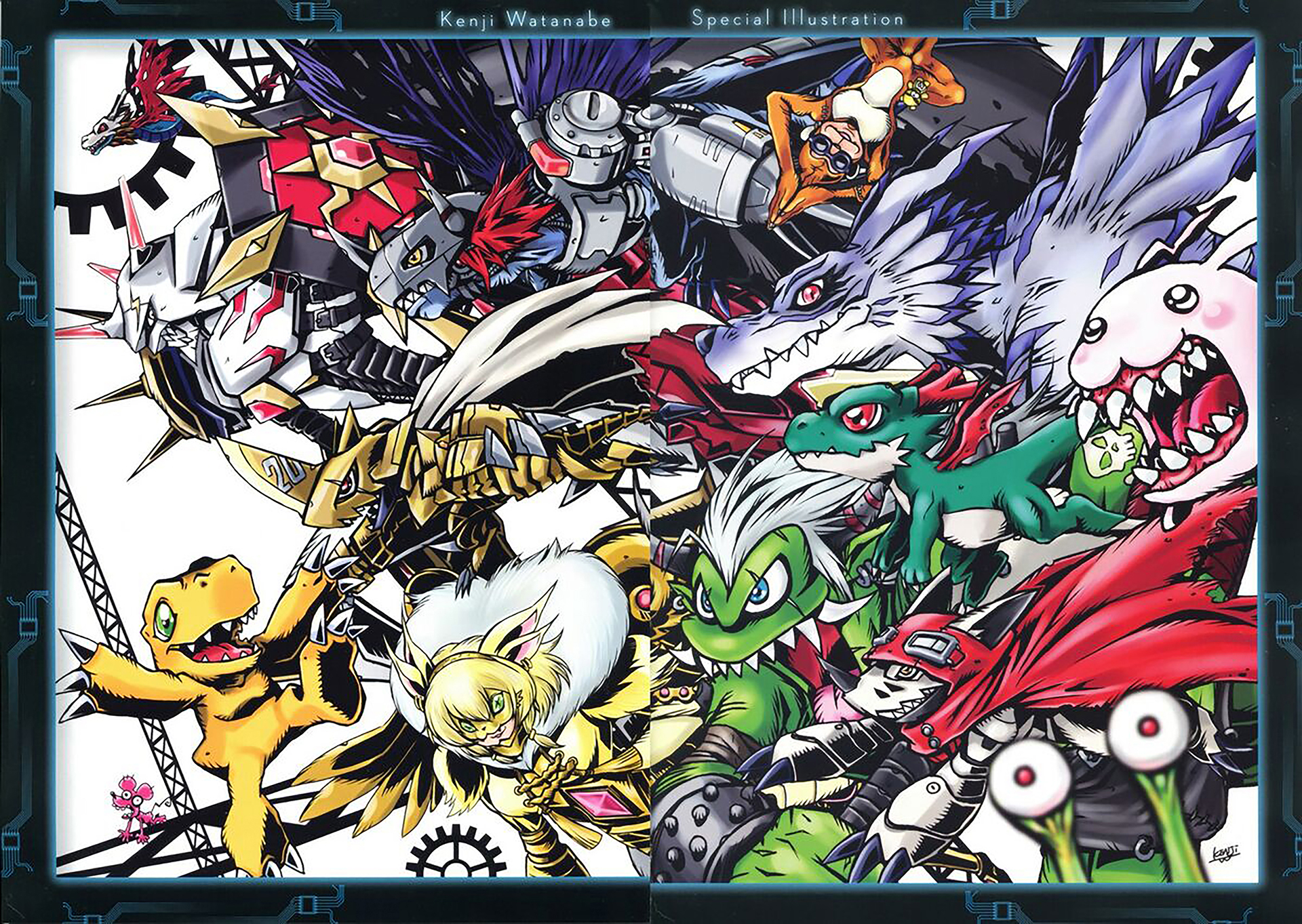
In their own universe, Digimon are “a virus possessing artificial intelligence spread onto computers throughout the world. This virus evolved in a way similar to living organisms, changing its appearance and nature on the Network, becoming the ‘digital lifeforms’ that came to be known as ‘Digital Monsters’, which were first discovered on there in 1997” (Wikimon, 2026a). These digital creatures adapt and take on many forms based on the “data” gathered from the Real World (i.e. planet Earth and the Internet), and mostly reside in a parallel dimension known as the Digital World (Digimon Web, 2026a).
Digimon are represented in many ways throughout the franchise. However, in essence they are identified by three elements: their names; descriptions of their personality, strength level and abilities; and visual appearance, usually in the form of one or more illustrations. These elements, as catalogued in the Digimon Encyclopedia, will be our points of reference to what is considered a Digimon, as well as what sort of data the Digital World tends to extract from the Real World when creating these digital monsters.
It is also important to note that Digimon names may vary depending on the language but usually follow a structure of prefixes derived from different languages that detail some aspect of the Digimon’s design, followed by the near universal suffix -mon.
For example, Plesiomon (Fig. 2b) is a plesiosaur type Digimon described as being “A previously imaginary Digimon discovered within the computer of a British cryptozoology research institute. It was a Digimon that had already been rumored among researchers” (Digimon Encyclopedia, 2015b). Its description and overall character design are derived greatly from the Loch Ness Monster (Fig. 2a), believed by some to be an extant species of plesiosaur (Spicer, 1933).

While the entire structure of the Digital World is (1) a complex mystery that varies across media and leaves much room for narrative interpretation, and (2) a way to justify the designers’ decisions within fiction; some parallels can be drawn between how the Digital World interprets information from the Real World and the relation of signs in Saussure’s semiology (1916).
Herein we explore the notions of sign and myth and how they translate in the fictional world of Digimon.
SIGNS AND MYTHS
Semiology is the study of signs and how individuals use them to communicate meaning. According to Saussure’s model of semiology (1916), a sign is composed by the image (signifier) and the concept from which it derives meaning (signified). An image, in this case, is not just a visual representation of an object or concept: it can be a sound, a gesture, a written word, an abstract idea or an entirely different object. For example: the picture of a cat, or even the word “cat” itself, are signifiers of the platonic ideal of the species Felis catus Linnaeus, 1758, the signified. If cats didn’t exist, then these signifiers would lose their meaning. As such, it is the image attached to an external meaning that creates a sign.

Saussure’s semiology falls under the category of structuralism, a philosophical understanding that human culture can be viewed as a language, or a system of signs, that interprets a concrete reality. This concept is not without its criticisms, however, and a different movement called post-structuralism challenges this notion directly by counter-arguing that our reality is not as concrete as it suggests, and that meaning can and does change (Hawkes, 2003). Charles Sanders Peirce (1900), a contemporary of Saussure, proposes a more post-structuralist study of signs called semiotics.
The main difference between semiology (Saussure, 1916) and semiotics (Peirce, 1900) lies in the notion that the signified does not exist as a structure independent from the interpreter.
In semiotics, the model of a sign reimagines the signified dividing it into two components: the object (the concept from which the signifier derives its meaning); and the interpretant (the resulting image in the interpreter’s mind based on their personal experiences). Together with the signifier, or representamen, these three components result in a sign through a process Peirce (1900) calls semiosis.
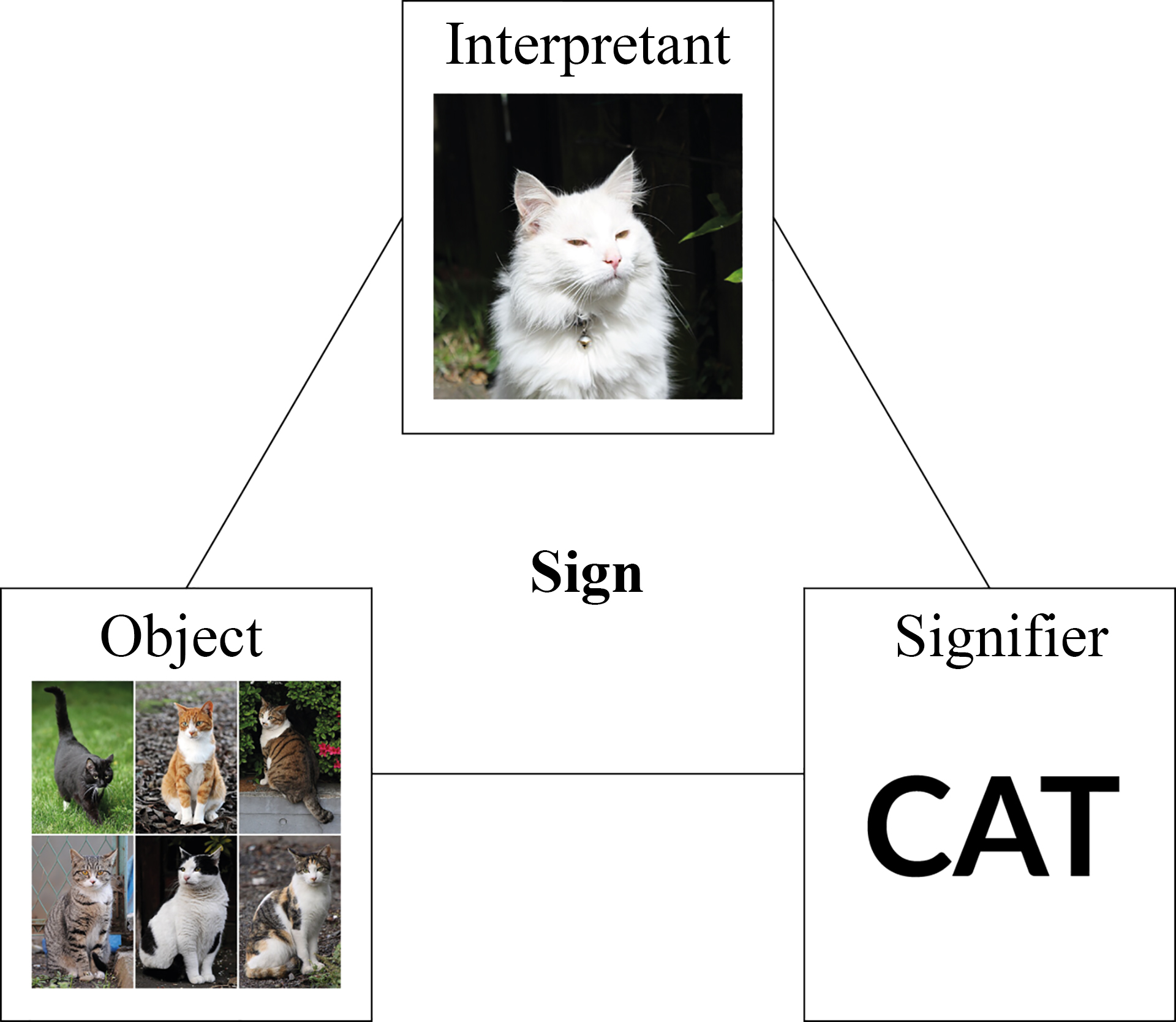
According to Peirce (1900), signs can also be classified as icons, indexes or symbols depending on the relation between the objects and their signifiers: “icons are signs wherein there is an immediate, sensorial connection or resemblance between signifier and object”. An image of a horse (Fig. 5a) is considered an icon of a horse because it visually resembles the species Equus ferus caballus (Linnaeus, 1758). Indexes share a causal relation between signifier and object. A horseshoe (Fig. 5b) is an index of a horse due to their causal association.
Symbols bear no immediate relation between the object and the signifier, and must instead rely on a previously established language or code. The word ‘horse’ (Fig. 5c) does not conjure an image of a horse in the mind of someone who doesn’t understand English. Therefore, the word is a symbol that represents a horse.

This idea that signs can derive meaning from other signs can result in an “unlimited semiosis” (Eco, 1979), in which the interpretant of one sign becomes the object of the next in a seemingly infinite game of telephone. In a collection of short essays exploring the idea of modern myths through the lens of semiology, Roland Barthes (1953, 1957) introduces the concept of myth, which offers a different perspective on this phenomenon. In Barthes’ interpretation, myths are a new layer of semiosis in which the signs become in themselves signifiers for new, sometimes completely unrelated meanings. Barthes’ myth (1957) bridges the gap between Saussure’s model of signs (1916) and the post-structuralist notion that cultural semiosis can give new meanings to our perceived reality (Hawkes, 2003).
The image of a pumpkin (Fig. 6a), outside of popular culture, signifies little more than the fruit of the genus Cucurbita L. Furthermore, jack-o’-lanterns were born from Irish folklore and used produce like turnips to create the decorative lanterns (Fig. 6b). This tradition was brought to America, where the pumpkin was more readily available, and now the word ‘jack-o’-lantern’ conjures in our minds images of hollowed pumpkins with grotesque, candle-lit expressions (Fowler, 2005). These are examples of how continuous interpretations of signs based on a malleable culture and shared experiences give images like that of the pumpkin their status as modern myths associated with Halloween.

DIGIMON SIGNIFIED
Returning to Plesiomon and the Loch Ness Monster, we must concede that there is very little physical evidence to the monster’s existence. The Loch Ness Monster, or Nessie, is a creature from Scottish folklore that has garnered much media attention since its alleged sighting in 1933 or 1934 (sources differ), proven to be a hoax (Darnton, 1994). From then on countless interpretations of the creature have surfaced in popular culture, both as direct references to the creature and as passing resemblances to its plesiosaurid appearance (Langford, 2021).
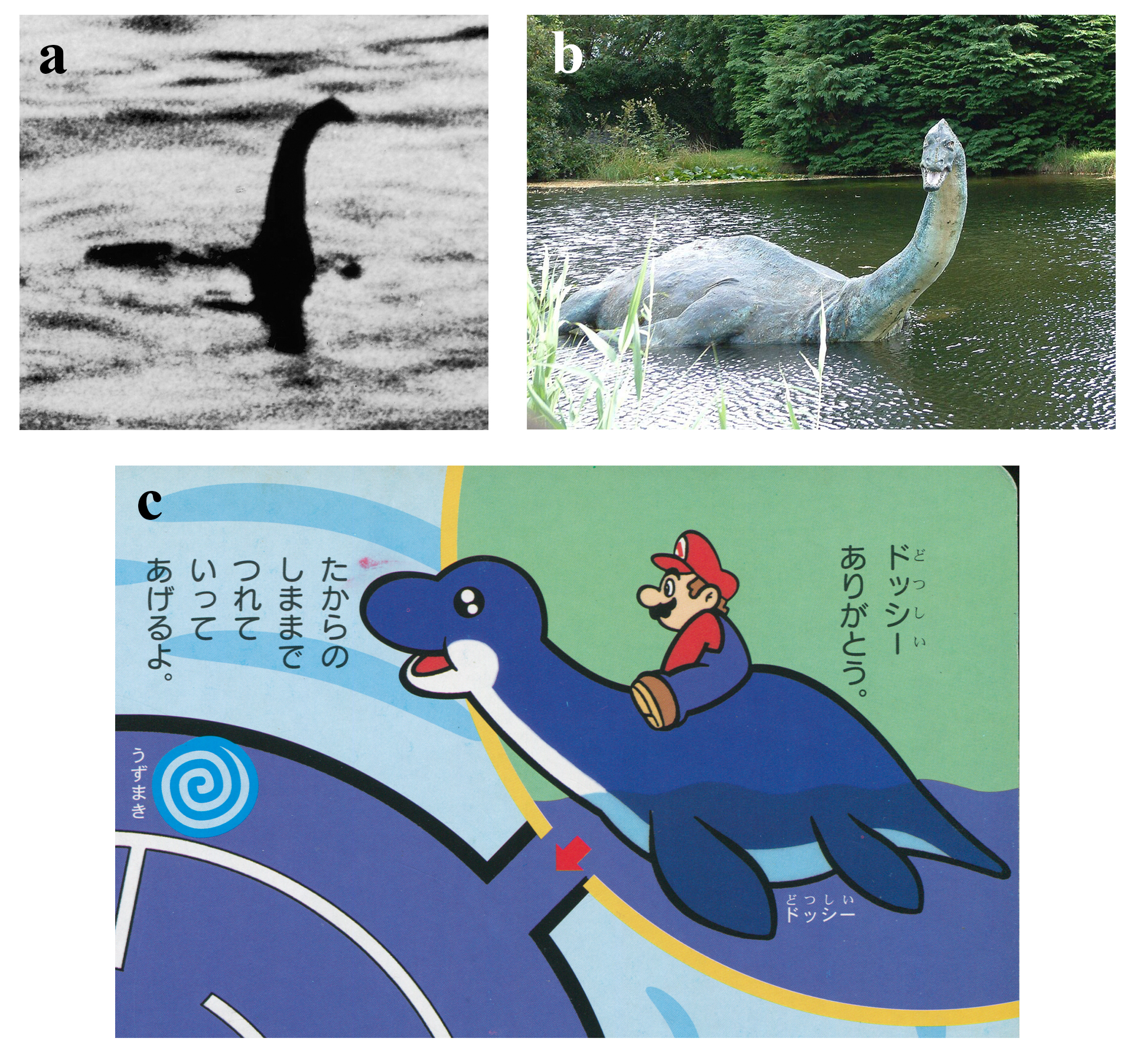
As such, we rely on common interpretations in the media and on unreliable photographs to derive our main sources of meaning; the Loch Ness Monster becomes a myth signified by our visual culture instead of an actual animal. This myth becomes the data from which in the Digital World creates Plesiomon; had a different interpretation of the monster been popularized by the media, like the idea of it being an elephant as was proposed by Donald Johnson and Dennis Power (1974), then one of two things could have happened: either Plesiomon would not reference the Loch Ness Monster in its description and would instead focus solely on the plesiosaur; or it may have ended up a very different Digimon, with a trunk and a back hump and a name like Elephantmon.
Indeed, the Digital World often derives meaning from many aspects of human culture when deciding the names, designs and descriptions of its inhabitants. Many pillars of classical Greco-Roman mythology are represented in the Digital World by their digital counterparts: Marsmon, Neptunemon, Mercurymon, Jupitermon, Junomon, Ceresmon, Apollomon, Dianamon, Venusmon, Minervamon, Vulcanusmon and Bacchusmon form the Olympos XII (Fig. 8b), a collective analog of the twelve Olympians of Greek mythology and their associated myths (Fig. 8a), albeit represented by the names of their Roman counterparts, with the exception of Apollo, whose Greek name is preserved in Apollomon (Long, 1987; Digimon Encyclopedia, 2008).

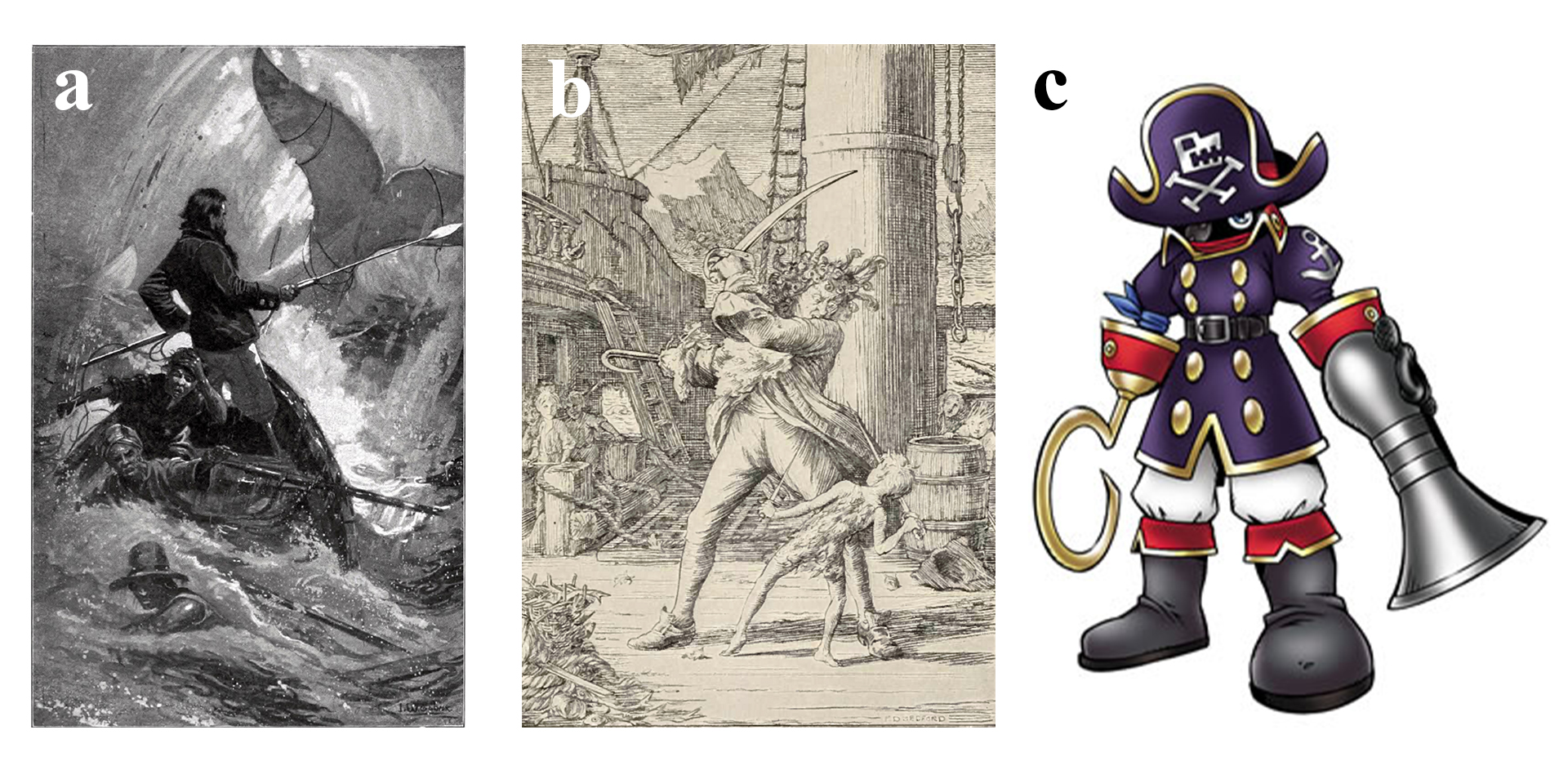
More modern stories are also present within the franchise. The designs of Digimon are not only influenced by manga, movies and western comics (Watanabe, 2018), but are also inspired by classical literary works. Hookmon (Fig. 9c) references Peter Pan’s Captain Hook (Barrie, 1904) (Fig. 9b) as well as Moby Dick’s Captain Ahab (Melville, 1851) (Fig. 9a). While its name and design resemble the hook-handed pirate, Hookmon’s description references “pursuing the phantom White Whamon” (Digimon Encyclopedia, 2015a). Whamon being the name of a whale-like Digimon, then the “White Whamon” becomes the titular white whale from Herman Melville’s novel Moby Dick (1851), while Hookmon, its pursuer, signifies the obsessive protagonist of the novel.
Some Digimon combine more than one concept with varying levels of abstraction in their designs. Elizamon (Fig. 10c) is based on the frill-necked lizards Chlamydosaurus kingii Gray, 1825 (Fig. 10a) and on Elizabethan fashion (Fig. 10b); while the reptilian characteristics are more present in its design, the Digimon’s ruffed collar in association with the prefix Eliza- becomes an index of the style of Elizabethan England (Vicki, 2013).

Another example, Bearmon (Fig. 11c) has in its identity both an icon and a symbol that signify the same concept but with very different meanings. The Digimon visually resembles a bear (albeit of indeterminate species), as its name implies. However, the creature also dons a backwards sports cap with an icon of a bear (Fig. 11d) and the word ‘bears’ written in English. It is said that the bear icon is an homage to Chiaki J. Konaka, who considers the titular teddy bear character (Fig. 11a) from the movie Kuma-Chan (1992) the screenwriter’s “calling card” (Digimon Web, 2019). Even then, along with the word ‘bears’ and the sports cap, Bearmon also becomes associated with American sports teams like the Chicago Bears (2013) that use the animal as one of their symbols. These decisions add three layers of interpretation to Bearmon’s design by signifying bears as animals, bears as symbols of Konaka’s work in cinema, and bears as sports mascots.

Digimon can also signify more complex concepts through the relations they share with each other. Kabuterimon and Kuwagamon are two Digimon based on the Japanese rhinoceros beetle Trypoxylus dichotomus (Linnaeus, 1771) and the Japanese stag beetle Prosopocoilus inclinatus (Motschulsky, 1857), respectively. These two Digimon are described as having a “perfect rivalry” (Digimon Encyclopedia, 2015), a trait shared by other characters in media inspired by these beetles. References to rivalry and conflict aren’t necessarily derived from the insects themselves, but rather from the popular Japanese hobby of beetle-fighting, wherein beetles are caught or raised to battle each other (Inglese, 2016).

Another common and significant relation between Digimon lies in the in-fiction metamorphosis known as Evolution. Beyond the linear notion of evolution popularized by other monster taming franchises, Digimon’s Evolution, or Digivolution, is closer to a network of transformations: Digimon can turn into other Digimon based on a multitude of factors (Digimon Web); these changes in form serving as vehicles for added meaning.
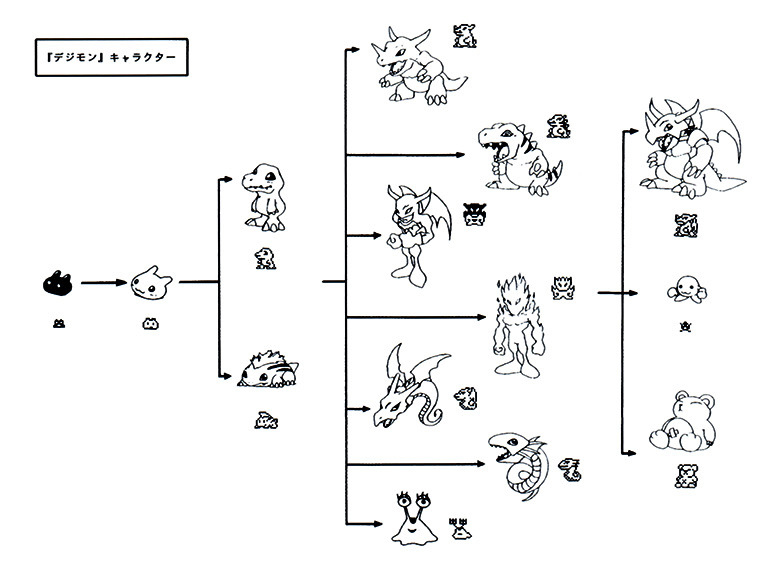
In most iterations of the Digimon anime, the protagonists’ Partner Digimon change forms throughout the narrative based on the bonds they share with their human companions, known as Tamers, as well as the emotional challenges they overcome (Fig. 14). Through Evolution, Partner Digimon become living timelines of their Tamers’ changes in maturity across the series (Wikimon, 2026b).
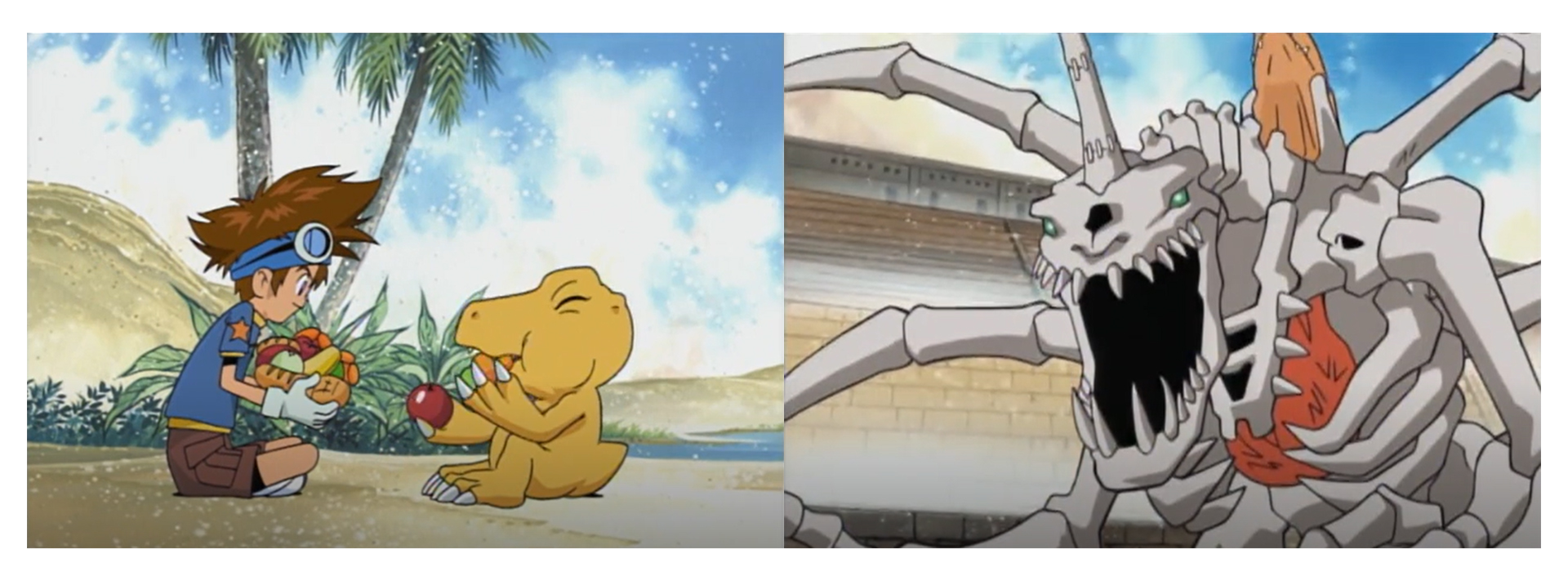
Digimon can also become myths within the Digital World. The teddy bear-like Monzaemon (Fig. 15b) does not resemble the 17th century Japanese playwright Chikamasu Monzaemon (Fig. 15a), and yet it is believed that this Digimon bears the playwright’s name. Monzaemon also has a dark variant known as Waru Monzaemon (Fig. 15b), a corruption of the teddy bear with an oversized claw and wicked demeanor. The name and appearance of this dark Digimon originate not from Chikamasu Monzaemon, but from the Digimon Monzaemon, adding to it the prefix derived from the japanese waru, meaning evil, reflected in its design. In this case, the name Monzaemon becomes the signified teddy bear of the Digital World, a cultural myth detached from its original meaning.

Changes in our culture and society also influence the data from which the Digital World derives meaning. Appmon are digital creatures based on mobile apps and other functionalities of smartphones and are part of the spin-off series Digimon Universe: App Monsters created in 2016. Many of the franchise’s developers “referenced Appmon as an example of the Digimon franchise’s adaptation to the contemporary digital environment and the widespread accessibility of online networks” (Wikimon, 2023). Even then, these creatures soon became a product of their time: the Appmon Tubumon (localized as Tweetmon) (Fig. 16b) seems to have been based on the social media platform Twitter, which changed its brand and name to X in 2023 (Fig. 16a) (Babatunde, 2024). However, the myths surrounding this social media platform are still manifested in its reference book description: “A chatty Appmon that tells you more than you care to know about the people you follow. It can’t help itself from spreading whatever it finds amusing far and wide” (Appmon Encyclopedia, 2016).
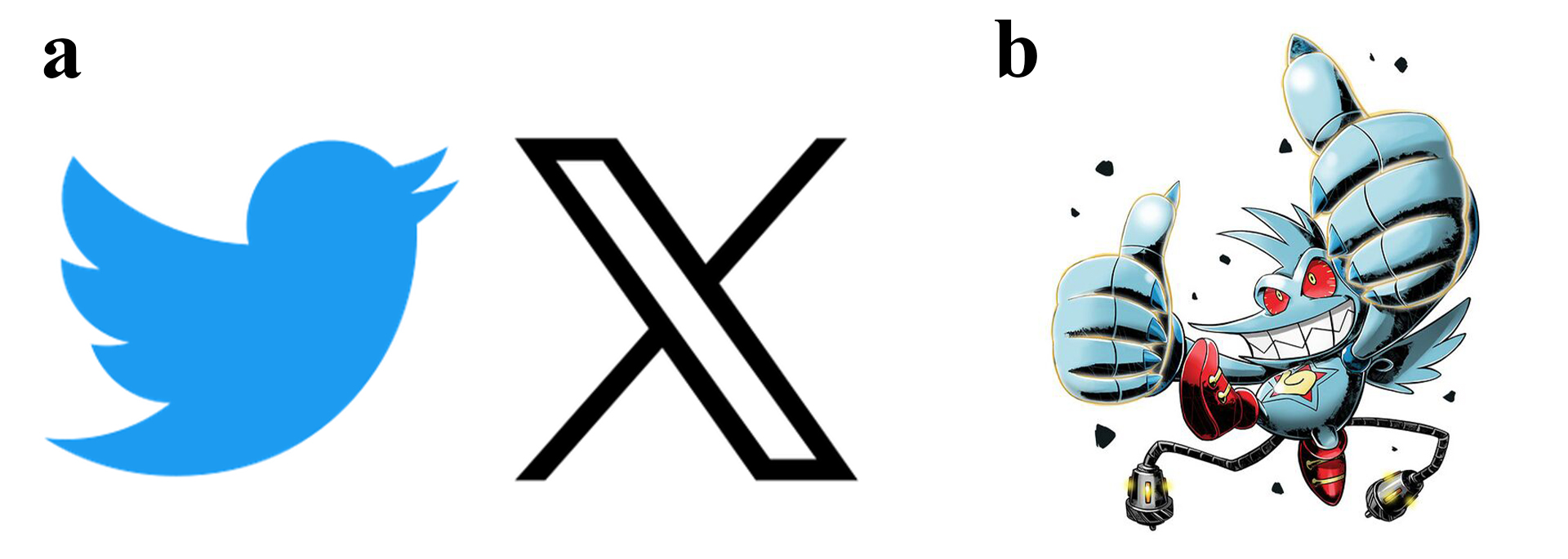
Moreover, these creatures could not have existed at the time of Digimon’s inception since the concept of a mobile app did not exist in 1997 (Holwerda, 2011). This shows how the pre-established structure of the Real World’s data can evolve, creating new concepts that the Digital World (or the Net Ocean in Appmon’s case) can condense into creatures.
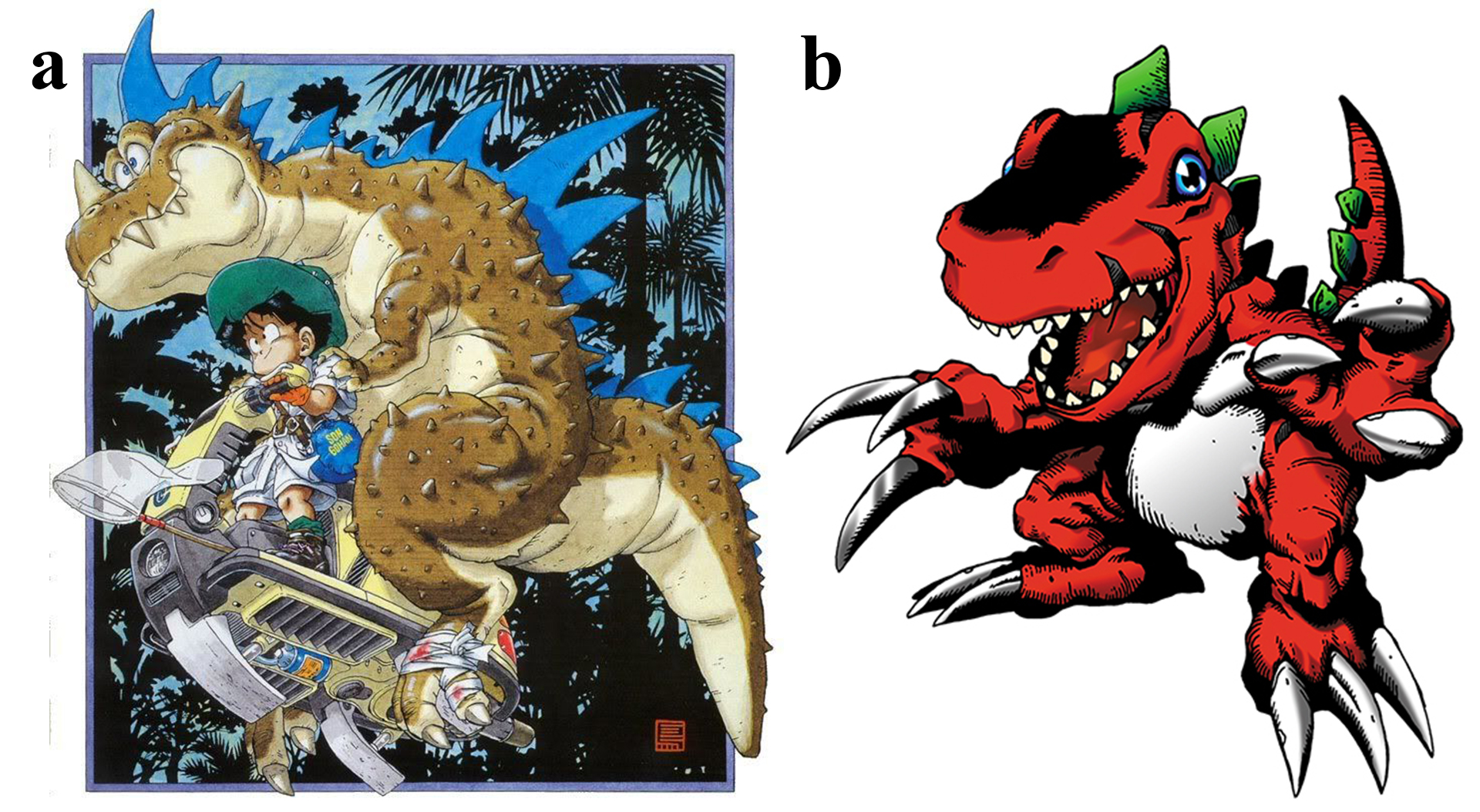
The same can be said of Tyrannosaurus rex Osborn, 1905 and its digital counterpart Tyranomon. While it is not directly stated that Tyranomon is based on tyrannosaurids, its name and general appearance seem to reference this extinct animal. Tyranomon’s original designer Kenji Watanabe (2017) details that the original concept for the Digital Monster virtual pet, from which Tyranomon originates, resided in the idea of “taking dinosaurs on a walk” (Watanabe, 2017). As we know, the dinosaur as a concept has varied greatly throughout the decades. As fossil records unearth and scientific methods refine, so does a genus of dinosaur differ greatly in appearance when compared to its first paleoart pieces (Ashworth, 2022).
In the same sense, the myth of dinosaurs has also changed in popular culture: from reptilian monsters to cartoon pets, dinosaurs fill a wide range of narrative niches (Totey, 2025). We must then consider what existed at the time of a Digimon’s creation as an indicative of its design; not just in the scientific consensus, but in the many creative interpretations of its real-world counterpart in media.

The works of Dragon Ball mangaka Akira Toriyama, for example, inspired much of the franchise’s visual style in the original anime (V Jump, 2003). Considering the mangaka’s influence in popular culture (Langit, 2024), it might be fair to say that Toriyama’s distinct visual style also signified some of the design decisions behind Digimon like Tyranomon, itself a sign of the myths surrounding its dinosaur counterpart at the time of its creation.
CONCLUSIONS
According to Barthes’ idea of modern myth, we can consider that Plesiomon is not just the outcome of repeated representations of the Loch Ness Monster in popular culture. In the Digital World, Plesiomon is the Loch Ness Monster in digital form.
While the more commonly accepted notion of human culture is that it operates in a network-like production of meaning more in tune with Peirce’s semiotics, the myths derived from the assimilation of contemporary media, technology and popular culture create the basis for the ever-evolving structure that breathes life into the Digital World. The data of the Real World can be seen as the concrete reality from which the Digital World extracts meaning, and its interpretations signified as fragments of names, designs and physiologies of living, breathing signs: Digimon.
In turn, Digimon can be seen as representations of our visual culture at determined points in time. And if history is any guide, in the future it might be possible to observe a Digimon derived from a recent event, a new cultural myth or a literary work published today.
REFERENCES
Appmon Encyclopedia. (2016) Tweetmon. Available from: https://digimon.net/appmon_en/detail.php?id=4 (Date of access: 19/Jul/2026).
Ashworth, J. (2022) Palaeoart: the history of bringing dinosaurs back to life. Available from: https://www.nhm.ac.uk/discover/palaeoart-the-history-of-bringing-dinosaurs-back-to-life.html (Date of access: 19/Jul/2026).
Babatunde, A. (2024) From Twttr to ‘X’: Twitter’s Journey as a Platform for free speech and social mobilization. The Research Conference on Communications, Information and Internet Policy, Washington, D.C.
Barrie, J.M. (1904) Peter Pan; or, The Boy Who Wouldn’t Grow Up. Duke of York’s Theatre, London.
Chicago Bears. (2013) Staley Da Bear’s Bio. Available from: https://www.chicagobears.com/news/staley-da-bear-s-bio-9593124 (Date of access: 19/Jul/2026).
Darnton, J. (1994) Loch Ness: fiction is stranger than truth. The New York Times. Available from: https://www.nytimes.com/1994/03/20/weekinreview/loch-ness-fiction-is-stranger-than-truth.html (Date of access: 19/Jul/2026).
Digimon Encyclopedia. (2015a) Hookmon. Available from: https://digimon.net/reference_en/detail.php?directory_name=hookmon (Date of access: 19/Jul/2026).
Digimon Encyclopedia. (2015b) Plesiomon. Available from: https://digimon.net/reference_en/detail.php?directory_name=plesiomon (Date of access: 19/Jul/2026).
Digimon Web. (2019) X post by @digimonweb_net. Available from: https://x.com/bandai_digimon/status/1106073811760238592 (Date of access: 19/Jul/2026).
Digimon Web. (2026a) Digimon About: Data 3 – Digital World. Available from: https://www.digimon.net/about/ (Date of access: 19/Jul/2026).
Digimon Web. (2026b) Digimon Profile: Digi-Basics: Digimon “Level”. Available from: https://digimon.net/profile/report011/ (Date of access: 19/Jul/2026).
Eco, U. (1979) A Theory of Semiotics. Indiana University Press, Bloomington.
Fowler, J. (2005) Turnip battles with pumpkin for Hallowe’en. BBC. Available from: http://news.bbc.co.uk/2/hi/uk_news/northern_ireland/4383216.stm (Date of access: 19/Jul/2026).
Hawkes, T. (2003) Structuralism and Semiotics (New Accents). 2nd Ed. Routledge, London.
Holwerda, T. (2011) The history of ‘app’ and the demise of the programmer. OS News. Available from: https://www.osnews.com/story/24882/the-history-of-app-and-the-demise-of-the-programmer/ (Date of access: 19/Jul/2026).
Inglese, F. (2016) A look into the strange world of Japanese beetle-fighting. SnapThirty. Available from: https://web.archive.org/web/20210206095019/https://snapthirty.com.au/archived/articles/a-look-into-the-strange-world-of-japanese-beetle-fighting/ (Date of access: 19/Jul/2026).
Johnson, D. & Power, D. (1974) A fresh look at Nessie. New Scientist 83: 358–359.
Langford, D. (2021) Loch Ness Monster. The Encyclopedia of Science Fiction. Available from: https://sf-encyclopedia.com/entry/loch_ness_monster (Date of access: 19/Jul/2026).
Langit, A. (2024) Akira Toriyama and his influence on pop culture. Grafis Masa Kini. Available from: https://grafismasakini.com/article/akira-toriyama-and-his-influence-on-pop-culture/en (Date of access: 20/Jul/2026).
Long, C.R. (1987) Twelve Gods of Greece and Rome. Brill, Leiden.
Melville, H. (1851) Moby Dick. Richard Bentley, London.
Peirce, C.S. (1900) Semiótica. Perspectiva, São Paulo.
Saussure, F. (1916) Curso de Linguística Geral. Payot, Paris.
Spicer, G. (1933) Is this the Loch Ness Monster? Inverness Courier 04/Aug/1933.
Totey, J. (2025) Beyond the world of ‘Jurassic Park’: pop culture dinosaurs. Writer of Pop Culture. Available from: https://writerofpop.com/2025/07/10/beyond-the-world-of-jurassic-park-pop-culture-dinosaurs/ (Date of access: 19/Jul/2026).
V Jump. (2003) TVアニメ&劇場版アニメデジモン公式超図鑑. [TV Anime & Theatrical Anime Digimon Official Super Illustrated Encyclopedia]. Shueisha, Tokyo.
Vicki. (2013) Elizabethan Ruffs. Historical Britain. Available from: https://historicalbritain.org/2013/07/22/elizabethan-ruffs/ (Date of access: 19/Jul/2026).
Watanabe, K. (2017) Watanabe Kenji Special Interview. In: Digital Monster Artbook Ver. 1~5 & 20th. Bandai, Tokyo. Pp. 168–171.
Watanabe, K. (2018) Translated Interview with Kenji Watanabe from Digital Monster 20th Anniversary Art Book. With the Will. Available from: https://withthewill.net/threads/translated-interview-with-kenji-watanabe-from-20th-anniversary-art-book.19653/ (Date of access: 19/Jul/2026).
Wikimon. (2023) Derived from livestream dedicated to Digimon Story: Cyber Sleuth Hacker’s Memory, by Habu Kazumasa, Kakudou Hiroyuki, and Watanabe Koji. X post by @RavelMonte. Available from: https://x.com/RavelMonte/status/1733603322030928155 (Date of access: 19/Jul/2026).
Wikimon. (2026a) Digimon (Species). Available from: https://wikimon.net/Digimon_(Species) (Date of access: 19/Jul/2026).
Wikimon. (2026b) Evolution. Available from: https://wikimon.net/Evolution (Date of access: 19/Jul/2026).
Acknowledgments
A special thanks to Wikimon’s team for compiling all of the images and information regarding the Digimon franchise. The Digimon franchise, including all references to the Digital Monsters media, characters and products, belong to Akiyoshi Hongo, Bandai and Toei.
About the author
Francisco Seco is a graphic designer and silly little creature with a Master’s in Graphic Design from Escola Superior de Artes e Design das Caldas da Rainha, Leiria, Portugal.