Thiago S. Ranzani da Silva
Finnish Museum of Natural History, University of Helsinki, Helsinki, Finland.
Email: tsrsilv (at) gmail (dot) com
Oh, I don’t believe in evil, I believe only in horror. In nature there is no evil, only an abundance of horror: the plagues and the blights and the ants and the maggots.
Karen Blixen in Prokosh (1984: 299)
When we think of the survival horror genre, our minds almost instinctively default to moralized threats. The primary sources of dread in these narratives are typically tied directly to human agency, ethical failure, or ideological arrogance. On one end of the spectrum, we encounter fanatical cults and demonic pacts seeking eschatological renewal through theological nihilism, exemplified by The Order in Silent Hill or the suffocating, tradition-bound sacrifices of Fatal Frame. On the other end lies the Promethean hubris of mad science playing God through bio-engineering, whether seen in the corporate greed of Resident Evil’s Umbrella Corporation, the brutal vivisections of H.G. Wells’s The Island of Doctor Moreau, or the foundational Frankensteinian obsession with conquering death through technology in Mary Shelley’s masterpiece, Frankenstein. In all these frameworks, the monsters exist because someone sinned, transgressed a divine taboo, or sought to exercise tyrannical control over the natural order, remaining fundamentally moral (Fig. 1).
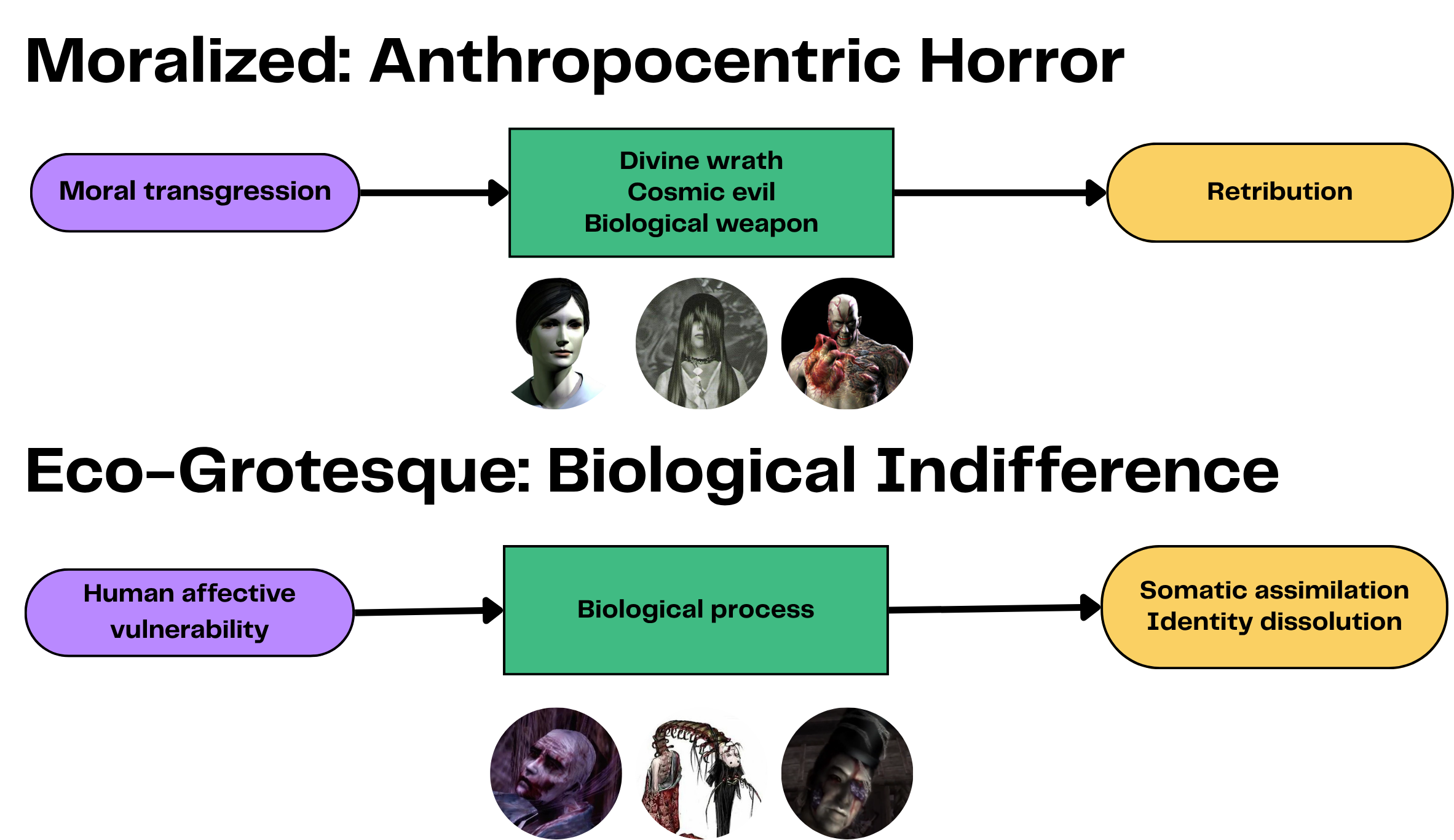
Conversely, FromSoftware’s 2004 cult classic Kuon, set within the refined aristocratic world of Heian-period Japan, operates through a very different and far more unsettling vein of dread. The nightmare of Kuon does not stem, primarily, from demonic malice, divine judgment, or human scientific vanity, but from nature itself, specifically in the form of the completely indifferent, squirming, and visceral processes of organic change (Fig. 1). Although we later discover elements reminiscent of vanity in the main antagonist, it hardly qualifies as “scientific” in the strict sense. By substituting the Manichean moral struggle between good and evil in the process of reincarnation with the ambivalent, unrelenting mechanisms of biological life, in the form of decay, digestion, parasitism, and metamorphosis, the game grounds its defiance of reincarnation as a spiritual act in eco-grotesque motifs.
In the following sections, I will argue that, by centring its primary narrative theme on the life cycle of the silkworm, Kuon strips the sacred concept of reincarnation of its traditional spiritual grace, which is frequently framed through a clean, karmic ascension of the soul, and redefines rebirth as a physical, entomological phenomenon driven by bodily intrusion, conjoining, and dehumanization. I will first briefly elaborate on how the game subverts the idea of refinement associated with the Heian period and with the silk itself. After that, I will juxtapose rebirth as a transcendental process with its bodily counterpart in the game, grounding my arguments in Julia Kristeva’s concept of the abject. Finally, I will close the essay with a brief commentary on nature’s indifference to human morality and its karmic requirements for spiritual transcendence.
THE BEAUTY AND THE BUG: Subverting Heian aesthetics
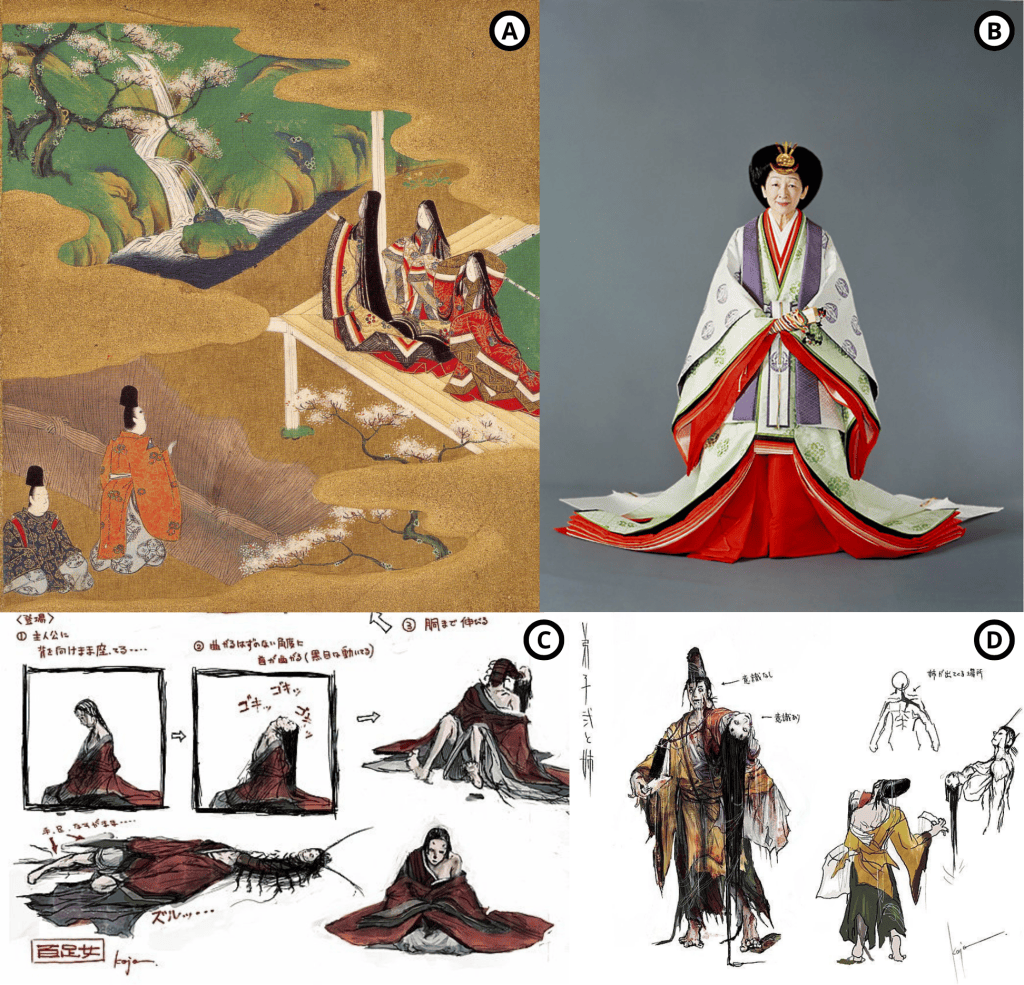
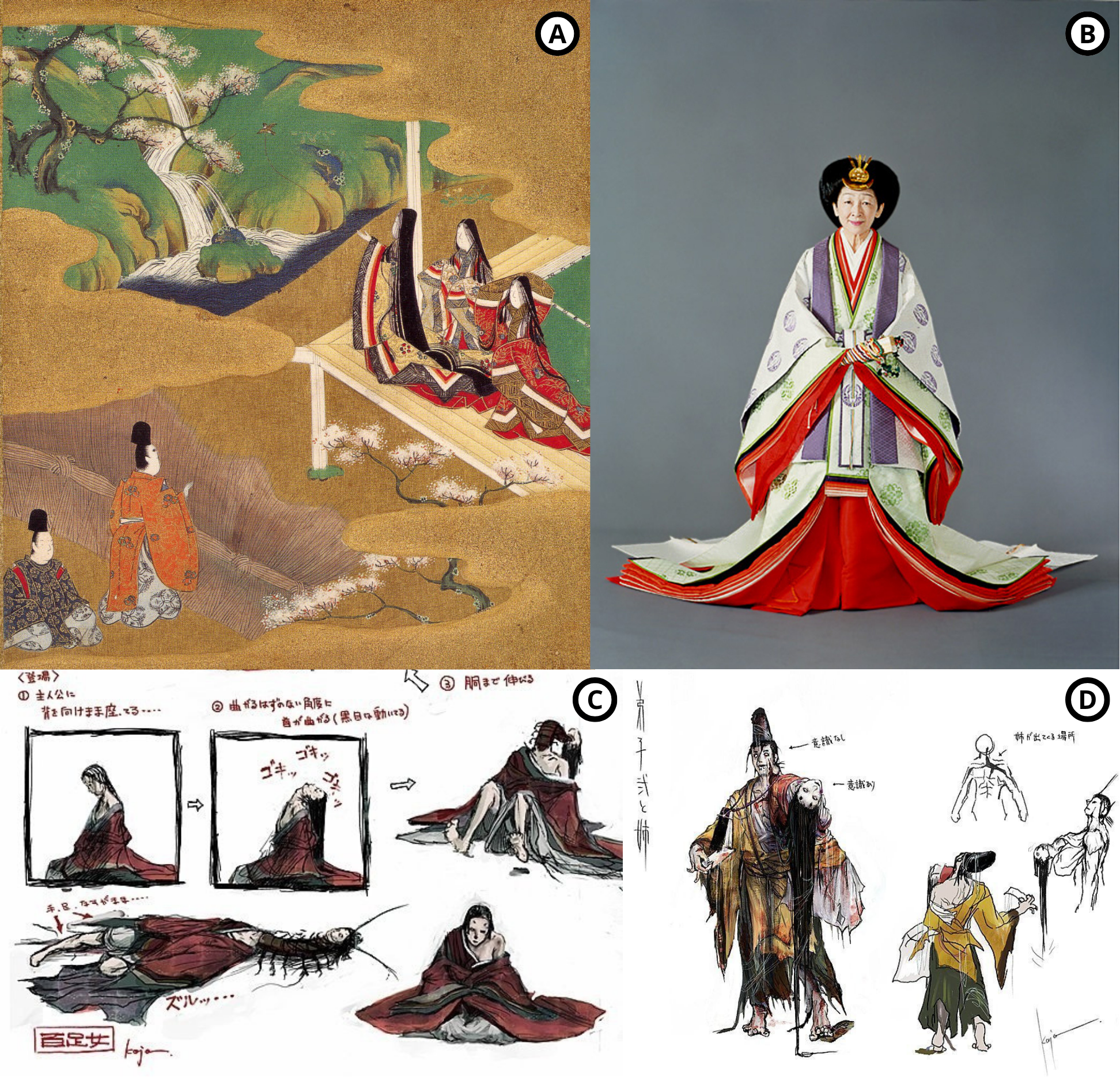
The Heian period (794–1185 CE) is celebrated in Japanese historical memory as an era defined by transcendent artistic refinement, courtly elegance, and an obsession with aesthetic perfection (Shively & MacCullough, 1999). It was a culture concerned with sensory harmony, manifested in everything from intricate layered kimonos (jūnihitoe) to poetic appreciation for the impermanence of things (mono no aware) (Fig. 2A,B). At the pinnacle of this material sophistication was silk, considered to be the ultimate symbol of noble status, delicate beauty, and human mastery over raw, unrefined nature (Shively & MacCullough, 1999). The silk-weaving industry flourished in centres like Kyoto, driven by sophisticated techniques introduced by naturalized immigrant groups such as the Hata-shi (Hata Clan). These methods laid the foundation for legendary textile traditions like Nishijin-ori (Nishijin brocade), solidifying silk as a pristine canvas of Japanese high culture (Hareven, 2003; Dusenbury, 2004).
Interestingly, in a rupture movement, Kuon takes this cultural symbol and drags it violently back into the dirt, stripping away its aristocratic glamour to expose the writhing reality of its origins. Before silk becomes a lustrous robe, it is an agricultural by-product born of the silkworm’s voracious appetite. Sericulture relies on methodical, industrial slaughter and biological containment: larvae feed continuously on mulberry leaves, spin protective cocoons from their own silk glands, and are then boiled alive inside their casings so humans can unravel intact threads without the emerging moth breaking the fibres. By grounding its horror in the real-world procedures of sericulture, the game forces a collision between human artistry and entomological viscerality.
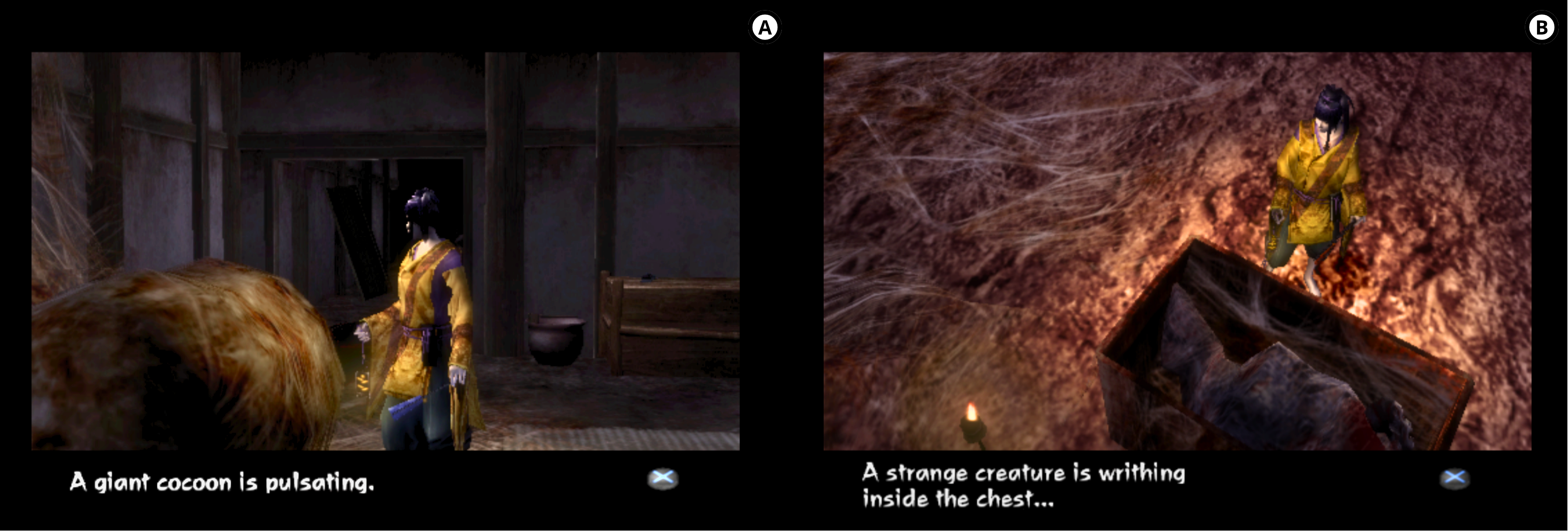
In Kuon, however, humans are no longer the master artisans harvesting silk for high fashion, but instead, they become the raw, passive host material consumed and cocooned by the insects. Throughout the game’s setting (the decaying Fujiwara Manor), silk is no longer experienced as a smooth, luxurious garment. It becomes a wet, sticky, suffocating web of entrapment and desubjectivation (Fig. 2C,D). Bodies merge and transform through grotesque entanglements, forcing human individuality into a boundary-less duality. This desubjectivation process also extends to the non-human: the aristocratic manor, once a bastion of human order and artistic refinement, becomes visibly subsumed by organic infestation. Elegant shoji screens are choked by pale, fibrous webbing; tatami mats rot beneath pools of dark fluids; and the architectural symmetry of high court life gives way to the chaotic, labyrinthine structure of an insect nest.
Both bodily and environmental degradation emphasize the game’s aesthetic subversion. The horror in Kuon operates by weaponizing the contrast between Heian refinement and biologically repulsive excess. The material that once represented courtly status and delicate art becomes a symbol of parasitic consumption, forcing players to first wander through corridors where high-class textiles are tainted by the grotesqueness of biological materiality (blood, organic filth, and misshapen beings) and, later, to wander through underground areas with squirming larvae, liquefying bodies, and meaty structures.
Through these operations, Kuon exposes the uncanny tension between human civilization’s desire for a lasting, idealized beauty and nature’s unstoppable urge to consume, rot, and transform.
THE KUON RITUAL: Corrupt reincarnation as metamorphosis
The game’s narrative core lies in the Kuon Ritual (or Kuon Spell, written as 九怨 in its original Japanese), a taboo technique designed to cheat mortality and grant rebirth. To execute it, a practitioner must seal two living, dying, or deceased bodies inside a large wicker chest alongside thousands of hungry silkworms. As the caterpillars consume the soft tissue of both hosts, they bind the flesh, blood, and lingering spirits together into a singular, pulsating cocoon. If the practitioner repeats this process through nine distinct cycles, they are promised rebirth into a perfected, immortal body.
In traditional East Asian philosophical, folk, and religious traditions, ranging from institutional Buddhist karmic cycles (Lin & Yen, 2015) to syncretic belief systems like Taiwan’s Yiguandao (Billioud, 2016), reincarnation is fundamentally understood as an immaterial, transcendent process (Fig. 3: top). The soul, refined or burdened by moral actions in life, sheds the physical body like worn-out clothing to transition into a new state of being. Kuon, however, perverts this spiritual grace into what can be described as “corrupt reincarnation”, stripping reincarnation away from the mechanisms of spiritual ascension and replacing it with crude, wet biological fusion (Fig. 3: bottom). Ironically (or not), similar themes appear in other FromSoftware titles, such as the infested Senpou monks and creatures of Sekiro: Shadows Die Twice, parasitized by giant centipedes that granted them a “corrupt immortality”. In Sekiro: Shadows Die Twice, these centipedes are manifestations of “uncleanliness” or “defilement” (a concept from Shinto known as kegare, 汚れ; Namihira, 1987) that came into existence from the stagnant waters that flowed from the Divine Dragon’s perch and pooled in Ashina.
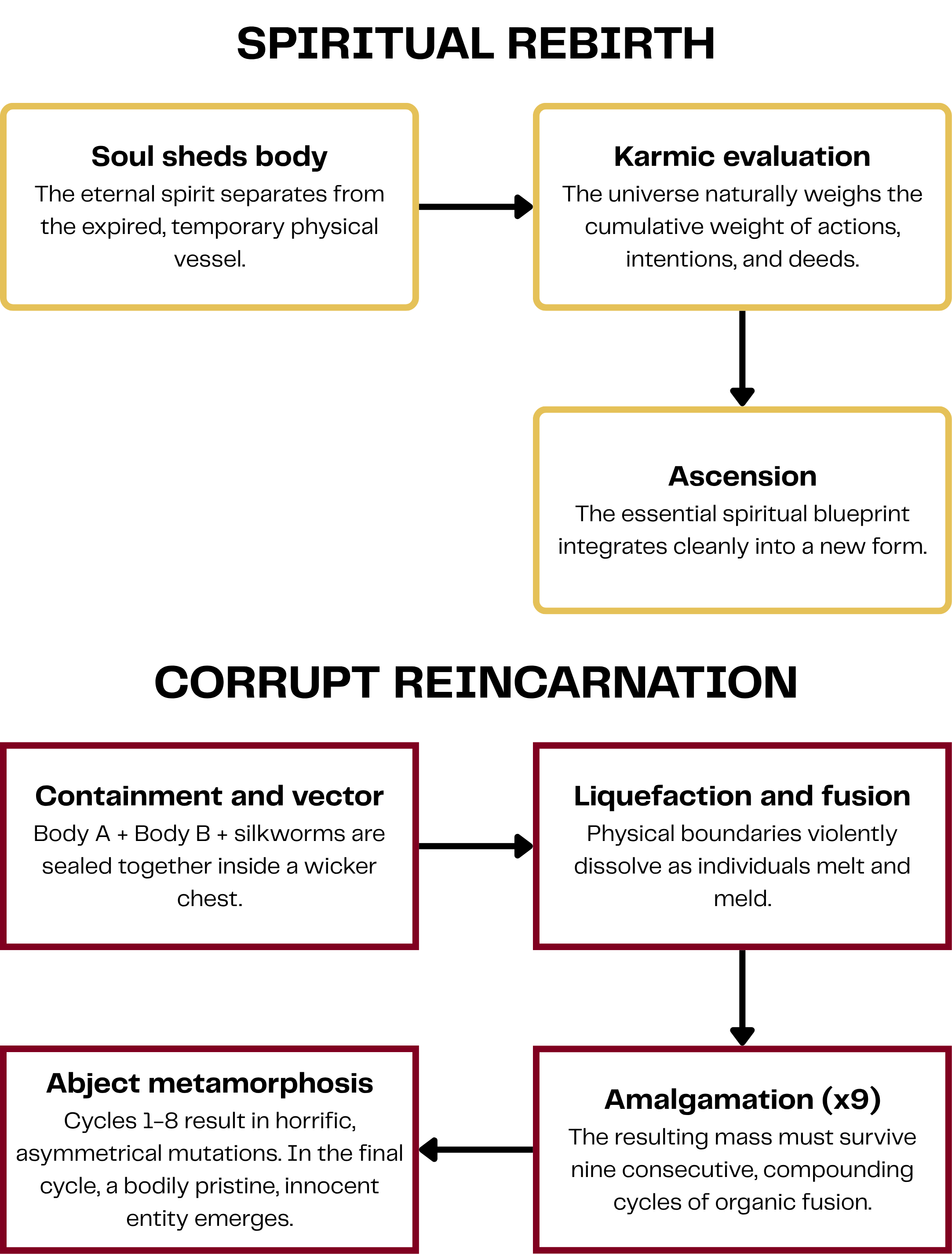
In those cases, and more specifically in Kuon, rebirth is stripped of spiritual ascension and replaced with pure biological fusion through three distinct, but interrelated processes: (i) identity dissolution, where two distinct individuals are forcibly melted into a single biological amalgam, rather than a soul transcending from the material realm; (ii) body mulch, where human bodies are no longer treated as sacred temples or vessels for the soul, but are reduced to host material and substrate for larvae; and (iii) entomological metamorphosis, where rebirth is not a gradual process of spiritual cycling, but an aggressive, viscous organic metamorphosis akin to a caterpillar transforming itself inside a cocoon. The structural differences between traditional karmic ascension and Kuon’s biological perversion are summarized in Table 1.

This perversion of rebirth finds its theoretical anchor in Julia Kristeva’s concept of the abject (Kristeva, 1982). Abjection, for Kristeva, arises when an individual is confronted with their repressed, raw “corporeal reality”, or, in Lacanian terms, when the terrifying void of the Real violently intrudes upon the Symbolic order. Here, the abject occupies a traumatic middle ground, existing in the liminality between ‘subject’ and ‘object’ and disturbing social reason, human dignity, and cultural taboos (Childers & Hentzi, 1995). In Kuon, the silkworm cocoon becomes the fundamental site of abjection by blurring the vital boundaries that some human societies work so tirelessly to maintain: life and death, self and other, and human culture and natural phenomena (Fig. 4). Through the silkworm motif, the game transforms the desire for immortality into the utter loss of individual humanity by reducing the sacred promise of eternal life to a messy entomological fusion of rotting flesh and writhing worms. Reincarnation, thus, is subverted by no longer being a promise of spiritual salvation, but a descent into biological horror.
ON NATURE’S INDIFFERENCE TO KARMIC TRANSCENDENCE
The subversion of rebirth in Kuon ultimately returns to Karen Blixen’s diagnosis of non-human reality (Prokosch, 1984: 299). Standard survival horror tropes frequently position biological mutation or cosmic infestation as an explicitly punitive force, like a moral reckoning visited upon arrogant individuals or corrupt societies. As argued, Kuon decouples bodily horror from ethical retribution. The tragic characters driving the narrative, such as Doman and his daughters, are not necessarily archetypal villains that pursue destruction or domination out of sheer malevolence. Instead, they are impelled by human, affective vulnerabilities, such as grief, sororal devotion, pathological inferiority, and an obsession with immortality.
As argued before, within traditional East Asian soteriological frameworks, overcoming mortality and achieving rebirth or karmic elevation requires moral purification, spiritual discipline, and alignment with cosmic order. The Kuon Ritual, instead, bypasses these ethical and moral imperatives completely, and substitutes spiritual cultivation with the material exploitation of the silk-work. The resulting horror arises from the complete rupture between human moral expectations and the natural world’s absolute, procedural indifference.
The silkworm functions without intent, malice, or moral discernment. It operates entirely within its biological imperative, which is to feed, metabolize, secrete silk, and undergo metamorphosis. The organism remains indifferent whether its substrate is mulberry leaves or human remains. Within the logic of the game, the Kuon Ritual functions precisely because natural processes are unburdened by human constructs of karma, justice, or dignity. The silkworm does not evaluate the spiritual purity or moral standing of the bodies sealed inside the wicker chest. It merely consumes the organic substrate provided to it. When Doman attempts to “hijack” these biological mechanisms to force an artificial immortality, nature does not respond with theatrical wrath or moral judgment. There is no divine fire, brimstone, or spiritual condemnation. On the contrary, nature responds with passive, metabolic assimilation. The human subject —along with its grief, memories, and identity— is simply absorbed, incorporated, and rewoven into fluid, silk, and fused flesh.
Kuon exposes the fragility of human morality masterfully by framing reincarnation as a physical process mediated by hungry larvae, destabilizing every single preconception of how immortality can be attained and what it represents. The true horror of the game lies in the revelation that life is not structured around human ethics, nor does it care about preserving human subjectification. In the face of nature’s relentless biological cycles, human grief and spiritual aspirations are reduced to organic matter, destined to be digested, encased, and transformed by an indifferent other.
CONCLUSION
Kuon remains one of survival horror’s most unsettling titles because it understands that the most profound terror often comes from biological materiality. It shifts the survival horror paradigm away from human morality and transforms a sacred journey of the soul into an exercise in eco-grotesque body horror. By wrapping its tale of grief, desire, and rebirth in the silkworm’s visceral life cycle, the game shows that we don’t need monsters from hell to feel true horror. We only need to look at the terrifying indifference of the natural world and remember how easily human identity can be unravelled, spun, and rewoven into something else.
REFERENCES
Billioud, S. (2016) Yiguandao’s patriarch Zhang Tianran: hagiography, deification, and production of charisma in a modern religious organization. In: Ownby, D.; Goossaert, V.; Zhe, J. (Eds.) Making Saints in Modern China. Oxford University Press, Oxford. Pp. 209–240.
Childers, J.W. & Hentzi, G. (1995) The Columbia Dictionary of Modern Literary and Cultural Criticism. Columbia University Press, New York.
Dusenbury, M.M. (2004) Flowers, Dragons, and Pine Trees: Asian textiles in the Spencer Museum of Art. Hudson Hills Press, Easthampton.
Hareven, T. (2003) The Silk Weavers of Kyoto: Family and work in a changing traditional industry. University of California Press, Los Angeles.
Kristeva, J. (1982) Powers of Horror: An essay on Abjection. Columbia University Press, New York.
Lin, C.T. & Yen, W.H. (2015) On the naturalization of karma and rebirth. International Journal of Dharma Studies 3: 6.
Namihira, E. (1987) Pollution in the folk belief system. Current Anthropology 28(4): S65–S74.
Prokosch, F. (1984) Voices: A Memoir. Farrar, Straus & Giroux, New York.
Shively, D.H. & MacCullough, W.H. (1999) The Cambridge History of Japan. Volume 2: Heian Japan. Cambridge University Press, Cambridge.
Acknowledgements
This work was partly supported by using Grammarly (for grammar and style) and Google Gemini (to improve text coherence and cohesion). The author reviewed and modified the text to minimise circular reasoning and overtly repetitive bridges, taking full responsibility for the manuscript’s final content.
About the author
Dr Thiago Silva is a Brazilian researcher working at the intersection of biology, technology, and humanities. A neurodivergent geek (Autistic, level 2 support), he explores how technological innovations in biology (e.g., standards, data models and infrastructures, digitisation initiatives) are instrumentalised as “technologies of power”. As an avid gamer, reader, and writer, he wanders through the liminal spaces where “the others” gather, thinking about horror, rot, and decay, and how they manifest in fantastic worlds. For him, monsters are incomprehensible witnesses to a rupture in the world’s logic and not catalogable antagonists.