Interview with Charlene Putney, Martin Pichlmair, and Florian Verdier
Video games can be classified into various categories, following different systems. Academics typically use divisions that are foreign to most players and even to people who work in the industry (Apperley, 2006). Most people will familiar with the market/media categorization based on core gameplay mechanics, such as ‘shooter’ or ‘strategy’, forming the so-called game genres (Manocha, 2023). However, genre boundaries can be muddy and many games can often blur categories (Clarke et al., 2015). Notably, game genres differ from film and literary genres such as sci-fi or fantasy, because games require the active participation of the player (Wolf, 2008).
Still, literary categories can be borrowed and used in tandem with game genres, such as a ‘sci-fi shooter’ or a ‘fantasy RPG’. That is because setting, narrative, and aesthetics are important factors in whether players decide to devote hours to one game or another. In addition, ‘subgenres’ or even impromptu categories can be used for classification, to further differentiate a game and attract players with different preferences. And thus, we come to our new “genre” of interest, bird games.
While there are many games featuring notable birds (e.g. the Pokémon and The Legend of Zelda franchises), the surge in games explicitly built around birds is perhaps a more recent phenomenon in the long history of video games. This is curious because, outside gaming, birds are the wild animals that the majority of people have the most daily contact with. Depending on where you live, you will see plenty of pigeons, corvids, gulls, sparrows, thrushes, and/or starlings on a daily basis, during your commute or just outside your window at home. In fact, fascination with birds brings lots of people together through the hobbies of birdwatching and bird photography (Tomotani & Salvador, 2016), and many people feed birds in their gardens (Reynolds et al., 2017).
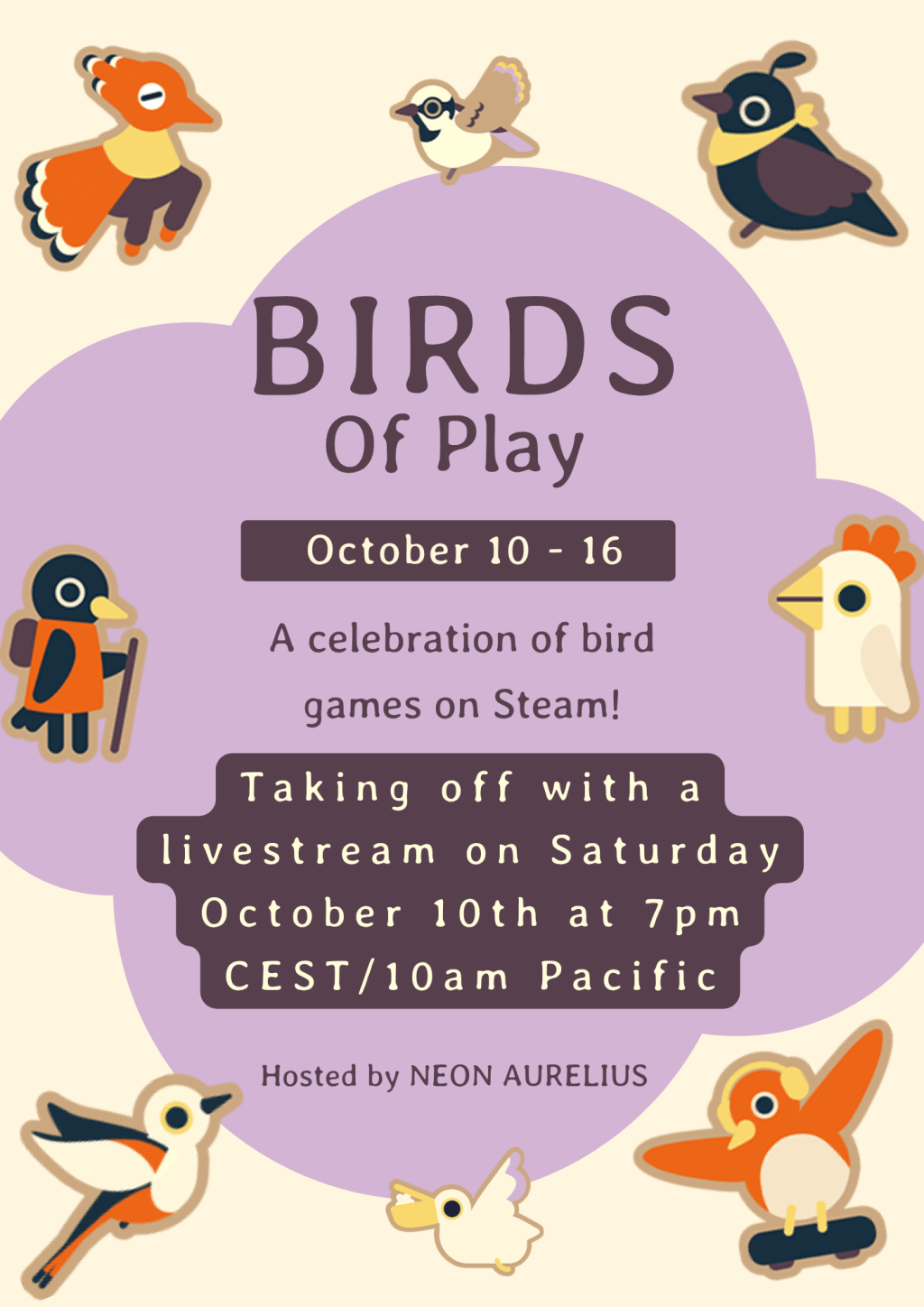
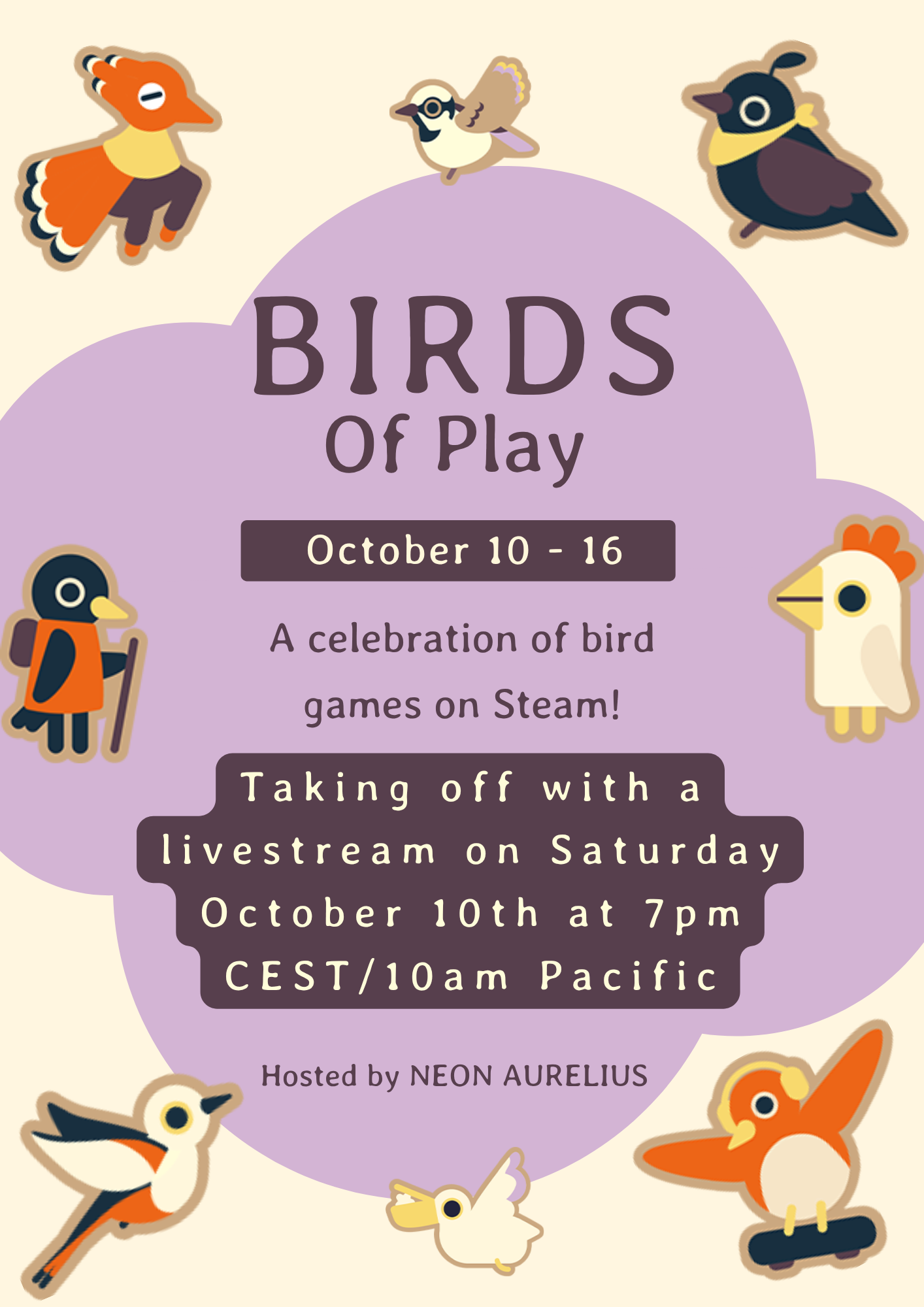
So, why couldn’t this love of birds also bring gamers together? Enter ‘Birds of Play’, a Steam event that showcased “140 participating bird games dedicated to our feathered friends!”, as the program advertised. It took place from October 10 to 16, 2026, and was led by game developers Charlene Putney and Martin Pichlmair, from NEON AURELIUS studio, alongside science consultant and bird nerd Florian Verdier. During the event, games were divided into four somewhat self-explanatory categories (Be a Bird, Birds on the Case, Birdwatching, Weird Birds) and there were discounts, Q&As with game devs, new demos, and updates regarding bird games.
We interviewed Charlene, Martin, and Florian to discover more about the event, from the story behind it to more bird-centric and nerdy questions.
Let us start at the beginning: how the idea for Birds of Play was born and how this collaboration came about?
Charlene: The initial idea for this event came from noticing how many bird games there are out there at the moment—it feels like a strong time for birds in entertainment! I had been applying our game Sparrow Warfare to festivals and events and found that the best response was when we were in an event (for example, the “Games from Ireland” event was great for us!). So, I had the idea to run a bird-focused Steam event that could showcase both our own game and the other bird games out there.
Florian: As for me, I’m a latecomer to the party. I get to follow a lot of indie game studios in social media (French ones, of course), but also others (especially when they talk about animals). I can’t remember exactly how I started following Sparrow Warfare. Maybe it was last year during the Steam festival featuring animal-themed games. But you should know that I do a lot of monitoring for my animal-focused chronicles called “Game of Faune”, where I discuss the representation of animals in video games. This research gives me ideas for topics to explore.
I had previously spoken with Charlene and I kept following the studio’s work until the announcement of Birds of Play. From there, I reached out to Charlene to offer my help, and she accepted right away. I remember her saying something like, “We couldn’t have done this without an expert like you” (that was wholesome from her), so I guess she was going to reach out to me anyway. Plus, some people who know me well on social media sent me DMs to let me know about it too—there was no way I could’ve missed it.
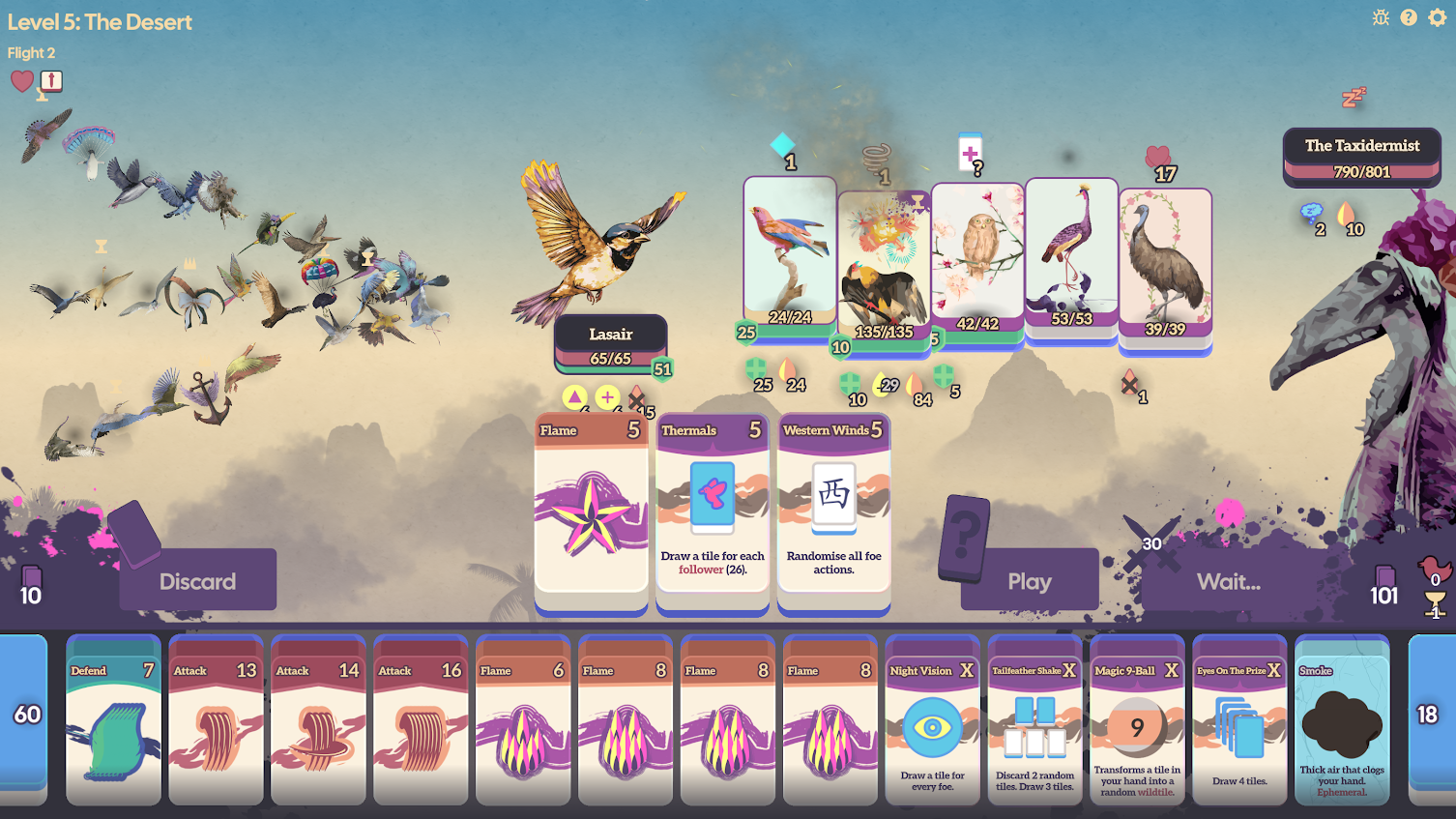
Was Birds of Play conceived primarily as a celebration of bird games, or as a way to create a community around a niche interest?
Charlene: A celebration of bird games!
Martin: A community around bird games! (I’m half joking but at the same time I believe it’s a theme that deserves a festival to bring all these games together.)
Florian: I doubt I have anything better to say.
Why do you think there are so many new games about birds? Are birds the new cats?
Charlene: I think people really love birds, and when we get the chance to appreciate them, we do! I used to be the secretary for BirdWatch Ireland a long, long time ago, and I remember then realising that the love of birds is present in many people from all walks of life.
Florian: Hmm…that’s a tough question. No, birds haven’t, in my opinion, become the new cats. However, over the past few years, we’ve seen a resurgence of games centred on birds, and I would say that trend has really picked up speed in the last few months. All of this is summarized by the increasing presence of “birding games” (as I’m calling them for now) which are games that simulate birdwatching in nature. At this festival alone, we have several titles that follow this trend, such as Flock Around and Feather Trails, of which I have been following the development for a few years now. And I think this trend will not stop there.
After curating 140 bird games for Birds of Play, have you noticed any patterns in how game developers depict birds?
Charlene: There is a huge group of folks who depict birds mostly in the “cute” category. Then there are the ones who use birds as a symbolism for “wise” or “sly” also.
Martin: And of course, some birds are used for the symbolism that they stand for, especially ravens and crows seem to often come with mysterious powers.
Florian: It’s hard to answer that question. At least from a mechanical point of view, as all games are built differently. On the other hand (and this might sound a little silly), all games featuring birds are made by people who are fascinated by birds. They are rarely ornithologists though, just people who are passionate about them, watch them, or sometimes have personal stories to tell.
But I think that’s true of a great part of games involving animals. I would love for it to go even further, which would give us even more exceptional portrayals, but is that necessary to make good (or even great) games? I don’t think so. That’s what I call “folklore,” and it’s exactly what Martin and Charlene are saying. Using a stereotypical image as the basis for your narrative or systems, which can be both a good thing and a bad thing. The problem isn’t so much with birds as it is with animals that are truly unloved; it’s a vicious cycle.
Which bird species (or higher taxon, like genus or family) seems to be the most popular in games, and are there any unexpectedly underrepresented birds?
Charlene: I’m not sure there is one! In the course of the curation I have seen so many different types of birds—I don’t think there is one overwhelming type, or an underrepresented one. Perhaps crows are the most popular overall.
Martin: I think flightless birds like ostriches are rare (outside Final Fantasy).
Florian: I agree with Charlene about corvids (especially crows and ravens). There’s a real love between game developers (especially those of cozy games) and this family of birds.
As surprising as it may seem, chickens, roosters, and other barnyard birds also seem well-represented to me, though I’m not quite sure why yet. They are mostly featured in games where the “fun” is immediate, such as party games or games with fast-paced rounds. Could an unconscious “Zelda bias” play a role in this representation? Does the animal’s proximity to people contribute to its presence in games? Possibly. Proximity to the public may also be a key factor in the presence of bird families. This is typically the case for pigeons and seagulls.
There was a time when the penguins were also on this list. And I think they have been making a strong comeback over the past two or three years.
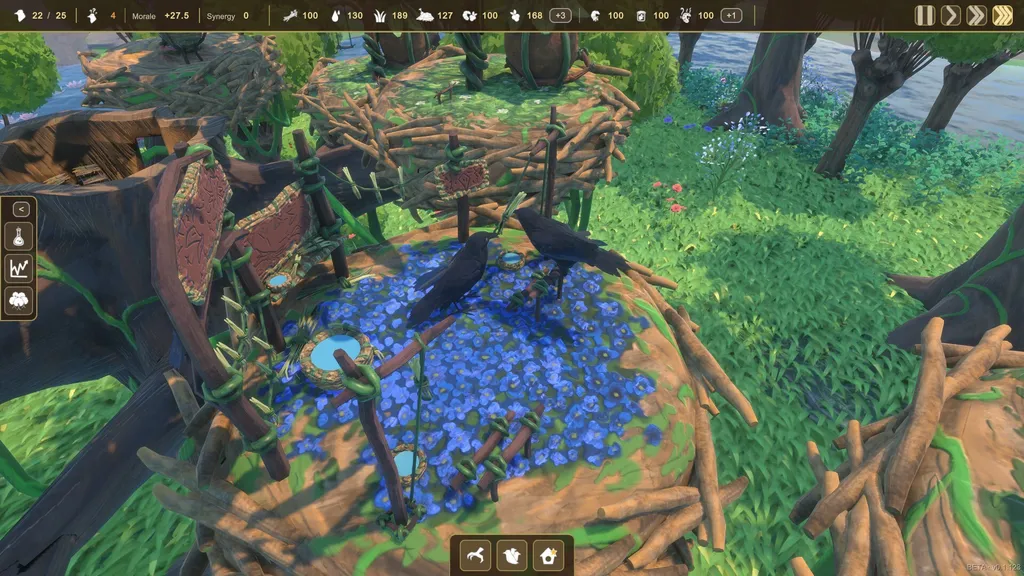
What was the strangest or most innovative use of birds as a gameplay mechanic that you encountered while curating games for Birds of Play?
Charlene: The most surprising and fun thing was how many games there are based around bird detectives!
Martin: I have no explanation for this either. Never seen a bird detective out in the wild.
Florian: Bird detectives are definitely a thing and I also don’t know why. Is it because some birds are really intelligent? But I don’t think so, as a great number of birds that play detective roles aren’t well known for their cognitive abilities…
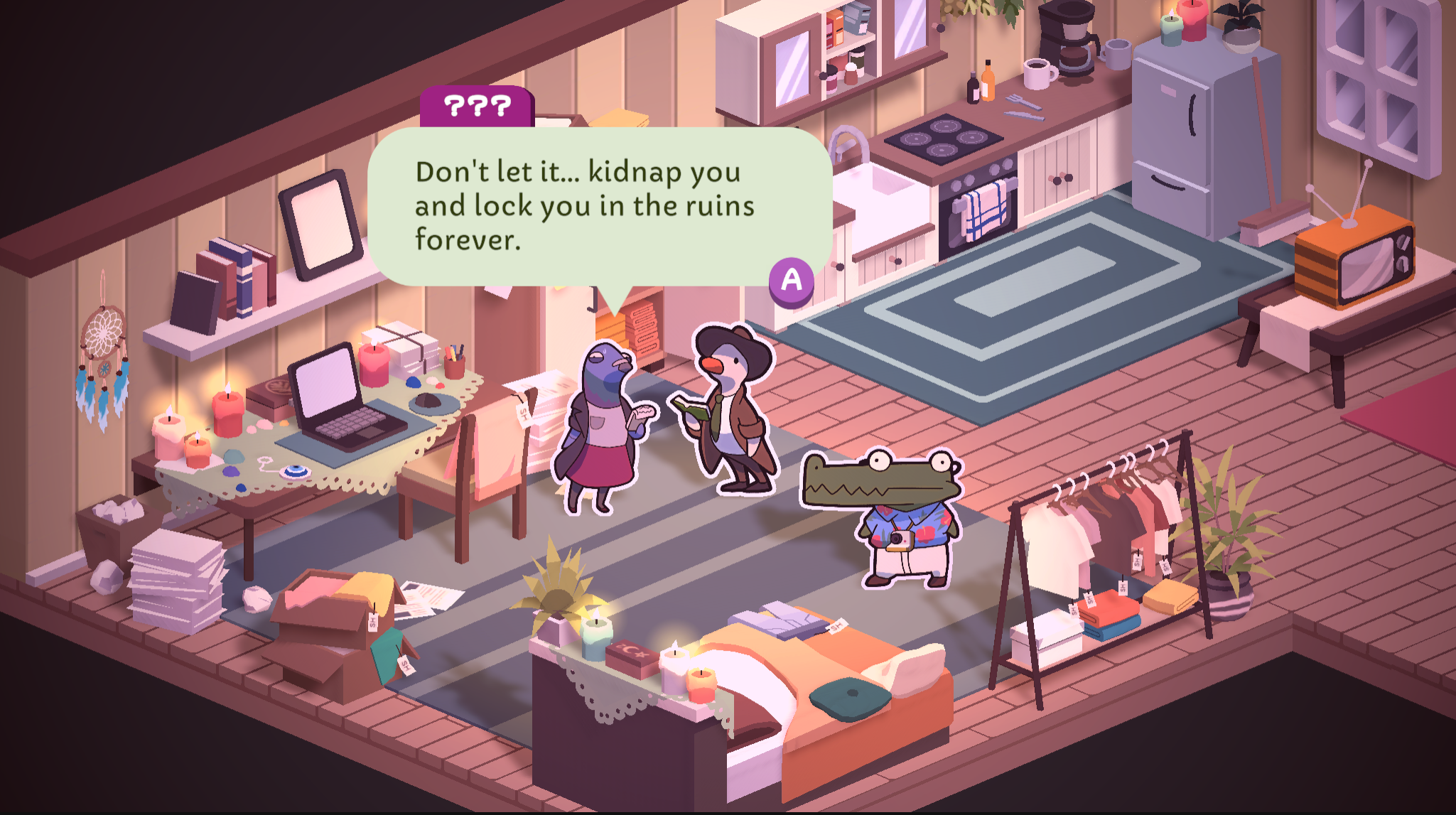
What do bird protagonists allow game designers to do that human (and mammalian) protagonists cannot?
Charlene: The most obvious answer here is ‘to fly’! And I think this carries over to all kinds of uses: thinking outside the box, flying free with emotions, widening perspective.
Martin: There’s also a rich layer of stories, anecdotes, and associations we have with birds that makes it easy to associate a bird with something specific. A magpie supposedly is a little rogue (except if it’s an Australian one—then they are organised crime) and you can just make a game about that and everyone will be able to get it immediately. Stereotyping is kind of okay with birds, and comes with much more implications when we’re talking about humans.
Florian: Flying is just the tip of the iceberg. It’s now up to the developers to work out how to incorporate other characteristics into their game. The more they know about birds, the more extraordinary the creative potential becomes. And as an ornithologist, I’m already dreaming of seeing some of these games come to life (laughs)! (If you want to hire me…)
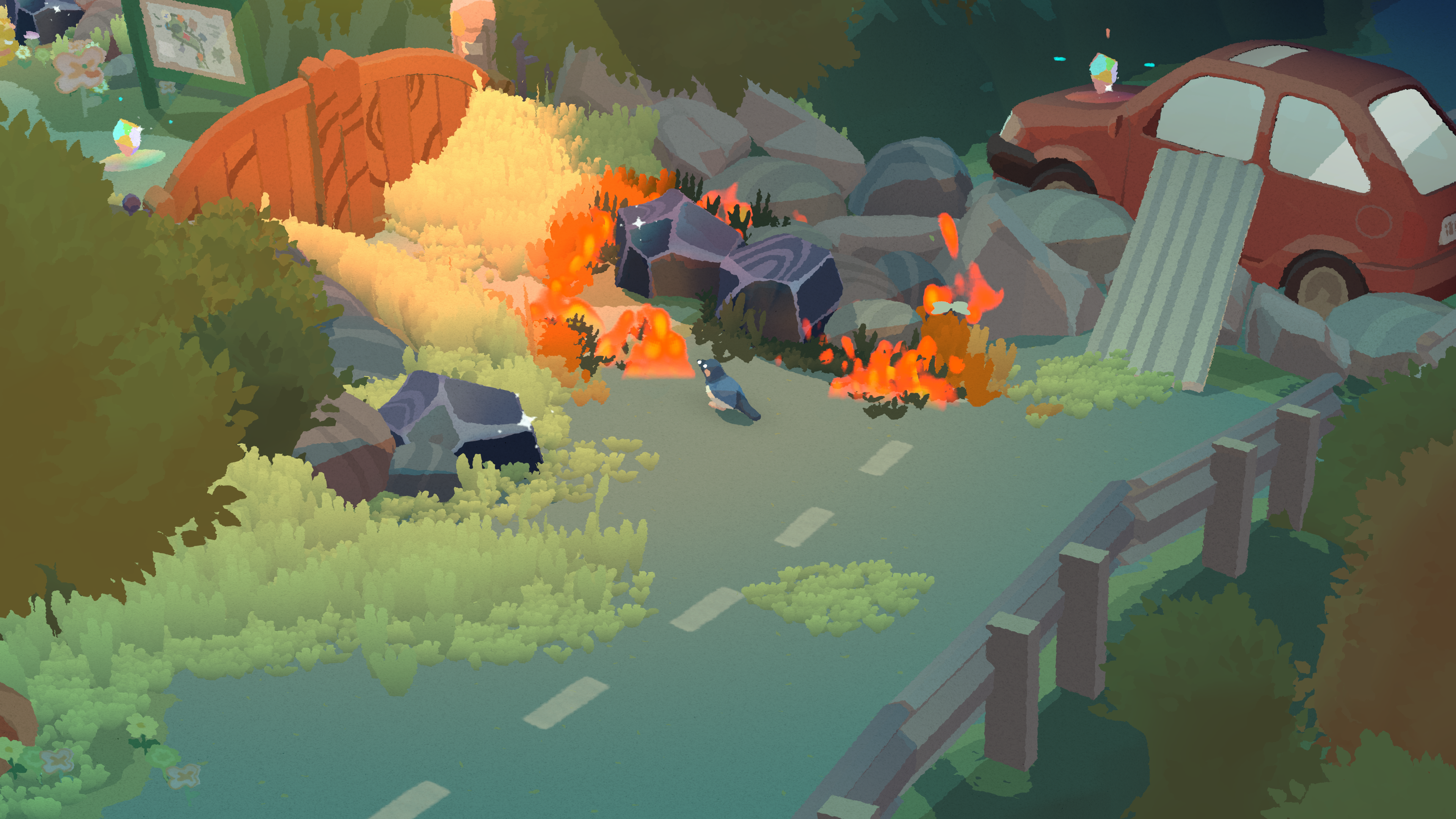
What are the biggest design challenges involved in making bird-centred gameplay interesting?
Charlene: At least from our perspective, I think the challenge is not in making the gameplay interesting but in making the bird animations feel juicy!
Martin: I think that bird flight is uniquely fascinating to humans. From Da Vinci onwards people tried to imitate this magical mode of transportation. And a lot of video games (including some I’ve worked on) try to translate the elegance of bird flight to player movement. It’s hard but something that a whole game can be built around.
Florian: I think it depends on each game. Sometimes it’s a matter of character distribution, sometimes a narrative choice, and sometimes a reflection on the game mechanics. It can also have to do with the artistic direction, the depiction of birds, or even the way the game juggles between reality and fiction. To sum it up: each game is unique and has its own challenges.
Birds are perhaps the most visible wildlife species in urban environments. Do you think games offer a way to reconnect players with nature that they may otherwise overlook?
Charlene: I hope so! Martin and I spend a lot of time out at the lakes in Copenhagen with our bird friends, and they inspired us to make our game. I hope seeing and hearing birds in games inspires people to go outside and appreciate the beautiful world of nature all around them.
Florian: Absolutely. The only problem is reconnecting on a large scale. That’s what’s currently missing in video games when it comes to environmental issues. The actions are personal but difficult to extend to a wider audience. But this problem is by no means unique to video games.
In the past few years, there has been an increase in the number of birdwatchers, especially Gen Z (Bantock, 2026). People have even suggested there is a link to growing up with the likes of Pokémon GO (Pancia, 2025). Do you think now this is going the other way around and attracting people to bird games?
Charlene: I’m not sure about this one, the amount of games we curated that are focused on collection in this way is pretty small.
Florian: The more I look into the links between ornithology and video games, the less convinced I am that there’s a connection between Pokémon GO and an interest in ornithology. It may well have been the starting point for some people, but to suggest that it led to a 66% increase in the Gen Z birds and a whopping 216% increase in the number of millennial birdwatchers in the UK in eight years… that would be really surprising.
As for the reverse… again, I doubt it’s relevant. Video games are an extremely complex world to unpick and get to grips with, and I don’t think there’s any need to draw people from the real world into the virtual one for that purpose. (That purpose being ornithology.) Maybe for a kind of educational purpose (like ringing birds with a VR Game, for theoretical basis), but for other stuff, I don’t think that will be relevant.
Have any ornithological or birdwatching society, or conservation groups shown interest in the Birds of Play event?
Charlene: Yes, we have been covered in Ornithomedia thanks to Florian, and BirdWatch Ireland told their members about it too.
Florian: It’s SO complicated to interest birdwatching society on such things. That’s a bit discouraging sometimes…
Do you think bird-themed games can increase public awareness of and care for bird conservation issues? And could such games function as “gateways” into real-world birdwatching or citizen science activities such as eBird or iNaturalist?
Charlene: I’d hope so! In the case of some of the games in the event, these are prime considerations for them.
Martin: I think one of the most beautiful things about games is that they allow you to learn something without being explicitly taught. So, yes, I do hope the games in our festival lure people to topics around birds, their conservation, and the importance of protecting our environment.
Florian: Oh, that’s exactly what we’re hoping for! But on the other hand, I have shown previously that the interest in nature shown in a video game or through video games doesn’t seem, for the time being, to be translating into reality. But… is that really necessary?
In recent years, the number of sighting records on eBird and iNaturalist has skyrocketed. The principle is simple: people go for walks in the countryside and record all the birds they see or hear. Some people view this as a proper game, complete with its own rules, environment, mechanics and randomness. Whilst we cannot strictly call it a video game, it is interesting to see how the emergence of these lists is transforming people’s habits and interests. Pokémon GO paved the way a few years ago, and many researchers have tried to find the magic formula… which may well have been right under our noses all along.
Now, should we make these lists even more game-like, with reward systems, for example? But wouldn’t thinking about it in this way ultimately amount to a form of betrayal in the name of playfulness? And how can we avoid problematic behaviours (competition, disrespect for nature) that already exist to some extent? This will be a real challenge.
One thing is certain: we are at a turning point. Birdwatching is attracting more and more people, particularly young people. We cannot miss this opportunity.
If after participating in the Birds of Play event, a player became curious about birds in real life, where would you suggest them to start?
Charlene: With a walk outside! And then, with the Cornell Lab Bird Academy—Martin and I did a wonderful “Intro to Drawing Birds” class online with them that taught us so much.
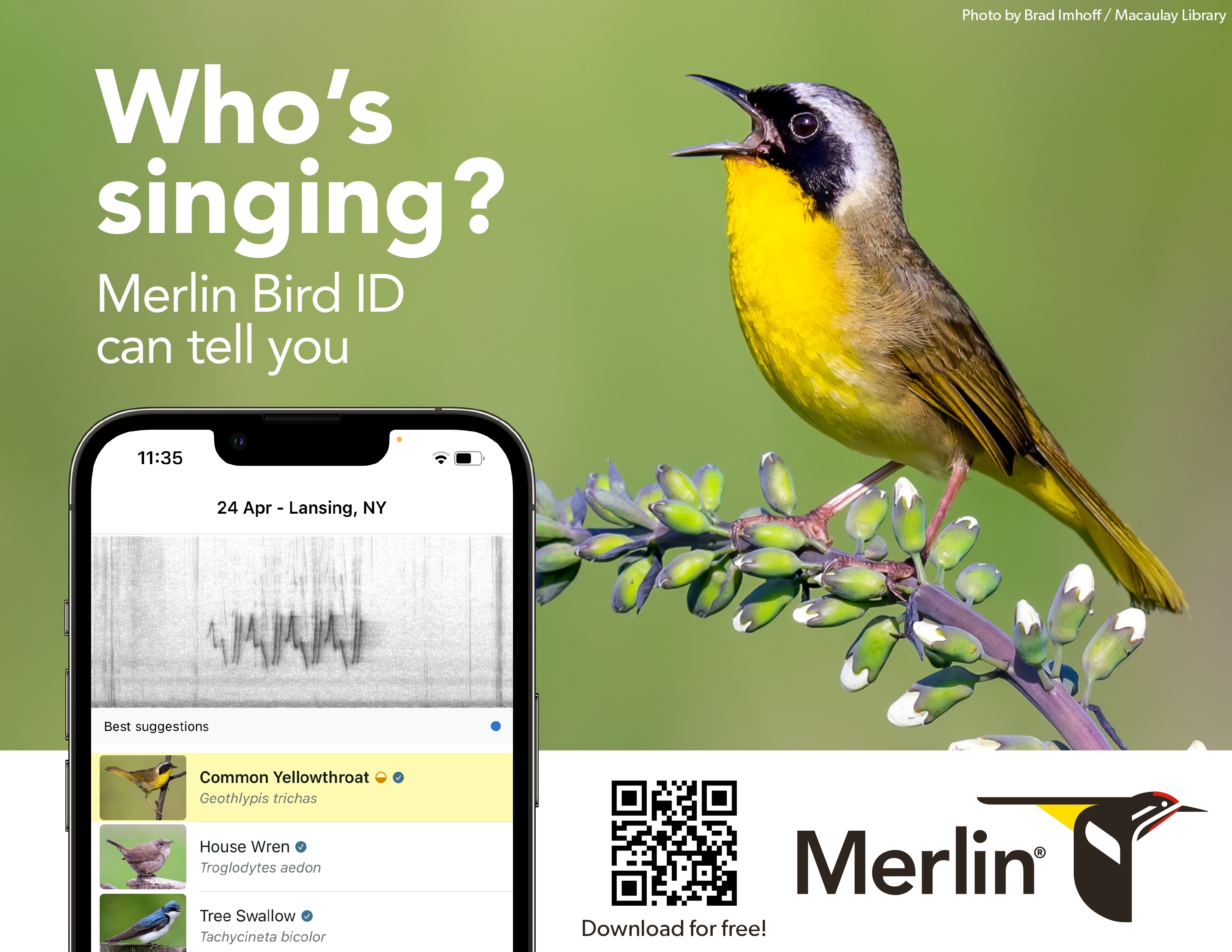
Martin: There’s also a wonderful free app from the same lab that lets you identify bird calls so you can easily recognise the birds around you.
Florian: I’m joining Charlene and Martin, but keep in mind that birdwatching is very complex. At first, if all you see are pigeons and crows, that’s perfectly normal! We’ve all started out that way, and it’s by going out more and more that you’ll learn to recognise them, and even anticipate their movements. Reading up on them, listening to them, learning to understand how they behave… It really is like Pokémon in real life!
I’m self-taught, but I’ve also had help with identifying certain species. I’ve been lucky to come across kind people, which unfortunately isn’t always the case and might put people off birdwatching. There is, in fact, a sort of hierarchical dynamic that establishes itself quite quickly and is difficult to shake off, especially when you’re a woman.
And even today, despite everything I do, I’m still sometimes looked down upon by some of my peers. Is it because I talk about video games as well? Because I’m young? Hahaha, I don’t know.
All this to say that it’s normal to get common species wrong at first, that it’s normal to ask questions, that it’s normal to ask people for help. And that for every person who pokes fun at you, there will be ten who will help you improve.
After curating so many bird games, what is the single most important thing you have learned about birds, games, or the people who love both?
Charlene: I’ve heard some horror stories about organising Steam events and how difficult and entitled people can be. I’m delighted to say that I have experienced nothing but support and joy from the bird game developers, so I think people who make bird games are nice people!
Florian: I had begun to suspect as much, but now I’m absolutely certain: the “birding game” is really taking off. It’s taken a long time for the trend to take hold, and even the pioneer, Alba: A Wildlife Adventure, wasn’t necessarily followed by other titles (there had been Red Dead Redemption II before that, but that’s a different context).
Over the next few years, I think birdwatching will become firmly established in the world of video games. We will need to be careful not to get overwhelmed though. But some developers have already opted for intriguing gameplay mechanics, different perspectives or a greater emphasis on storytelling. I can’t say too much, but the diversity of approaches I’m seeing is very interesting.
Finally, if you had to identify a “bird canon” of video games, which titles would be essential and why?
Charlene: I think Wingspan takes the top spot. Then I would probably also add Pigeon: A Love Story, SkateBIRD, Flock Around, and A Short Hike.
Martin: And of course, on mobile there’s Angry Birds, Tiny Wings and the evergreen Flappy Bird. And we must not forget the Untitled Goose Game.
Florian: In terms of gameplay quality, I consider A Short Hike to be one of the best games of the last 10 years, particularly in the way it understands how to create an open world (and I’d love to see others take inspiration from it).
In terms of ornithology, and perhaps this will change in the coming years, particularly with the rise of ‘birding’ games, Alba: A Wildlife Adventure remains, for me, the benchmark, thanks to its accessibility and its appeal across generations. The game managed to capture something truly wonderful, and whenever I speak to parents looking for games for their children, it’s a title that always comes up in conversation. And birds are easy to spot!
FINAL THOUGHTS
Birds of Play attracted a good deal of attention on Steam, exceeding initial expectations. It amassed over 12 million impressions and attracted over 450,000 visits. We all hope this is just the beginning of the popularisation of bird games and of birds in games.
REFERENCES
Apperley, T.H. (2006) Genre and game studies: toward a critical approach to video game genres. Simulation & Gaming 37: 6–23.
Bantock, J. (2026) Why Gen Z is going bonkers for birding. CNN World. Available from: https://edition.cnn.com/world/gen-z-birdwatching-boom-intl-spc (Date of access: 31/Oct/2026).
Clarke, R.I.; Lee, J.H.; Clark, N. (2015) Why video game genres fail: a classificatory analysis. School of Information Studies – Faculty Scholarship 167: 1–22.
Manocha, V. (2023) The ultimate guide to video game genres. Gameopedia. Available from: https://gameopedia.com/blogs/the-ultimate-guide-to-video-game-genres (Date of access: 31/Oct/2026).
Pancia, A. (2025) Gen Z drawn to bird watching after growing up on Pokemon GO. ABC News. Available from: https://www.abc.net.au/news/2025-12-13/gen-z-drawn-to-bird-watching-after-growing-up-on-pokemon-go/106136816 (Date of access: 31/Oct/2026).
Reynolds, S.J.; Galbraith, J.A.; Smith, J.A.; Jones, D.N. (2017) Garden bird feeding: insights and prospects from a north-south comparison of this global urban phenomenon. Frontiers in Ecology and Evolution 5: a24.
Tomotani, B.M. & Salvador, R.B. (2016) Over(bird)watch. Journal of Geek Studies 3(2): 16–24.
Wolf, M.J.P. (2008) The Video Game Explosion: A History from PONG to Playstation and Beyond. Bloomsbury Academic, London.
Acknowledgements
A big thanks to Sienna Blumstengel, from Friend Shaped Games, who did the art for the event (including the flyer reproduced here); and to all participating studios and games.
About the interviewees
NEON AURELIUS ApS is a micro game studio established in 2024. Based in Copenhagen, Denmark, the studio is run by two award-winning veteran game developers and educators: Martin Pichlmair and Charlene Putney. The studio currently works on two upcoming titles: Sparrow Warfare and an unannounced title. Over the course of 25+ combined years in game development, Martin and Charlene have worked on over 19 commercially-released titles, including Divinity: Original Sin 2, Secrets of Rætikon, and Baldur’s Gate 3. The company website is neonaurelius.com.
Charlene Putney is an award-winning games writer and teacher. After working at Google and Facebook in management positions, she’s been writing for video games since 2013, including writing for Divinity: Original Sin 2, Baldur’s Gate 3, NUTS, and Saltsea Chronicles. She has taught writing for games at Trinity College, DIT, ITU Copenhagen, KADK Copenhagen, and many conferences and events (including teaching quantum scientists at CERN about interactive fiction!). She also teaches yoga every Tuesday. Her personal website is alphachar.com. Her favourite birds are crows, owls, and sparrows.
Dr Martin Pichlmair is a game developer, game educator, and media artist with many years of experience in the games industry. Recently, he spent 10 years as Associate Professor on the games programme at ITU Copenhagen. He is also a veteran entrepreneur with several games studios under his belt, including the multi-award-winning Austrian studio Broken Rules who made Old Man’s Journey and Chasing Aurora. His personal website is vertical-progress.net.
Florian Verdier is a French science advisor and lecturer in the field of ornithology. Interested in the close ties between history, mythology, folklore, and birds, one of his other favourite topics is the close connection between video games and the representation of animals, a subject on which he has written numerous articles and for which he also serves as a consultant to game developers. He also hosts several chronicles about video games and ornithology, podcasts and short programs included. He is also the investigator of the French video games calendar. Find out more about his work in his Linktree page.
APPENDIX
List of games that participated in Birds of Play.
- 30 Birds
- A Short Hike
- A Story About Birds
- Alight
- Amerzone – The Explorer’s Legacy
- An Eggstremely Hard Game
- Atomic Owl
- Aviarium
- Bad Magpie
- Barda
- Beach Slap
- Beacon Patrol
- BEAST BREAKER
- Birb Game
- Bird
- Bird Game 3
- Birdfull
- Birdigo
- Birds Organized Neatly
- Birds Watching
- Birdseed VR
- Birdteeth
- Birdwatching Notebook
- Bits & Bops
- Budgie’s Bug Shop
- UNDERGROUNDED
- Cascadou
- Chicken Assassin: Reloaded
- Chicken Journey
- Chicken Scratch
- Chickens Don’t Fly
- Chicks In Trouble
- Chocolate Parade
- Cinderline
- Clash: Artifacts of Chaos
- Cold Lazarus
- Crowded – A Crow City Builder
- Deadliest Pigeon
- Death’s Door
- DekaDuck
- Detective Dunkadoo
- Diatonic
- Dicey Birdball
- Dodo Duckie
- Drill Bird
- Duck Detective: The Secret Salami
- Duck Paradox
- Duck Side of the Moon
- Eagle Island Twist
- Egg Game
- Elmin
- Escape From Cluckov
- Fall of Porcupine
- Feather Land
- Feather Trail
- Feather’s Edge
- Fjong
- Flock
- Flock Around
- Flocked and Loaded
- FlockSol
- Fly’N
- Forefeathers
- Free as birds: UAZO
- Fugl
- Goeland: Seagull Adventure
- Gravity Whipped
- Grayton the Detective
- GRIMPS
- Gulltastrophe
- Gun Goose
- Hawthorn
- Hayatsubasa / ハヤツバサ
- Headbangers: Rhythm Royale
- Interlocked: Puzzle Islands
- Isle of Trees
- Jack Barau
- Janwar
- Jet Birds
- Just Crow Things
- Kansallislintuja; punaisessa planeetassa.
- Kinguin: Become a Streaming Legend
- Little Aviary
- Look to the Birds
- Luvu: Your Desktop Pet
- MAFATE
- Many Ducks
- Mawkey The Last Macaw
- Migration
- No Wings Required
- Not a Crow
- Omelet You Cook
- Quack Quack Up
- PaperKlay
- Parry the Bullet
- Peckers
- Pelikeeper
- Penguin Colony
- Pidge
- Pie in the Sky
- Pigeon: A Love Story
- Pip Pepper Park Planner
- Placid Plastic Duck Simulator
- Placid Plastic Duck VR
- Planet Surf
- Plume
- Quackoban
- RavenStar
- Rita
- Ritual of Raven
- Rockbeasts
- Rocket Penguin
- Scales of the Ibis
- Secrets of Rætikon
- Shrike
- SkateBIRD
- Snakebird
- Sparrow Warfare
- STONEFEATHER
- Summit Drive
- The Birdsong Tree
- The Duck Amikaze Strikes Back
- The Falconeer: Revolution Remaster
- The machinEGG
- The Merlies
- Tiny Birdtopia
- TORIDAMA2: Brave Challenge
- Toroa: Skycall
- Tyto
- Ultimate Chicken Horse
- Under a Rock
- Upwards, Rain! The Post Office of Farewells
- URLate
- VORON: Raven’s Story
- When the Past Was Around
- Wild City
- Wing Haven
- Wingspan
- Woodland Rebels
- Zoominoes