Erika A. Reyes-Velázquez1 & Aldo Gómez-Benitez1,2
1Red de Investigación y Divulgación de Anfibios y Reptiles MX, Toluca de Lerdo, Mexico.
2Departamento de Ciencias Ambientales, Universidad Autónoma Metropolitana Unidad Lerma, Lerma de Villada, Mexico.
Emails: erikadrianarv (at) gmail (dot) com; gobeal940814 (at) gmail (dot) com
Since its launch in Japan in 1996, Pokémon has become one of the most widely recognized entertainment franchises worldwide, expanding beyond video games into animated television series, films, trading card games, and other forms of popular culture. Its fictional universe is inhabited by creatures known as Pokémon, which exhibit an extraordinary diversity of shapes, sizes, behaviors, and ecological characteristics. Although some of these creatures are inspired by objects, mythological elements, or fantastical beings, many bear striking resemblances to real organisms. These similarities extend beyond their external appearance and may also be reflected in their behavior, feeding habits, habitat preferences, and other biological characteristics (Mendes et al., 2017; Prado & Almeida, 2017).
The relationship between Pokémon and biodiversity has attracted attention from various scientific and educational perspectives. Balmford et al. (2002) highlighted children’s familiarity with Pokémon compared with their knowledge of real wildlife species, emphasizing the importance of harnessing this interest to promote awareness of the natural world. Subsequently, several studies have explored the similarities between Pokémon and different zoological groups. Mendes et al. (2017) examined the ichthyological diversity represented in the franchise, identifying 34 fish-inspired Pokémon and relating them to different taxonomic groups and biological characteristics. Similarly, Prado & Almeida (2017) investigated the arthropods represented in Pokémon, whereas Kittel (2018) conducted a review focusing on their entomological diversity. Together, these studies demonstrate how fictional creatures can serve as a starting point for exploring the diversity, classification, and biology of real organisms.
Amphibians and reptiles are among the vertebrate groups that have inspired Pokémon designs. Both groups exhibit considerable taxonomic, morphological, and ecological diversity. Extant amphibians comprise three major orders: Anura (frogs and toads), Caudata (salamanders and newts), and Gymnophiona (caecilians), with more than 9,000 recognized species worldwide (Frost, 2026). Non-avian reptiles, in turn, comprise more than 12,600 living species, primarily distributed among Squamata (lizards, snakes, and amphisbaenians), Testudines (turtles and tortoises), Crocodylia (crocodiles, alligators, caimans, and gharials), and Rhynchocephalia (tuataras) (Uetz et al., 2026). Both groups exhibit numerous adaptations related to locomotion, feeding, reproduction, defense, and the exploitation of diverse environments, ranging from aquatic ecosystems to arid regions and structurally complex terrestrial habitats.
In addition to their biological diversity, amphibians and reptiles play important roles in ecosystems, particularly as components of trophic networks. However, many species face threats associated with habitat transformation, pollution, emerging infectious diseases, and climate change. Notably, the second global amphibian assessment revealed that approximately 41% of assessed species are threatened with extinction, making amphibians one of the most threatened vertebrate groups worldwide (Luedtke et al., 2023). In this context, promoting awareness and appreciation of amphibians and reptiles is an important task for science communication and biodiversity conservation.
Numerous Pokémon resemble frogs, salamanders, turtles, lizards, snakes, and crocodilians. Some exhibit particularly distinctive morphological features, such as the external gills of Wooper, the expandable neck frill of Heliolisk, or the serpentine body of Serperior. Others combine traits from different zoological groups with fantastical or mythological elements, making precise taxonomic associations difficult to establish. Furthermore, the franchise includes creatures inspired by extinct organisms, including non-avian dinosaurs and other prehistoric reptiles.
Therefore, this study aims to identify and characterize amphibian- and reptile-inspired Pokémon by establishing morphological, ecological, and behavioral correspondences with real zoological groups. We also seek to describe the taxonomic diversity represented, examine its distribution across the different generations of the franchise, and explore the biological characteristics that may have inspired these designs. Through this approach, we aim to provide a herpetological perspective on the Pokémon universe and contribute to science communication by promoting a greater understanding of amphibian and reptile diversity and biology.
METHODS
A review of Pokémon introduced across the first nine generations of the franchise was conducted to identify those whose designs exhibited morphological characteristics associated with amphibians and reptiles. Selection was primarily based on the external appearance of each Pokémon, considering anatomical features such as body shape, the presence and arrangement of limbs, integumentary characteristics, cranial structures, tail morphology, and other distinctive traits. Ecological, behavioral, and defensive characteristics were also considered when they provided additional evidence of similarities to real organisms.
The selection included both Pokémon exhibiting clear zoological similarities and those whose designs combined characteristics of different taxonomic groups or incorporated fantastical elements. Each Pokémon was evaluated individually, including the different stages of its evolutionary line, as these may exhibit morphological changes that allow comparisons with different zoological groups. Pokémon whose inclusion relied primarily on a mythological association rather than a sufficiently supported comparison with a real amphibian or reptile were excluded. Fantastical elements alone did not preclude inclusion when observable zoological correspondences supported the comparison.
The selected Pokémon were classified according to their morphological similarities to real amphibians and reptiles, with the aim of assigning them to the lowest possible taxonomic level. To achieve this, their characteristics were compared with anatomical and taxonomic descriptions of the corresponding zoological groups, using scientific literature and specialized taxonomic resources, particularly Amphibian Species of the World (Frost, 2026) and The Reptile Database (Uetz et al., 2026).
Taxonomic assignments were made at the class, order, and family levels. When the morphological characteristics of a Pokémon did not provide sufficient evidence to support its assignment to a particular family, its family-level identification was considered undetermined. In cases where specific similarities to particular genera or species were identified, these taxa were used as references to describe and discuss the corresponding biological characteristics.
Pokémon exhibiting morphological similarities to extinct lineages were also included and distinguished from those associated with extant groups. Because Pokémon are fictional organisms, taxonomic assignments were interpreted as morphological correspondences rather than actual phylogenetic relationships.
Construction of the phylogenetic reference framework and Pokémon type representation
We constructed a reference cladogram to place the proposed zoological affinities of the selected Pokémon within the evolutionary relationships of amphibians, reptiles, and relevant extinct lineages. The framework combined relationships from published studies, retaining the animal groups represented in the comparative assessment and selected contextual clades.
The sarcopterygian backbone followed Schartl et al. (2024), with Actinistia and Dipnoi placed outside Tetrapoda and Dipnoi closer to tetrapods. Relationships among the principal reptile lineages followed Crawford et al. (2012), placing Testudines as sister to Archosauria within Archelosauria. The Rhynchocephalia–Squamata relationship within Lepidosauria followed Gemmell et al. (2020). Archosaur relationships were contextualized using Ezcurra (2016); the inclusion of Pterosauria alongside Dinosauria within Ornithodira was checked against Ezcurra et al. (2020). Ornithodira was summarized in a contextual box without resolving relationships among its illustrated subgroups, with birds included within theropod dinosaurs. Relationships among living amphibian orders and the retained anuran and caudate families were synthesized from the phylogeny of Hime et al. (2021). The deeper placement of Diplocaulidae followed the lepospondyl hypothesis recovered in the R4 analysis of Marjanović and Laurin (2019), considered alongside their expanded Bayesian analysis. Accordingly, Diplocaulidae was retained on the amphibian side of the tetrapod framework, outside Lissamphibia. This placement represents a selected hypothesis concerning lissamphibian origins rather than a consensus resolution of early tetrapod relationships. For Squamata, the published constrained ultrametric tree of Title et al. (2024), containing 6,885 terminal taxa, was pruned to ten representative species, one for each retained family. Relationships within Testudines were synthesized from the clade framework and diagrams of Joyce et al. (2021). Protostegidae was incorporated as a stem chelonioid following Evers et al. (2019), and relationships among the three retained crocodylian families followed Hekkala et al. (2021).
Pokémon were associated with families where the comparative assessment supported that resolution; uncertain cases were annotated at a more inclusive clade. Alternative family affinities were retained where appropriate. Evolutionary lines (EL) denote associations among Pokémon in the franchise and do not impose a common family assignment on all their stages. Taxon omission and suppression of resulting unbranched nodes simplified the diagram; apparent sister relationships therefore refer to the retained subset.
Type representation was summarized for each comparative group using current default-form typings from PokeAPI (2026). Two descriptive scenarios were compared: both listed types and only the first listed type (slot 1), operationally termed the primary type. Each species contributed once per applicable type, and percentages used the number of species in the group as the denominator. Percentages could therefore sum to more than 100% when both types were counted, but summed to 100% for primary types. Wooper was represented by its original Water/Ground form; regional forms and temporary transformations were not counted as additional species or extra type assignments. Mega Scrafty was discussed only as an illustrative example. The results were visualized as paired bubble matrices with a shared area scale.
Regional richness and compositional dissimilarity
We assessed regional representation of the curated corpus of 76 Pokémon species, grouped into 34 ELs, across nine selected regional game inventories. Species were distinguished by National Pokédex number; regional forms were not counted as additional species. Evolutionary lines richness was the number of distinct lines represented by at least one included member, reducing the influence of differences in the number of evolutionary stages among lines.
Inclusion followed an operational rule combining debut-region association with encounter documentation. A species was associated with its debut region once it had been introduced in the franchise, including cases available there only as gifts. In other regions, inclusion required a qualifying ordinary encounter documented in the compiled locality sources: PokeAPI (2026), Pokémon Database (2026), and Serebii.net (2026). Gifts, trades, transfers, breeding, player-mediated evolution, and fossil restoration alone did not establish occurrence outside the debut region.
Descriptive richness was calculated at species and EL levels. Included units were separated into those that debuted in the focal region and those that debuted elsewhere. Species were classified by their individual debut, whereas each EL was assigned to the debut region of its earliest member in the corpus. The latter category could include units from earlier or later generations represented in the selected release. The EL incidence matrix was visualized as a grid with regions as rows and lines as columns: red indicated inclusion, white indicated no qualifying inclusion, and gray indicated that an EL had not yet debuted at that software cut. Red cells combined debut-rule and encounter-supported inclusions; evidence categories remained separate in the source database.
The principal beta-diversity analysis used all 34 ELs. In its binary analytical matrix, 1 indicated inclusion and 0 indicated non-representation in the selected inventory. ELs not yet introduced at a software cut were coded as 0 solely for this descriptive comparison of game inventories; their original historical-ineligibility codes were preserved separately. Unknown records were not converted to zeros. A sensitivity analysis retained the 14 ELs that had debuted by Generation IV and were therefore historically eligible at every selected cut. This restriction addressed debut timing without standardizing the content or encounter design of the games. Pairwise compositional dissimilarity was calculated for the 36 unordered pairs of regional inventories using the Sørensen family of incidence-based measures, following Baselga (2010) and Baselga and Orme (2012). For each pair, a was the number of shared ELs and b and c were the numbers recorded in only the first and second inventories, respectively:
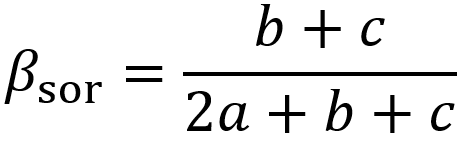
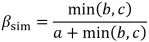

Here, βsor measures total Sørensen dissimilarity, βsim its turnover component, and βsne its nestedness-resultant component. For the nonempty inventories analyzed, total dissimilarity ranges from 0 for identical composition to 1 for no shared ELs. A zero component indicates no contribution from that component. Nestedness-resultant dissimilarity was distinguished from an independent measure of matrix nestedness (Baselga, 2012). The three dissimilarity matrices were displayed as heat maps. Arithmetic means were calculated over the same 36 pairs for the 34-EL analysis and the 14-EL sensitivity analysis. These means summarize pairwise comparisons and are not multisite beta-diversity estimates; pairs sharing inventories were not treated as independent replicates. Calculations and the original analytical figures were produced with custom base-R functions in R 4.6.0 (R Core Team, 2026).
RESULTS
A total of 76 Pokémon exhibiting morphological characteristics associated with amphibians, reptiles, and other extinct tetrapod lineages were identified (Tables 1,2). Of these, 49 Pokémon (64.5%) were assigned to Reptilia, 24 (31.6%) to Lissamphibia, and three (3.9%) to extinct tetrapods belonging to Lepospondyli (Figure 1). When considering only Pokémon associated with extant amphibian and reptile orders, the dataset comprised 73 Pokémon, of which 67.1% corresponded to reptiles and 32.9% to amphibians.
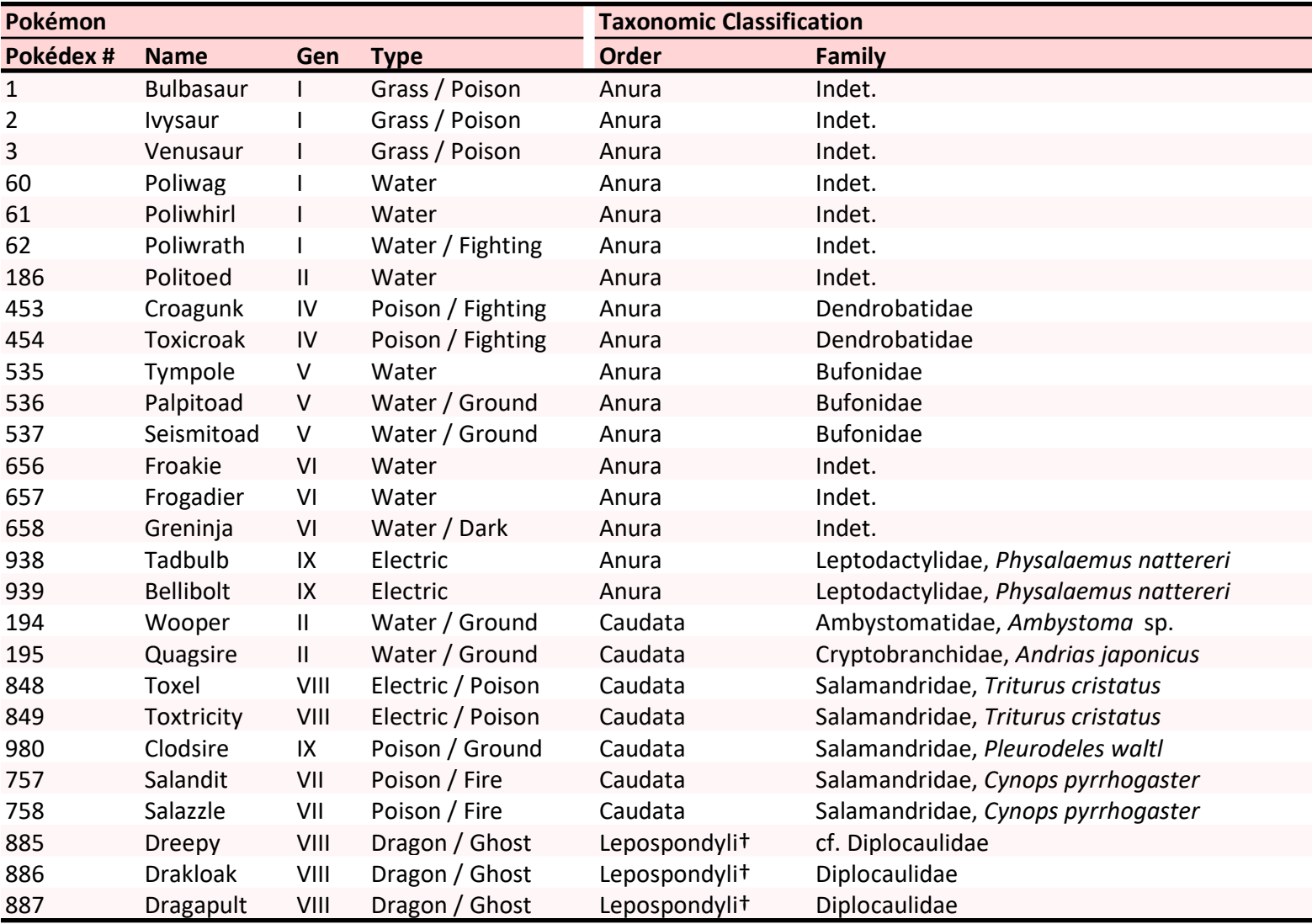
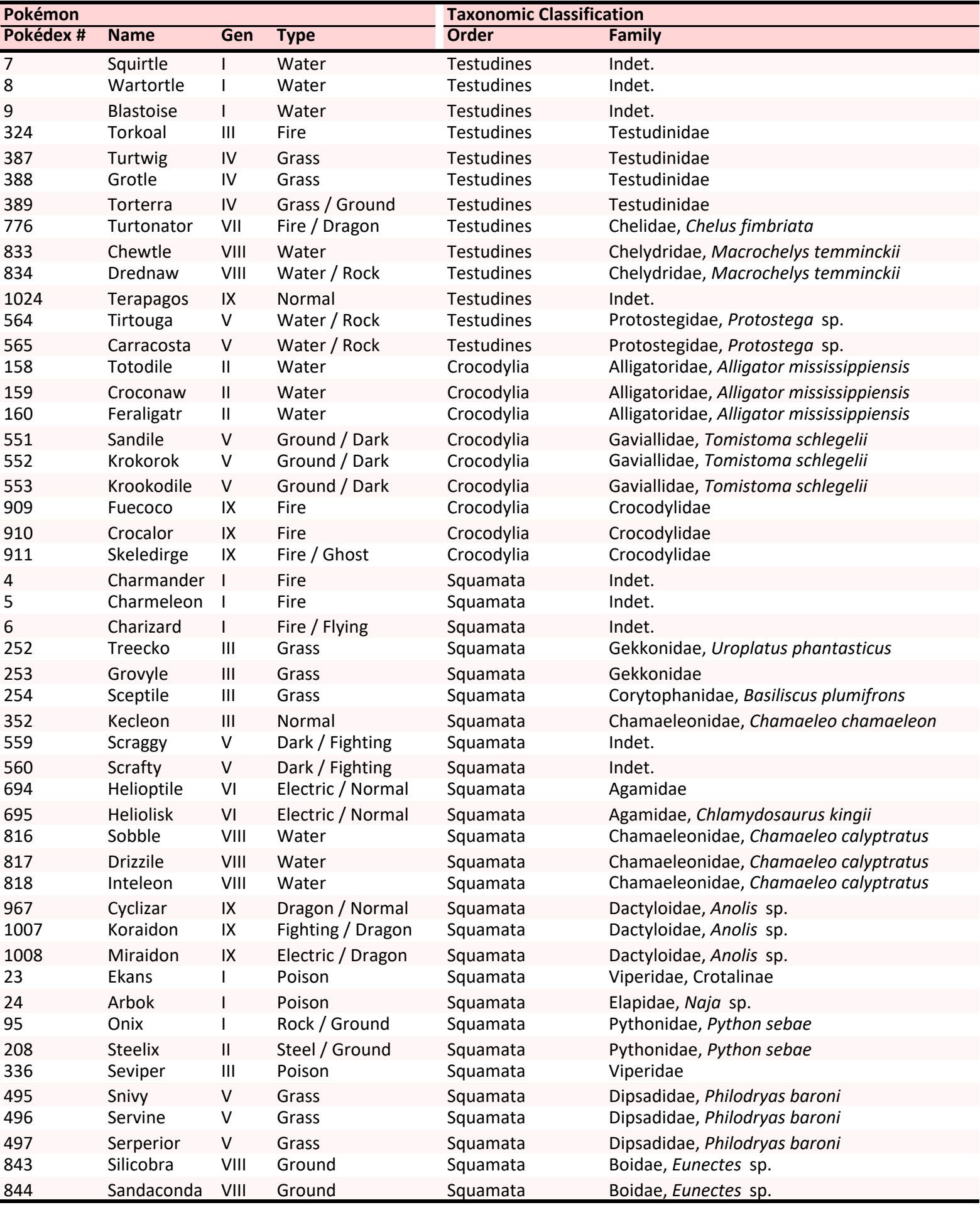
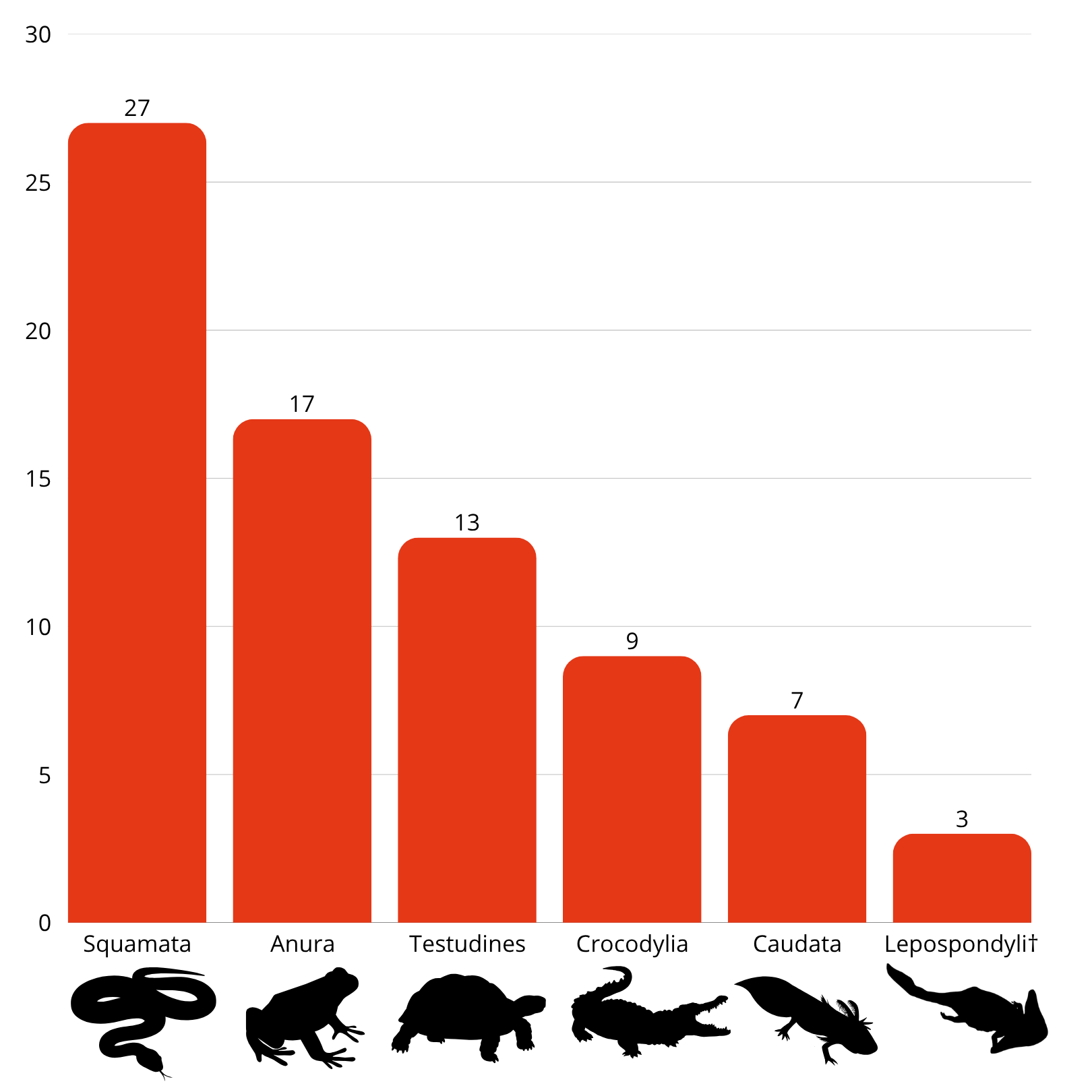
Among amphibians, Anura was the most represented order, comprising 17 Pokémon (70.8% of amphibian-associated Pokémon), whereas Caudata accounted for seven (29.2%). No Pokémon were identified as representatives of Gymnophiona. Among reptiles, Squamata accounted for the largest number of Pokémon, with 27 records (55.1% of reptile-associated Pokémon), followed by Testudines, with 13 (26.5%), and Crocodylia, with nine (18.4%). No Pokémon were identified as representatives of Rhynchocephalia. Additionally, three Pokémon were associated with Lepospondyli, an extinct tetrapod lineage analyzed separately from extant orders.
Taxonomic resolution varied among groups. Of the 76 Pokémon identified, 57 (75.0%) received a proposed family-level assignment, whereas 19 (25.0%) remained undetermined at this taxonomic level. Within Lissamphibia, all representatives of Caudata received family-level assignments, whereas only some anuran-associated Pokémon could be assigned to that level. Among reptiles, the proposed families included Testudinidae, Chelidae, Chelydridae, Protostegidae, Alligatoridae, Gavialidae, Crocodylidae, Gekkonidae, Corytophanidae, Chamaeleonidae, Agamidae, Dactyloidae, Viperidae, Elapidae, Pythonidae, Dipsadidae, and Boidae.
The classification also included morphological correspondences with extinct families, particularly Protostegidae within Testudines and Diplocaulidae within Lepospondyli. These assignments were retained in the dataset based on morphological similarities, although they were distinguished from those involving extant families. Because these identifications were based on design characteristics rather than actual evolutionary relationships, the proposed taxonomic assignments should be interpreted as hypotheses of morphological resemblance rather than as a phylogenetic reconstruction of Pokémon.
AMPHIBIA
Order Anura: frogs and toads
Anurans constitute the most diverse order of extant amphibians and are primarily characterized by the absence of a tail in adults, a relatively short body, and hind limbs that, in many species, are specialized for jumping. Their morphological and ecological diversity has enabled them to inhabit a wide range of terrestrial and aquatic environments. Furthermore, many species exhibit complex life cycles, with an aquatic larval stage followed by metamorphosis, although considerable variation exists in their reproductive strategies (Frost, 2026).
Within the Pokémon universe, we identified 17 creatures exhibiting characteristics associated with this order, distributed across six evolutionary lines. Their designs include tadpole-like forms, such as Poliwag and Tympole, as well as creatures that more closely resemble adult frogs and toads, including Politoed, Toxicroak, and Greninja. These representations allow comparisons with various biological characteristics of real anurans, particularly their development, morphology, locomotion, and defensive mechanisms.
Poliwag’s evolutionary line exhibits characteristics reminiscent of different stages of anuran development. Poliwag has a rounded body, a prominent tail, and no visible forelimbs, traits comparable to the general morphology of many tadpoles. In Poliwhirl and Poliwrath, well-developed limbs appear while the tail disappears, a change that partially resembles the transformations observed during frog metamorphosis. Finally, Politoed more closely resembles an adult anuran, with well-developed hind limbs and a body shape characteristic of frogs.
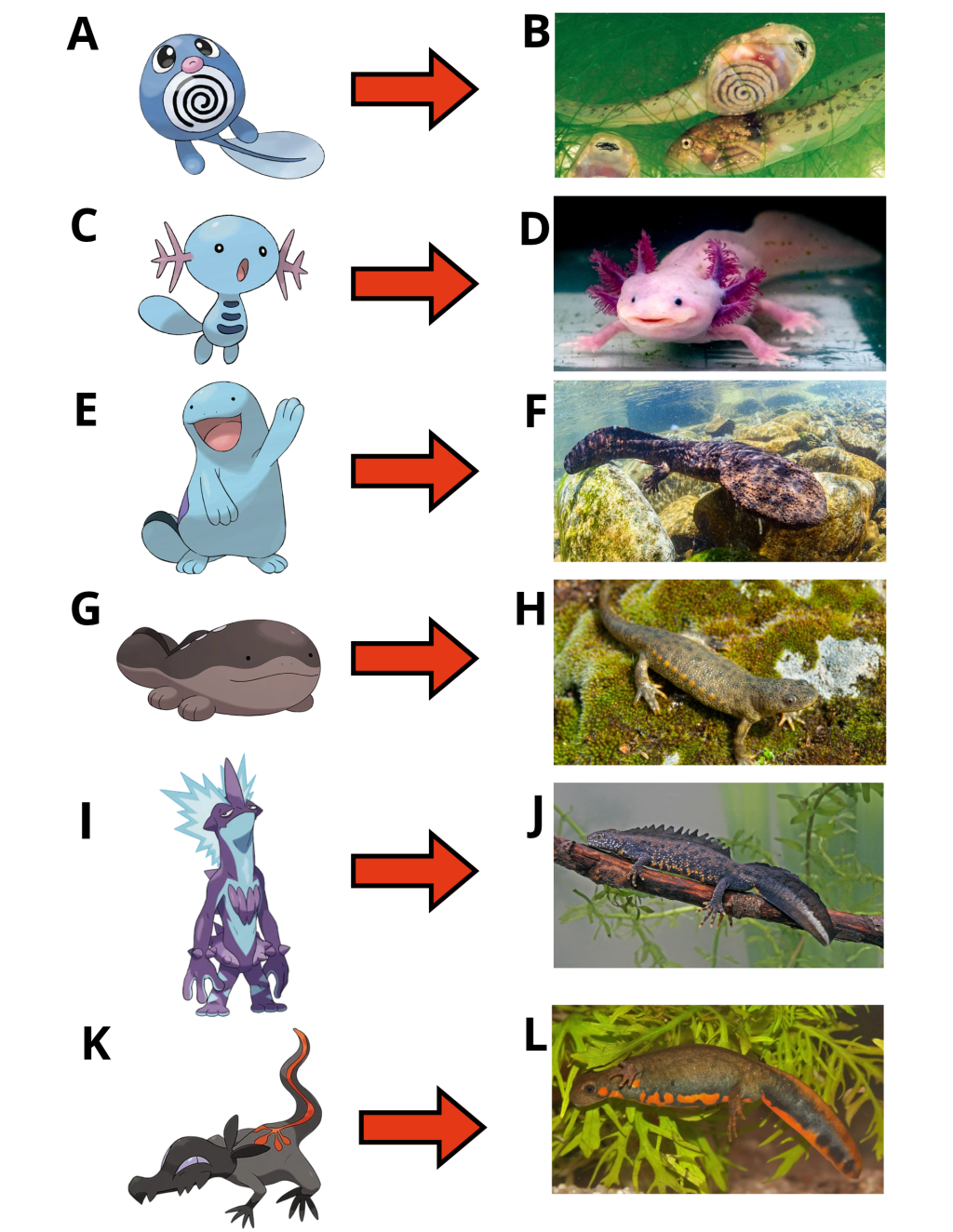
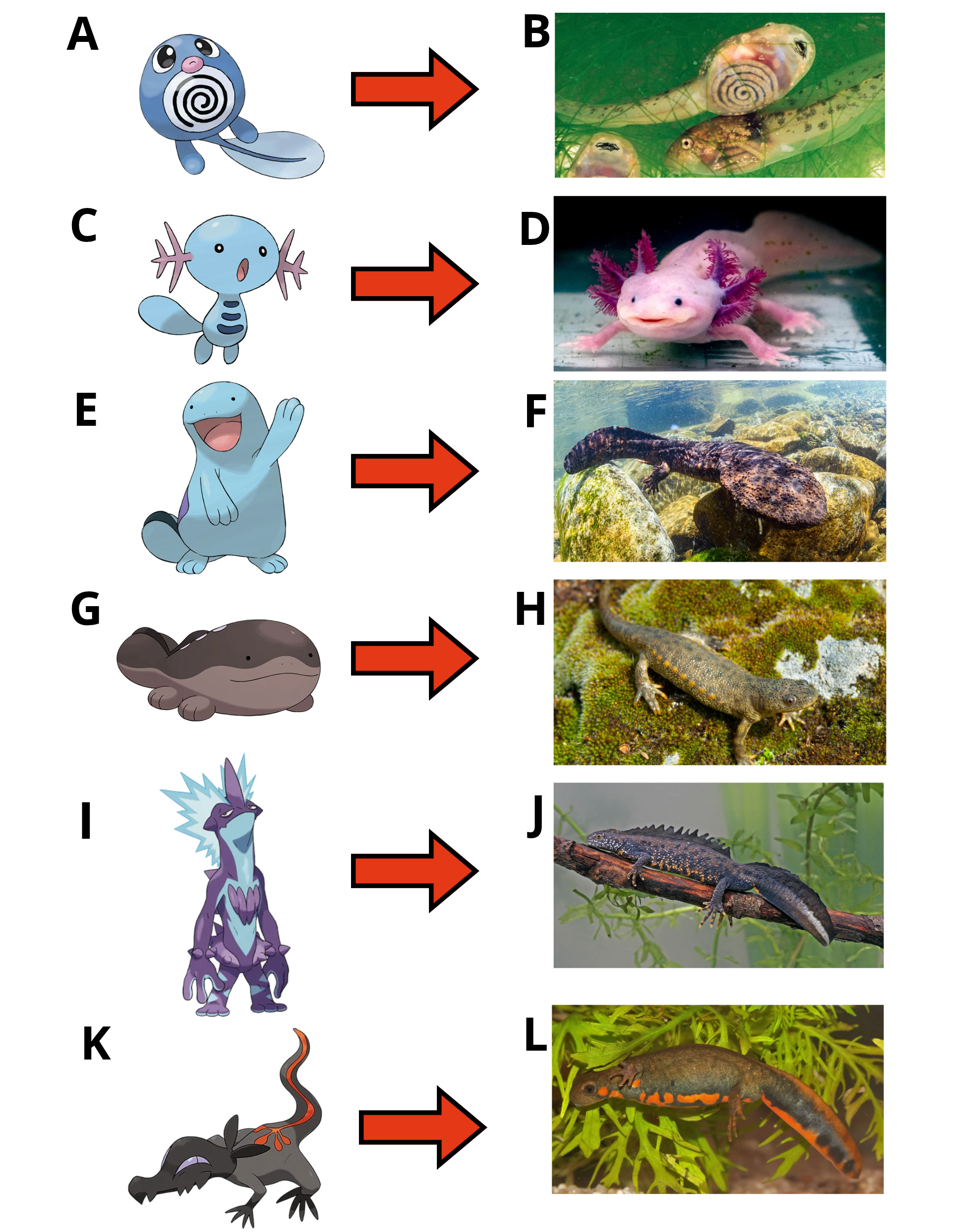
One of Poliwag’s most distinctive features (Figure 2A) is the spiral pattern on its ventral surface, which represents its internal organs visible through thin, partially translucent skin, as observed in the tadpoles of numerous anuran species (The Pokémon Company, 2026). This feature can be particularly associated with the coiled arrangement of the larval intestine. In many herbivorous and detritivorous tadpoles, the intestine is relatively long and forms multiple coils within the abdominal cavity, an arrangement associated with the processing of plant material and other organic matter (Figure 2B). However, digestive tract morphology varies considerably among species and is closely related to their feeding habits. Fabrezi & Cruz (2020) documented these differences in tadpoles of the family Ceratophryidae, showing that the organization of the digestive system can undergo substantial modifications associated with trophic specialization and larval development.
Overall, the characteristics of this evolutionary line allow comparisons with the external morphology, digestive anatomy, and ontogenetic changes of anurans. Although the transformations of these Pokémon do not represent a biologically accurate sequence of metamorphosis, they provide a useful example for illustrating some of the anatomical changes that occur during frog development.
Order Caudata: salamanders and newts
Caudates constitute one of the three orders of extant amphibians and include salamanders, newts, axolotls, and other related organisms. Unlike anurans, they generally retain their tails throughout adulthood and exhibit elongated bodies with limbs of variable size. Their diversity encompasses fully aquatic and terrestrial species, as well as organisms that alternate between both environments throughout their life cycles. Furthermore, some salamanders exhibit paedomorphosis, a phenomenon in which individuals reach sexual maturity while retaining juvenile characteristics, such as external gills and caudal fins (Frost, 2026; Laudet, 2011). Among their most remarkable biological characteristics are their regenerative abilities, diverse reproductive strategies, and the presence of skin secretions involved in defense against predators and microorganisms. Some species also exhibit highly specialized defensive mechanisms, such as the protrusion of skeletal structures through the skin. These adaptations provide interesting parallels with the characteristics of several Pokémon.
Wooper and Quagsire (Figure 2C,E), introduced in the second generation of Pokémon, exhibit morphological characteristics resembling those of aquatic salamanders. Wooper is distinguished by its rounded head and branched structures on either side of its head, which resemble the external gills of axolotls belonging to the genus Ambystoma (Figure 2D). These structures facilitate gas exchange in aquatic environments and may be retained into adulthood in paedomorphic species, such as Ambystoma mexicanum. In these organisms, sexual maturity is reached without necessarily undergoing a complete transformation into a terrestrial form (Laudet, 2011).
Quagsire, in turn, exhibits a robust body, short limbs, and a relatively well-developed tail, characteristics reminiscent of certain large aquatic salamanders, particularly those belonging to the family Cryptobranchidae. Salamanders of this family, such as those of the genus Andrias (Figure 2F), possess broad, flattened bodies adapted to aquatic environments and rely substantially on cutaneous gas exchange. Unlike Wooper, Quagsire lacks visible external gills, a characteristic also observed in adult giant salamanders.
Although the transformation of Wooper into Quagsire may resemble the loss of external gills during metamorphosis, these two Pokémon exhibit characteristics associated with different groups of salamanders.
Clodsire, introduced in the ninth generation, exhibits a broad, flattened body, reduced limbs, and pointed structures that it can project from the sides of its body (Figure 2G). This latter characteristic is particularly reminiscent of the defensive mechanism of the Iberian ribbed newt Pleurodeles waltl (Figure 2H).
In this species, the ribs have pointed tips that can be displaced laterally and pierce the body wall when the animal adopts a defensive posture. This mechanism exposes the rib tips, which come into contact with toxic secretions from the skin glands, thereby providing protection against predators (Heiss et al., 2010).
We recognize that Clodsire also shares general morphological affinities with giant salamanders, including Andrias japonicus, particularly in its broad head, flattened body, and short limbs. Nevertheless, the more specific correspondence between its protrusible defensive structures and the rib-based defense of P. waltl, together with its lateral markings and Poison typing, provides stronger comparative support for an affinity with Pleurodeles. This interpretation is also geographically consistent with Clodsire’s debut region, Paldea, which is inspired by the Iberian Peninsula, part of the native range of P. waltl (The Pokémon Company, 2024; Frost, 2026). We therefore assigned Clodsire to Salamandridae, using P. waltl as its closest comparative analogue while acknowledging similarities with other caudates.
Toxel and Toxtricity, introduced in the eighth generation, exhibit a combination of characteristics reminiscent of newts, although their designs also incorporate anthropomorphic and musical elements. Toxtricity (Figure 2I) has an elongated body, a well-developed tail, and a prominent dorsal crest, which can be compared with the ornamental structures found in some newts of the family Salamandridae, particularly species of the genus Triturus (Figure 2J).
In several newt species, males develop conspicuous dorsal crests during the breeding season, which play a role in courtship displays (Figure 2J). In Toxtricity, these structures are modified and combined with elements resembling musical instruments, particularly electric guitars.
Both Pokémon are Poison-type, a characteristic that also allows comparisons with the defensive secretions of real salamanders. Members of Salamandridae possess skin glands capable of producing bioactive substances, some of which are toxic and provide protection against predators. The composition and function of these secretions vary among species and constitute an important component of their chemical defense mechanisms (Lüddecke et al., 2018).
Salandit (Figure 2K), introduced in the seventh generation, exhibits a more ambiguous zoological inspiration, as its design combines characteristics of lizards and salamanders. Its elongated body, well-developed tail, and relatively short limbs reveal general morphological similarities to both groups. Furthermore, its name and association with fire evoke the mythical salamander.
One of its most interesting characteristics is its association with toxic substances. In real caudates, particularly members of Salamandridae, skin glands can produce chemical compounds that serve as defensive mechanisms. The Japanese fire-bellied newt, Cynops pyrrhogaster (Figure 2L), is a representative example, as it secretes tetrodotoxin and related compounds from its skin glands (Tsuruda et al., 2002; Lüddecke et al., 2018).
Salazzle also exhibits a distinctive form of sex-dependent evolution, as only female Salandit can evolve into this Pokémon. This fictional characteristic can be used to introduce the concept of sexual dimorphism, although it does not directly correspond to the mechanisms of sexual differentiation or metamorphosis observed in real salamanders.
REPTILIA
Order Testudines: turtles and tortoises
Turtles constitute one of the most distinctive lineages of extant reptiles, characterized by the presence of a shell composed of two main components: a dorsal portion known as the carapace and a ventral portion called the plastron. Unlike the protective structures found in other vertebrates, the turtle shell is integrated with elements of the axial skeleton, including the ribs and vertebrae, and its development involves substantial anatomical and embryological modifications (Gilbert et al., 2001; Lyson & Bever, 2020).
The order Testudines currently includes species adapted to terrestrial, freshwater, and marine environments, with diversity reflected in shell shape, limb structure, feeding habits, and locomotor strategies. In general, many terrestrial turtles and tortoises possess highly domed shells and robust limbs, whereas numerous aquatic species exhibit relatively flattened shells and limbs adapted for swimming. However, these associations are not universal, as shell morphology is shaped by multiple functional and evolutionary pressures (Stayton, 2011, 2018; Turtle Taxonomy Working Group, 2025).
Within the Pokémon universe, we identified 13 creatures exhibiting characteristics attributable to Testudines, including forms resembling aquatic turtles, terrestrial tortoises, and extinct species. Their designs allow comparisons with the morphology, locomotion, defensive adaptations, and ecology of real turtles.
Chewtle and Drednaw, introduced in the eighth generation, exhibit characteristics associated with snapping turtles of the family Chelydridae. Both possess relatively large heads, prominent jaws, and robust bodies, while Drednaw (Figure 3A) features a shell with large, angular projections.
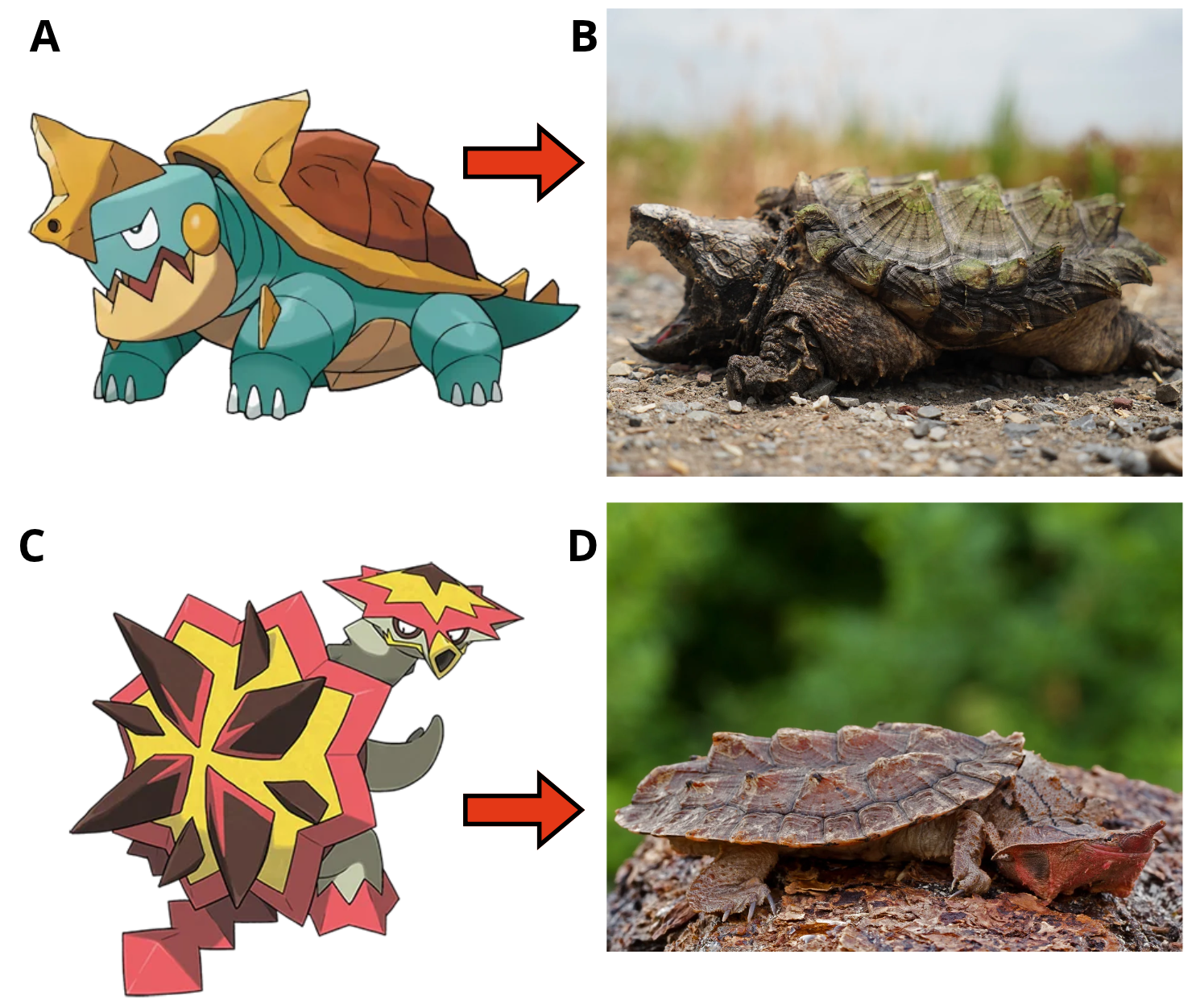
Among real turtles, species such as Macrochelys temminckii (Figure 3B) possess well-developed jaws and cranial morphology adapted for capturing and processing prey. Additionally, some snapping turtles exhibit relatively low-profile shells with rough dorsal surfaces or prominent keels. The most distinctive characteristic of this evolutionary line is the prominence of its jaws. Chewtle and Drednaw are depicted as Pokémon capable of delivering particularly powerful bites, a feature reminiscent of the importance of jaw musculature and cranial structure in the feeding biology of real turtles.
Turtonator (Figure 3C), introduced in the seventh generation, exhibits a particularly distinctive appearance, characterized by a flattened shell, an irregular outline, and large pointed projections. Its design bears some resemblance to certain aquatic turtles of the family Chelidae, particularly the mata mata turtles of the genus Chelus, although it also incorporates characteristics of dragons and other fantastical creatures. Mata mata turtles (Figure 3D) possess irregularly shaped shells, broad heads, and numerous cutaneous projections around the neck. These characteristics contribute to their cryptic appearance in aquatic environments. They also exhibit a remarkable feeding specialization: prey capture through suction feeding, facilitated by modifications of the hyoid apparatus and rapid expansion of the buccopharyngeal cavity (Lemell et al., 2002).
Order Crocodylia: crocodiles, alligators, caimans, and gharials
Crocodilians constitute an ancient lineage of predominantly semi-aquatic reptiles, currently represented by three families: Alligatoridae (alligators and caimans), Crocodylidae (crocodiles), and Gavialidae (gharials). These organisms exhibit numerous adaptations associated with aquatic life, including a robust body, a muscular, laterally compressed tail, relatively short limbs, and dorsally positioned eyes and nostrils, allowing them to keep most of their bodies submerged while observing their surroundings and breathing.
One of the most distinctive characteristics of crocodilians is the diversity of skull and jaw shapes, particularly variations in snout length and width. In general, alligators possess relatively broad, rounded snouts, whereas many crocodiles exhibit narrower snouts. Gharials, in contrast, are distinguished by their considerably elongated and slender snouts. These morphological differences are associated with distinct feeding strategies, as elongated snouts facilitate the capture of small, agile aquatic prey, whereas more robust jaws can withstand greater mechanical loads when processing larger prey (Walmsley et al., 2013).
Crocodilians are also characterized by their considerable bite force, specialized dentition for grasping prey, and the presence of osteoderms that provide mechanical protection. Furthermore, they possess integumentary sensory organs distributed across the head and, in some lineages, other regions of the body, enabling them to detect mechanical stimuli in their aquatic environment (Erickson et al., 2012; Leitch & Catania, 2012). Within the Pokémon universe, we identified nine creatures exhibiting characteristics attributable to Crocodylia, distributed across three evolutionary lines. Their designs combine anatomical features of crocodiles, caimans, and alligators with fantastical adaptations associated with the Water, Ground, Dark, and Fire types.
Introduced in the second generation, Totodile, Croconaw, and Feraligatr (Figure 4 A–C) exhibit morphological characteristics associated with alligators and caimans of the family Alligatoridae. Totodile has a relatively large head, a short, broad snout, well-developed limbs, and a robust tail, characteristics reminiscent of juvenile alligators. As the evolutionary line progresses, Croconaw and Feraligatr develop more robust bodies, prominent jaws, and larger dorsal structures.
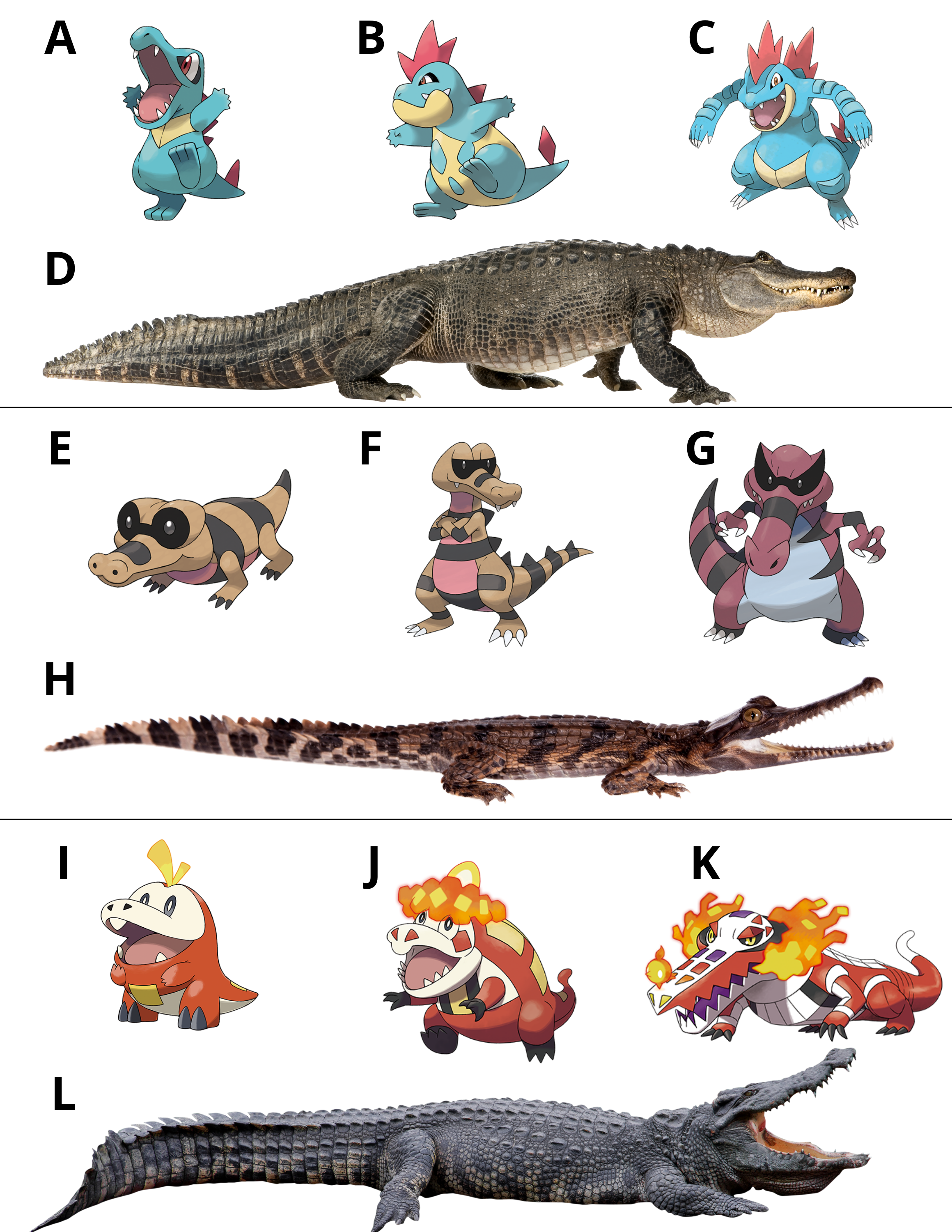
Figure 4. A. Totodile. B. Croconaw. C. Feraligatr. D. Alligator mississippiensis. E. Sandile. F. Krokorok. G. Krookodile. H. Tomistoma schlegelii. I. Fuecoco. J. Crocalor. K. Skeledirge. L. Crocodylus sp.
The appearance of these Pokémon can be compared with that of Alligator mississippiensis (Figure 4D), a species characterized by a relatively broad, rounded snout, muscular jaws, and dentition capable of grasping and processing a variety of prey. Although snout morphology varies considerably among crocodilian species, alligatorids generally exhibit more robust cranial proportions than gharials, reflecting differences in feeding ecology and mandibular biomechanics (Walmsley et al., 2013). One particularly prominent feature of Feraligatr is its well-developed jaws and teeth, which highlight the importance of bite force in real crocodilians. Erickson et al. (2012) demonstrated that these reptiles generate some of the highest bite forces recorded among living animals and that bite force is strongly associated with body size.
The pointed dorsal structures present throughout this evolutionary line can also be compared with crocodilian osteoderms. These bony elements develop within the dermis and form part of the animals’ body armor, providing mechanical resistance and protection. However, Feraligatr’s large dorsal projections represent a fantastical exaggeration of the structures found in real alligators. Finally, the association of this evolutionary line with the Water type is consistent with the semi-aquatic habits of crocodilians, although the predominantly bipedal locomotion depicted in these Pokémon represents a substantial departure from the locomotor patterns of their real-world counterparts.
The evolutionary line of Sandile (Figure 4E–G), introduced in the fifth generation, exhibits characteristics clearly associated with Crocodylia, although its members are distinguished by their occurrence in arid environments and their association with the Ground and Dark types. Sandile has an elongated body, four relatively short limbs, a well-developed tail, and a prominent snout. Krokorok and Krookodile exhibit progressively more upright and anthropomorphic body forms while retaining recognizable crocodilian cranial features. Among the most evident similarities are the general shape of the skull, the presence of conical teeth, and the dorsal positioning of the eyes. The latter represents an important adaptation in real crocodilians, allowing them to observe their surroundings while keeping most of their bodies submerged.
The snout morphology of these Pokémon also provides an opportunity to discuss differences among crocodilian families. Gharials, particularly Tomistoma schlegelii (Figure 4H), possess extremely elongated and narrow snouts associated with a diet specialized in fish. In contrast, crocodiles and caimans with more robust snouts exhibit a broader range of feeding strategies (Walmsley et al., 2013). Another interesting aspect is their association with desert environments. Although extant crocodilians depend on aquatic habitats for many of their activities, some species can move over land and use terrestrial habitats near water bodies. However, a predominantly subterranean lifestyle or one associated with extensive sandy environments, as depicted in these Pokémon, does not reflect the typical ecology of living crocodilians. Therefore, this evolutionary line illustrates how Pokémon designs retain recognizable anatomical characteristics of a zoological group while substantially modifying its habitat preferences and behavior to create fictional creatures.
Fuecoco, Crocalor, and Skeledirge (Figure 4I–K), introduced in the ninth generation, exhibit characteristics associated with crocodiles of the family Crocodylidae. Fuecoco has a large head, a relatively short snout, robust limbs, and a well-developed tail, whereas Crocalor and Skeledirge progressively develop ornamental structures and features associated with fire. Unlike other crocodilian evolutionary lines in Pokémon, Skeledirge adopts a quadrupedal posture and exhibits an elongated, robust body shape that more closely resembles the typical locomotor morphology of real crocodiles. Its prominent head, well-developed jaws, and overall body configuration reveal general similarities to species of the genus Crocodylus (Figure 4L), although these characteristics do not allow identification of a particular species. One of Skeledirge’s most striking features is the presence of structures resembling bony plates and skeletal elements across its body. These can be broadly compared with the dermal armor of crocodilians, which consists of osteoderms that contribute to protecting the underlying tissues. However, the coloration and arrangement of these structures in Skeledirge are primarily ornamental and fantastical. The presence of a small, bird-like creature made of flames introduces another interesting feature from an evolutionary perspective. Crocodilians and birds represent the only extant lineages of Archosauria, a group that also includes non-avian dinosaurs and numerous extinct reptiles. This phylogenetic relationship makes Skeledirge a useful starting point for explaining that, despite their substantial anatomical differences, birds are more closely related to crocodilians than to squamates or turtles.
Order Squamata: lizards and snakes
Squamata constitutes the most diverse order of extant reptiles and includes lizards, snakes, and amphisbaenians. Its members exhibit extraordinary morphological and ecological diversity, ranging from small arboreal species to large terrestrial predators and fully aquatic organisms. Their distinctive characteristics include keratinized epidermal scales, periodic shedding of the epidermis, and a remarkable diversity of locomotor, feeding, and defensive mechanisms (Vitt & Caldwell, 2014).
Although lizards and snakes are commonly distinguished by the presence or absence of limbs, respectively, this distinction does not represent two equivalent evolutionary lineages. Snakes constitute a specialized lineage within Squamata, and limb reduction or loss has evolved independently in several squamate groups (Greene, 1997; Vitt & Caldwell, 2014).
Within the Pokémon universe, we identified 27 creatures exhibiting characteristics attributable to Squamata. Of these, 17 exhibit lizard-like morphology, whereas ten possess snake-like characteristics. Their designs allow comparisons with adaptations related to arboreal locomotion, color change, display structures, limb reduction, chemical defense, and jaw specialization.
Lizards
Treecko’s evolutionary line, introduced in the third generation, incorporates adaptations associated with arboreal lizards. Treecko (Figure 5A) has a slender body, a well-developed tail, and relatively expanded digits, characteristics reminiscent of numerous geckos, particularly of Uroplatus phantasticus, belonging to the family Gekkonidae (Figure 5B).
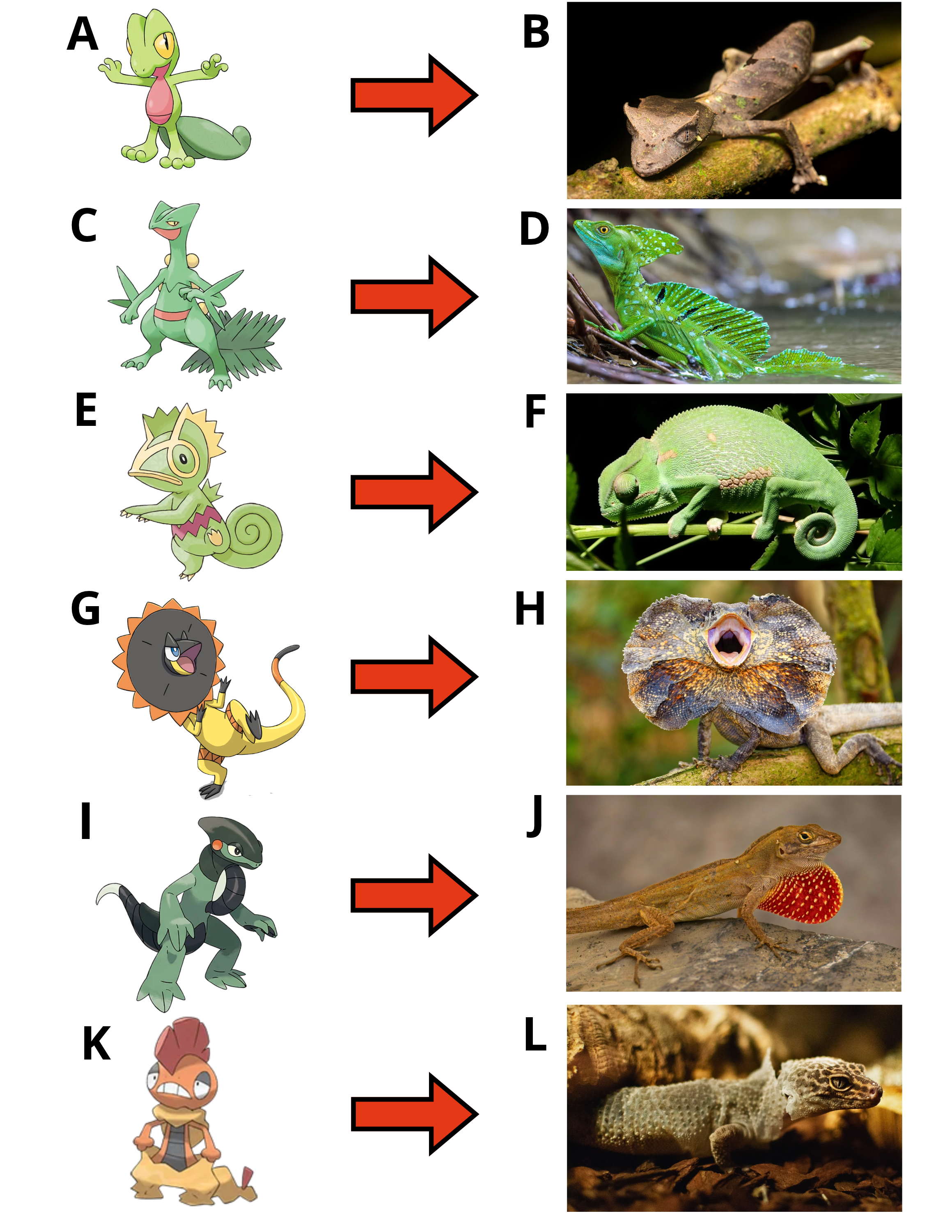
Geckos represent one of the best-documented examples of locomotor specialization among reptiles. In many species, the digits possess adhesive structures consisting of lamellae and numerous microscopic setae that enable attachment to different surfaces through molecular-scale physical interactions (Autumn et al., 2002). Although Treecko and Grovyle do not explicitly depict these microscopic mechanisms, their appearance and fictional ability to move across vertical surfaces resemble the adaptations of arboreal geckos.
Sceptile exhibits a remarkable morphological transformation, characterized by an upright posture and leaf-like structures on its limbs and tail (Figure 5C). Its overall silhouette can be partially compared with crested lizards, such as basilisks and other members of the family Corytophanidae, particularly Basiliscus plumifrons (Figure 5D).
Kecleon (Figure 5E) exhibits one of the clearest zoological correspondences within Squamata. Its laterally compressed body, prominent eyes, and ability to change coloration resemble the characteristics of chameleons of the family Chamaeleonidae. Chameleons possess numerous adaptations associated with arboreal life, including zygodactylous feet, prehensile tails in many species, and eyes capable of moving largely independently of one another (Figure 5F). However, one of their most widely recognized features is their ability to change coloration.
Although chameleons are commonly believed to change color primarily to blend into their surroundings, this phenomenon also plays a role in social communication and may be associated with physiological state and interactions among individuals. Stuart-Fox and Moussalli (2008) demonstrated that selection associated with visual communication has played an important role in the evolution of color change in these reptiles. Kecleon’s ability to alter its appearance represents a fantastical interpretation of this adaptation, particularly in terms of the speed and precision with which it can reproduce patterns from its surroundings.
Helioptile and Heliolisk, introduced in the sixth generation, exhibit characteristics reminiscent of lizards belonging to the family Agamidae. Heliolisk (Figure 5G) is particularly distinguished by the presence of a large, expandable neck frill, resembling that of Chlamydosaurus kingii, commonly known as the frilled lizard (Figure 5H). In this species, the frill is supported by cartilaginous structures and can be expanded during defensive displays and other behavioral interactions, considerably increasing the apparent size of the head and neck.
Furthermore, the association of these Pokémon with electrical energy and solar radiation allows a general comparison with the thermal dependence of ectothermic reptiles. In real lizards, exposure to solar radiation plays an important role in regulating body temperature and influences numerous physiological and behavioral processes. However, the direct conversion of solar radiation into electricity represents a fantastical characteristic with no known equivalent among agamid lizards.
Cyclizar, Koraidon, and Miraidon, introduced in the ninth generation, exhibit a combination of lizard-like characteristics and elements associated with transportation vehicles. All three possess elongated bodies, four limbs, well-developed tails, and prominent structures in the gular and dorsal regions. Their appearance allows general comparisons with lizards of the family Dactyloidae, particularly anoles of the genus Anolis, which exhibit considerable diversity in body morphology, crests, and display structures. In many species, males possess an extensible throat fan, or dewlap, used in social communication and territorial interactions (Figure 5I,J; Losos, 2009).
The loose skin of Scraggy and Scrafty evokes ecdysis, the periodic shedding of the outer cornified epidermal layers (Figure 5K,L), which renews the integument and accommodates body growth (Alibardi, 2002; Wagner et al., 2023). Their Shed Skin ability reinforces this association. The motif becomes particularly conspicuous in Mega Scrafty, whose shed skin turns white, further emphasizing this reptilian process.
Some Pokémon could not be confidently associated with a particular family, and even their placement within higher-level taxa required consideration of conflicting affinities. Charmander illustrates this difficulty, combining lizard-like features with salamander-related associations in its name and lore. Its Japanese name, Hitokage, can evoke both a “fire lizard” and the folkloric fire salamander, whereas its official Japanese category explicitly identifies it as a “Lizard Pokémon” (とかげポケモン). Additional morphological support comes from its official Detective Pikachu trading card, illustrated by MPC Film, which depicts a scale-like integumentary texture across the head, body, and tail. Together, these features provide stronger comparative support for a provisional placement within Squamata, without assignment to a particular family. This interpretation acknowledges its salamander and folkloric affinities while reflecting the relative strength of the available comparative evidence rather than an exclusive or confirmed source of design inspiration.
Snakes
Ekans and Arbok, introduced in the first generation, are among the most recognizable snake-like Pokémon. Although both possess elongated, limbless bodies, their morphological characteristics allow comparisons with different lineages of venomous snakes.
Ekans possesses a yellow rattle at the tip of its tail (Figure 6A), a distinctive feature of rattlesnakes belonging to the genera Crotalus and Sistrurus (Viperidae: Crotalinae). This structure consists of interlocking keratin segments that produce a characteristic rattling sound when the snake rapidly vibrates its tail, primarily serving as a defensive warning signal against potential threats. Based on this resemblance, Ekans can be tentatively associated with the genus Crotalus (Figure 6B), although the presence of a rattle alone does not allow it to be distinguished from Sistrurus.
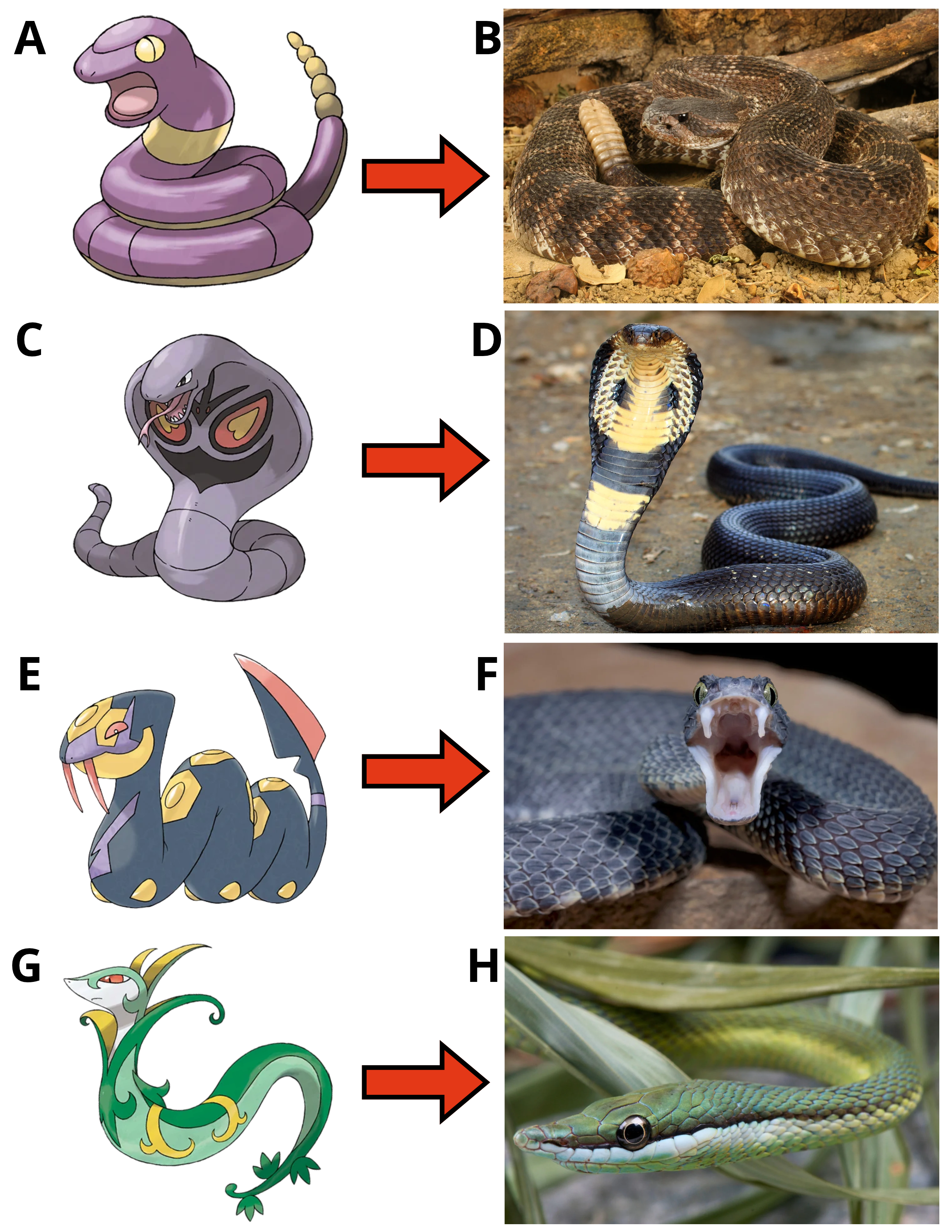
Arbok (Figure 6C), in turn, possesses an expanded neck structure resembling the hood of cobras belonging to the genus Naja (Elapidae; Figure 6D). In these snakes, lateral expansion of the neck occurs through the movement of cervical ribs and associated tissues, increasing the animal’s apparent size during defensive displays (Young & Kardong, 2010). This feature establishes a particularly clear morphological correspondence between Arbok and cobras.
Thus, this evolutionary line combines characteristics of two different families of venomous snakes: Viperidae in Ekans and Elapidae in Arbok. Although this transformation does not represent an actual evolutionary relationship between these lineages, it provides an interesting example of how Pokémon designs incorporate anatomical and defensive characteristics from different zoological groups.
Seviper (Figure 6E), introduced in the third generation, exhibits a distinctly snake-like appearance and several characteristics reminiscent of vipers belonging to the family Viperidae. These include a relatively broad head, prominent teeth, and a tail ending in a pointed structure. Real vipers possess important specializations associated with prey capture, particularly solenoglyphous dentition, characterized in many species by long, movable front fangs capable of injecting venom through a specialized system of glands and ducts (Figure 6F). This mechanism allows rapid venom delivery during a bite. Seviper’s association with the Poison type and its aggressive appearance allow general comparisons with these snakes. However, the blade-like structure at the tip of its tail does not correspond to any known defensive mechanism in Viperidae.
Snivy’s evolutionary line, introduced in the fifth generation, exhibits morphological characteristics that allow a particularly interesting comparison with Philodryas baroni (Dipsadidae; Figure 6H; Schoen, 2017), a South American snake with predominantly arboreal habits. This species is characterized by an elongated, slender body, frequently green coloration, a relatively long tail, and a prominent, pointed snout, features that are particularly reminiscent of Serperior’s appearance (Figure 6G).
Throughout this evolutionary line, a progressive modification of body morphology can be observed. Snivy possesses well-developed limbs and a prominent tail; Servine exhibits greater body elongation and proportionally reduced limbs, whereas Serperior develops a predominantly snake-like morphology. This transformation can be compared with the evolutionary processes of body elongation and limb reduction documented in different squamate lineages, although it does not represent a literal depiction of snake evolution.
In addition to its external similarities, Philodryas baroni possesses opisthoglyphous dentition, characterized by specialized posterior maxillary teeth associated with venom delivery. This feature illustrates the diversity of feeding and defensive specializations within Dipsadidae (Peichoto et al., 2012), although it is not explicitly represented in the design of these Pokémon. Therefore, Philodryas baroni constitutes a plausible zoological analogue for this evolutionary line, particularly for Serperior, although there is insufficient evidence to establish that this species directly inspired the original Pokémon designs.
GENERAL DISCUSSION
Phylogenetic framework and comparative affinities
Within the reduced reference framework, Anura and Caudata were united in Batrachia, with Gymnophiona outside this pair within Lissamphibia. The retained reptiles were organized into Lepidosauria and Archelosauria: the former included Rhynchocephalia and Squamata, while the latter united Testudines and Archosauria. Within Archosauria, Crocodylia was contrasted with the contextual Ornithodira assemblage, including Dinosauria and Pterosauria (Figure 7).
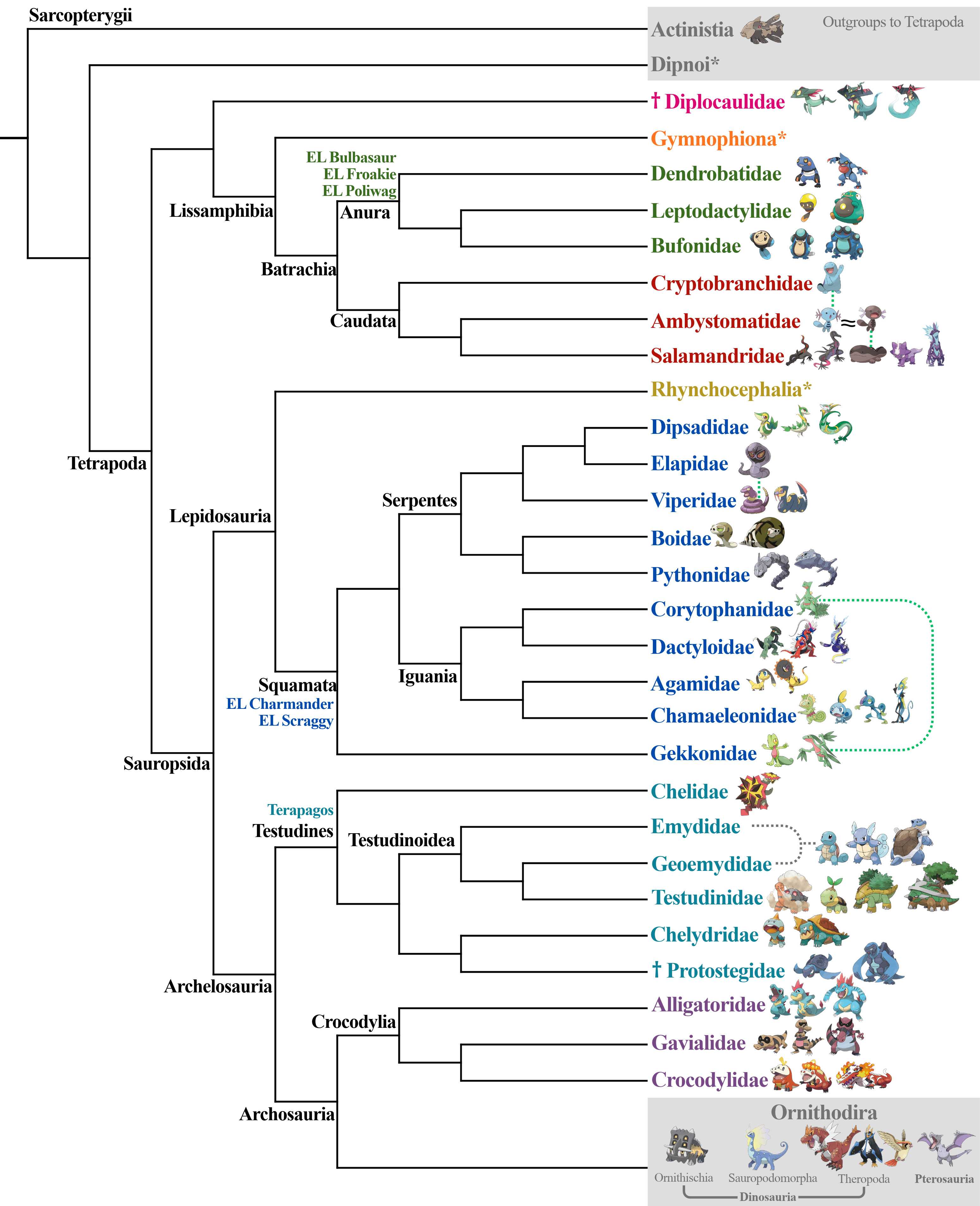
The reference framework included 26 zoological families: six within Lissamphibia, ten within Squamata, six within Testudines, three within Crocodylia, and Diplocaulidae. Diplocaulidae and Protostegidae provided the two extinct family-level references. Several Pokémon were retained at broader clades because their affinities could not be resolved to a single family. These included the Bulbasaur, Froakie, and Poliwag ELs within Anura, the Charmander and Scraggy ELs within Squamata, and Terapagos within Testudines. The Squirtle EL retained alternative comparisons with Emydidae and Geoemydidae within Testudinoidea. Associations within the Treecko EL crossed the Gekkonidae and Corytophanidae references. Dipnoi, Gymnophiona, and Rhynchocephalia were retained without an assigned Pokémon representative in the corpus, while the external sarcopterygian references and the Ornithodira box provided evolutionary context. The two extinct references extend this comparison beyond living herpetological groups. Their positions remain conditional on the selected hypotheses: the lepospondyl hypothesis for the deeper placement of Diplocaulidae (Marjanović & Laurin, 2019) and a stem-chelonioid position for Protostegidae (Evers et al., 2019; Figure 7).
Considering both types recorded for each Pokémon in Table 1, Water was the most frequent type in the complete corpus of 76 species (25; 32.9%), followed jointly by Poison and Ground (13 each; 17.1%; Figure 8A). Within Lissamphibia, excluding Diplocaulidae, Water occurred in 12 of 24 species (50.0%) and Poison in ten (41.7%). Among the 49 reptilian Pokémon, Water was most frequent (13; 26.5%), followed by Grass (nine; 18.4%; Figure 8).
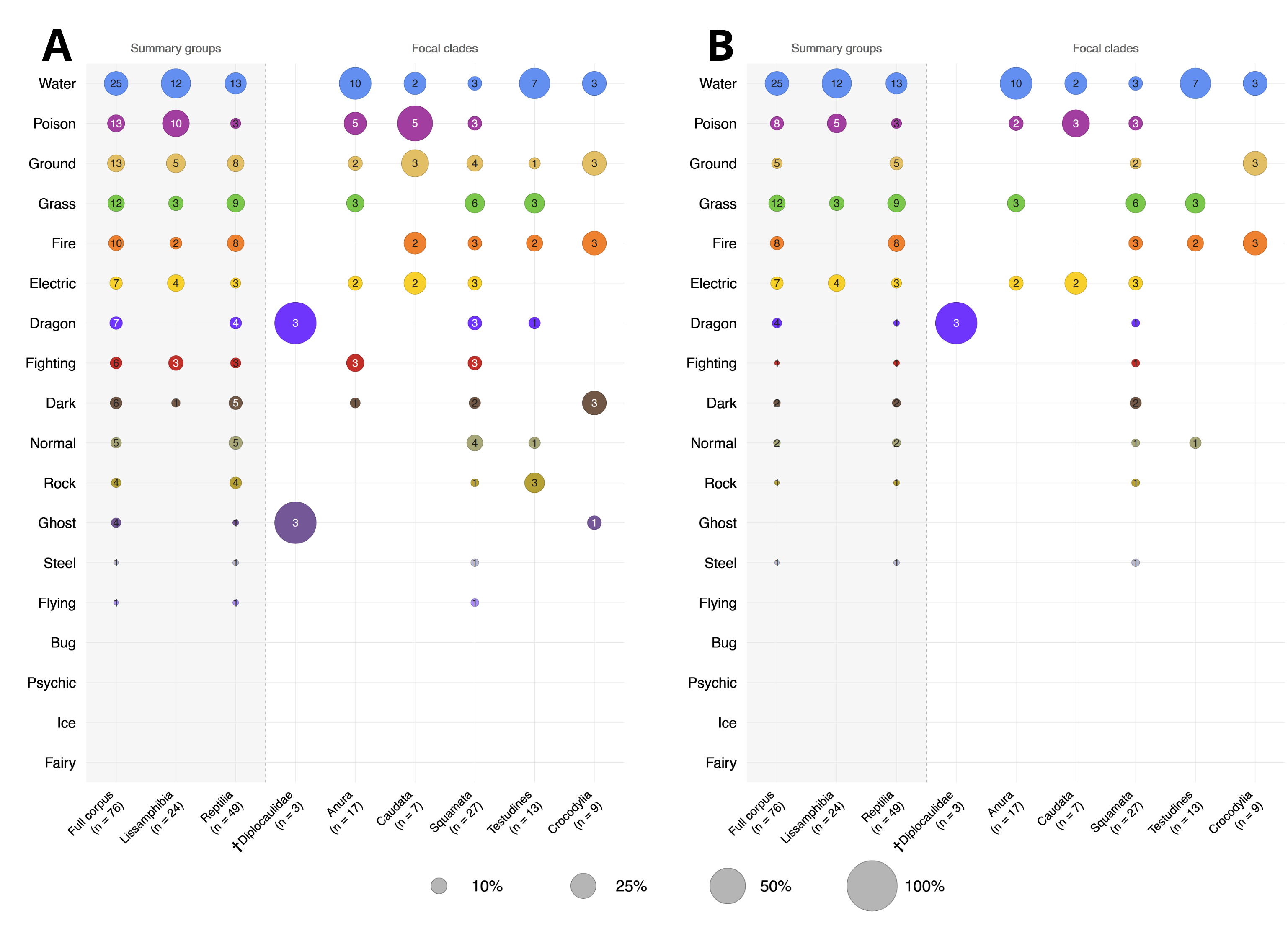
These aggregate patterns concealed differences among the focal clades. Water (10; 58.8%) and Poison (five; 29.4%) predominated in Anura, whereas Poison (five; 71.4%) and Ground (three; 42.9%) were most frequent in Caudata. Within Squamata, Grass ranked first (six of 27 species; 22.2%), followed jointly by Normal and Ground (four each; 14.8%). Water predominated in Testudines (seven; 53.8%), followed jointly by Grass and Rock (three each; 23.1%). Crocodylia showed a four-way tie among Water, Ground, Dark, and Fire, with three species each (33.3%). This reflected three ELs of three members each: Totodile contributed Water, Sandile contributed both Ground and Dark, and Fuecoco contributed Fire, with Ghost additionally occurring in Skeledirge. All three species assigned to Diplocaulidae belonged to the Dreepy EL and carried both Dragon and Ghost types (100% each; Figure 8).
Restricting the analysis to the primary type, defined as the first listed type, retained Water as the most frequent type overall (25; 32.9%) but placed Grass second (12; 15.8%; Figure 8B). Poison and Fire tied in third (eight each; 10.5%), while Ground occurred in five species (6.6%). Within Lissamphibia, Water remained first (12; 50.0%), followed by Poison (five; 20.8%). Water and Grass remained the leading types in Reptilia, with unchanged counts and percentages (Figure 8).
At the focal-clade level, primary-type counts retained Water first in Anura (10; 58.8%), followed by Grass (three; 17.6%). Poison remained first in Caudata (three; 42.9%), followed jointly by Water and Electric (two each; 28.6%). Grass remained first in Squamata (six; 22.2%), followed jointly by Water, Poison, Fire, and Electric (three each; 11.1%); Normal occurred in only one species (3.7%). Water and Grass remained the leading types in Testudines (seven, 53.8%, and three, 23.1%, respectively). In Crocodylia, the four-way tie became a three-way tie among Water, Ground, and Fire (three each; 33.3%), because Dark was secondary throughout the Sandile EL. Dragon remained the primary type of all three Diplocaulidae-associated Pokémon (100%), whereas Ghost was exclusively secondary. Thus, the predominance of Water was consistent across counting conventions, while the prominence of Poison and Ground partly depended on secondary typings (Figure 8).
Regional richness and compositional dissimilarity
Richness ranged from 10 to 37 Pokémon species and from six to 17 ELs. Galar contained the greatest richness (37 species, 17 ELs), whereas Hoenn had the fewest species (10) and Kanto the fewest ELs (six). ELs debuting elsewhere outnumbered those debuting locally in six regions. Although Kanto contributed the largest species-level debut cohort (15 species), Paldea contained the most inventory-exclusive ELs (six; Figure 9A–C). These contrasts distinguish contribution to the corpus, region richness, and exclusivity; Galar’s inclusion of two expansion areas also makes geographical scope relevant to its ranking.
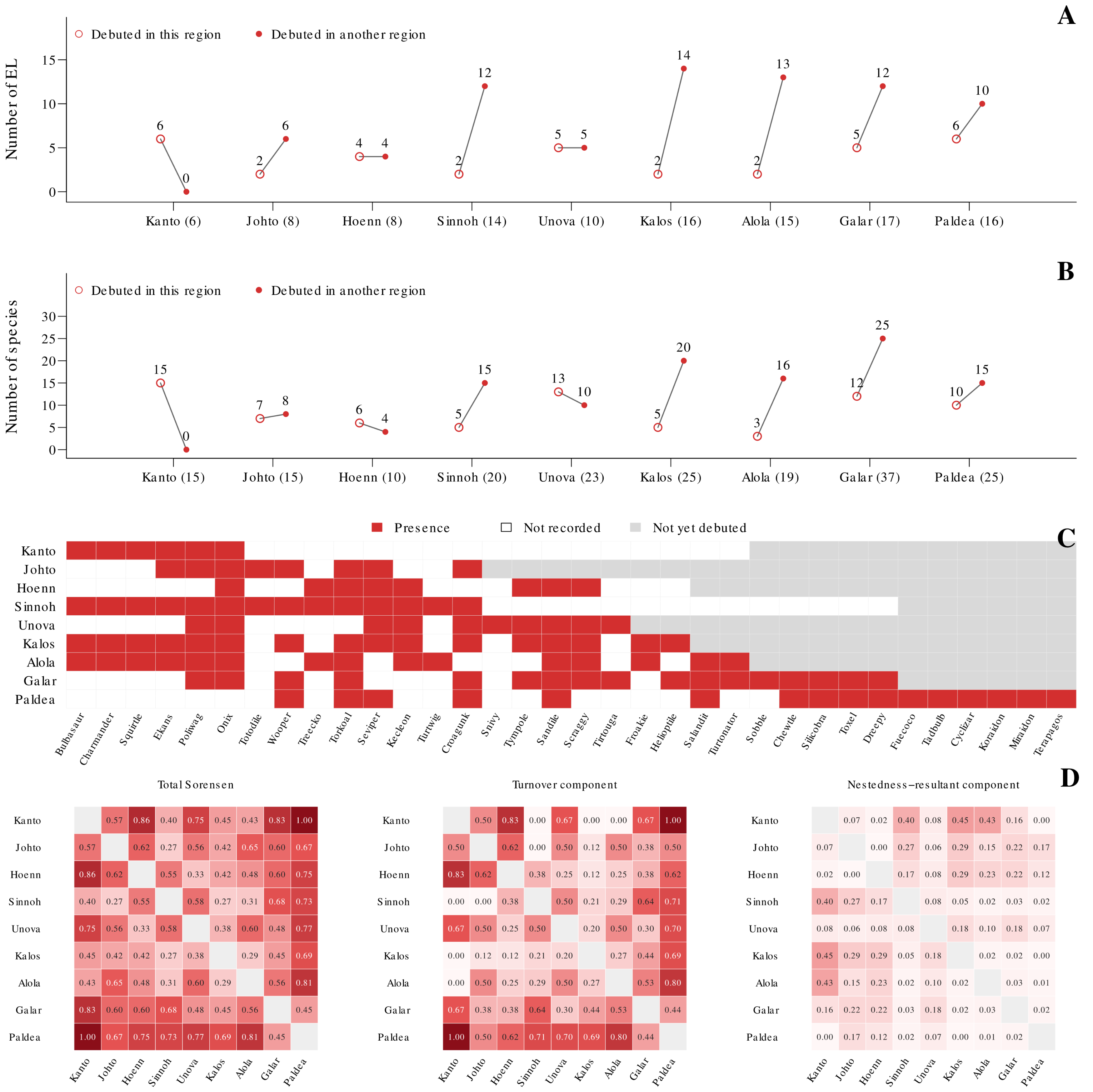
Across the 34 ELs, mean pairwise Sørensen dissimilarity was 0.563, with greater mean turnover (0.431) than nestedness-resultant dissimilarity (0.132). The lowest dissimilarities occurred between Johto and Sinnoh and between Sinnoh and Kalos (0.273 and 0.267, respectively). Kanto and Paldea shared no ELs, producing maximal total dissimilarity and turnover (1.000) with no nestedness-resultant contribution. Conversely, Kanto formed complete subsets of Sinnoh, Kalos, and Alola, and those comparisons had no turnover (Figure 9D). These patterns illustrate why a zero component does not necessarily indicate similar composition (Baselga, 2010, 2012).
Mean Sørensen dissimilarity decreased to 0.466 in the historical subset of 14 ELs, with mean turnover of 0.265 and nestedness-resultant dissimilarity of 0.201. The 20 additional ELs occurred in fewer regions on average (2.1 versus 4.9), and eight were exclusive to one region. Their inclusion therefore coincided with greater compositional differentiation, consistent with unequal historical opportunities for representation. Nevertheless, Kanto and Paldea remained completely dissimilar in the historical subset, indicating that debut timing alone does not account for the pattern.
CONCLUSION
Pokémon represents a recognizable but taxonomically uneven selection of amphibian and reptile diversity, combining anatomical, ecological, and behavioral traits with fantastical elements. When both types are considered, the predominance of Water and the frequent representation of Poison and Ground are consistent with familiar characteristics of many herpetozoans, including aquatic associations, chemical defenses, and burrowing habits. Water remains predominant when only the primary type is considered, whereas Grass ranks second, showing that the prominence of some associations depends on the counting convention. Nevertheless, numerous lineages remain without clearly identified representatives in our corpus, notably Gymnophiona and Rhynchocephalia, leaving considerable scope to explore less familiar body plans and adaptations. These comparisons highlight Pokémon’s potential as an accessible starting point for science communication, linking familiar fictional creatures with the evolutionary diversity of real organisms. Broadening this representation could also encourage appreciation of amphibians and reptiles beyond their most recognizable or commonly stereotyped forms.
REFERENCES
Alibardi, L. (2002) Histidine uptake in the epidermis of lizards and snakes in relation to the formation of the shedding complex. Journal of Experimental Zoology 292: 331–344.
Autumn, K.; Sitti, M.; Liang, Y.A.; et al. (2002) Evidence for van der Waals adhesion in gecko setae. Proceedings of the National Academy of Sciences 99: 12252–12256.
Balmford, A.; Clegg, L.; Coulson, T.; Taylor, J. (2002) Why conservationists should heed Pokémon. Science 295: 2367.
Baselga, A. (2010) Partitioning the turnover and nestedness components of beta diversity. Global Ecology and Biogeography 19: 134–143.
Baselga, A. (2012) The relationship between species replacement, dissimilarity derived from nestedness, and nestedness. Global Ecology and Biogeography 21: 1223–1232.
Baselga, A. & Orme, C.D.L. (2012) betapart: an R package for the study of beta diversity. Methods in Ecology and Evolution 3: 808–812.
Crawford, N.G.; Faircloth, B.C.; McCormack, J.E.; et al. (2012) More than 1000 ultraconserved elements provide evidence that turtles are the sister group of archosaurs. Biology Letters 8: 783–786.
Erickson, G.M.; Gignac, P.M.; Steppan, S.J.; et al. (2012) Insights into the ecology and evolutionary success of crocodilians revealed through bite-force and tooth-pressure experimentation. PLOS ONE 7: e31781.
Evers, S.W.; Barrett, P.M.; Benson, R.B.J. (2019) Anatomy of Rhinochelys pulchriceps (Protostegidae) and marine adaptation during the early evolution of chelonioids. PeerJ 7: e6811.
Ezcurra, M.D. (2016) The phylogenetic relationships of basal archosauromorphs, with an emphasis on the systematics of proterosuchian archosauriforms. PeerJ 4: e1778.
Ezcurra, M.D.; Nesbitt, S.J.; Bronzati, M.; et al. (2020) Enigmatic dinosaur precursors bridge the gap to the origin of Pterosauria. Nature 588: 445–449.
Fabrezi, M. & Cruz, J.C. (2020) Evolutionary and developmental considerations of the diet and gut morphology in ceratophryid tadpoles (Anura). BMC Developmental Biology 20: 16.
Frost, D.R. (2026) Amphibian Species of the World: an online reference (Version 6.2). American Museum of Natural History. Available from: https://amphibiansoftheworld.amnh.org/ (Date of access: 20/Nov/2026).
Gemmell, N.J.; Rutherford, K.; Prost, S.; et al. (2020) The tuatara genome reveals ancient features of amniote evolution. Nature 584: 403–409.
Gilbert, S.F.; Loredo, G.A.; Brukman, A.; Burke, A.C. (2001) Morphogenesis of the turtle shell: the development of a novel structure in tetrapod evolution. Evolution & Development 3: 47–58.
Greene, H.W. (1997) Snakes: The Evolution of Mystery in Nature. University of California Press, Berkeley.
Heiss, E.; Natchev, N.; Salaberger, D.; et al. (2010) Hurt yourself to hurt your enemy: new insights on the function of the bizarre antipredator mechanism in the salamandrid Pleurodeles waltl. Journal of Zoology 280: 156–162.
Hekkala, E.; Gatesy, J.; Narechania, A.; et al. (2021). Paleogenomics illuminates the evolutionary history of the extinct Holocene “horned” crocodile of Madagascar, Voay robustus. Communications Biology 4: 505.
Hime, P.M.; Lemmon, A.R.; Lemmon, E.C.M.; et al. (2021) Phylogenomics reveals ancient gene tree discordance in the amphibian tree of life. Systematic Biology 70: 49–66.
Joyce, W.G.; Anquetin, J.; Cadena, E.-A.; et al. (2021) A nomenclature for fossil and living turtles using phylogenetically defined clade names. Swiss Journal of Palaeontology 140: 5.
Kittel, R.N. (2018) The entomological diversity of Pokémon. Journal of Geek Studies 5(2): 19–40.
Laudet, V. (2011) The origins and evolution of vertebrate metamorphosis. Current Biology 21: R726–R737.
Leitch, D.B. & Catania, K.C. (2012) Structure, innervation and response properties of integumentary sensory organs in crocodilians. Journal of Experimental Biology 215: 4217–4230.
Lemell, P.; Lemell, C.; Snelderwaard, P.; et al. (2002) Feeding patterns of Chelus fimbriatus (Pleurodira: Chelidae). Journal of Experimental Biology 205: 1495–1506.
Losos, J.B. (2009) Lizards in an Evolutionary Tree: Ecology and Adaptive Radiation of Anoles. University of California Press, Berkeley.
Lüddecke, T.; Schulz, S.; Steinfartz, S.; Vences, M. (2018) A salamander’s toxic arsenal: review of skin poison diversity and function in true salamanders, genus Salamandra. The Science of Nature 105: 56.
Luedtke, J.A.; Chanson, J.; Neam, K.; et al. (2023) Ongoing declines for the world’s amphibians in the face of emerging threats. Nature 622: 308–314.
Lyson, T.R. & Bever, G.S. (2020) Origin and evolution of the turtle body plan. Annual Review of Ecology, Evolution, and Systematics 51: 143–166.
Marjanović, D., & Laurin, M. (2019) Phylogeny of Paleozoic limbed vertebrates reassessed through revision and expansion of the largest published relevant data matrix. PeerJ 6: e5565.
Mendes, A.B.; Guimarães, F.V.; Eirado-Silva, C.B.P.; Silva, E.P. (2017) The ichthyological diversity of Pokémon. Journal of Geek Studies 4(1): 39–67.
Peichoto, M.E.; Tavares, F.L.; Santoro, M.L.; Mackessy, S.P. (2012) Venom proteomes of South and North American opisthoglyphous (Colubridae and Dipsadidae) snake species: a preliminary approach to understanding their biological roles. Comparative Biochemistry and Physiology D 7: 361–369.
PokeAPI. (2026) PokéAPI documentation and Pokémon type data. Available from: https://pokeapi.co/docs/v2#pokemon (Date of access: 24/Nov/2026).
Pokémon Database. (2026) Pokémon Database. Available from: https://pokemondb.net/ (Date of access: 24/Nov/2026).
Prado, A.W. & Almeida, T.F.A. (2017) Arthropod diversity in Pokémon. Journal of Geek Studies 4(2): 41–52.
R Core Team. (2026) R: A language and environment for statistical computing. R Foundation for Statistical Computing, Vienna.
Schartl, M.; Woltering, J.M.; Irisarri, I.; et al. (2024) The genomes of all lungfish inform on genome expansion and tetrapod evolution. Nature 634: 96–103.
Schoen, T. (2017) Philodryas baroni. Animal Diversity Web. Available from: https://animaldiversity.org/accounts/Philodryas_baroni/ (Date of access: 22/Nov/2026).
Serebii.net. (2026) Pokémon game databases and encounter information. Available from: https://www.serebii.net/ (Date of access: 24/Nov/2026).
Stayton, C.T. (2011) Biomechanics on the half shell: functional performance influences patterns of morphological variation in the emydid turtle carapace. Zoology 114: 213–223.
Stayton, C.T. (2018) The influence of multiple functional demands on morphological diversification: a test on turtle shells. Evolution 72: 1933–1949.
Stuart-Fox, D. & Moussalli, A. (2008) Selection for social signalling drives the evolution of chameleon colour change. PLOS Biology 6: e25.
The Pokémon Company. (2024). Guía definitiva de la región Paldea: Pokémon Escarlata / Pokémon Púrpura. Altea.
The Pokémon Company. (2026) Pokédex. The Pokémon Company International. Available from: https://www.pokemon.com/el/pokedex (Date of access: 24/Nov/2026).
Title, P.O.; Singhal, S.; Grundler, M.C.; et al. (2024). The macroevolutionary singularity of snakes. Science 383: 918–923.
Tsuruda, K.; Arakawa, O.; Kawatsu, K.; et al. (2002) Secretory glands of tetrodotoxin in the skin of the Japanese newt Cynops pyrrhogaster. Toxicon 40: 131–136.
Turtle Taxonomy Working Group. (2025) Turtles of the World: Annotated Checklist and Atlas of Taxonomy, Synonymy, Distribution, and Conservation Status. 10th ed. Chelonian Research Monographs 10: 1–575.
Uetz, P.; Freed, P.; Aguilar, R.; et al. (2026) The Reptile Database. Available from: https://www.reptile-database.org/ (Date of access: 20/Nov/2026).
Vitt, L.J. & Caldwell, J.P. (2014) Herpetology: An Introductory Biology of Amphibians and Reptiles. 4th ed. Academic Press, Amsterdam.
Wagner, C.; Miller, A. K.; Engelbrecht, H.M.; et al. (2023) When to shed? Patterns and drivers of time to first ecdysis in snakes. Ecology and Evolution 13: e10364.
Walmsley, C.W.; Smits, P.D.; Quayle, M.R.; et al. (2013) Why the long face? The mechanics of mandibular symphysis proportions in crocodiles. PLOS ONE 8: e53873.
Young, B.A. & Kardong, K.V. (2010) The functional morphology of hooding in cobras. Journal of Experimental Biology 213: 1521–1528.
Acknowledgements
Pokémon and Pokémon character names are trademarks of Nintendo. Rights in Pokémon characters, designs, and official artwork remain with their respective rights holders, including Nintendo, Creatures Inc., GAME FREAK inc., and The Pokémon Company. These materials are referenced for scholarly analysis and science communication. This independent study is not affiliated with, sponsored by, or endorsed by these entities. Animal photographs were sourced from Canva Pro.
About the authors
Erika A. Reyes Velázquez holds an MSc from the Faculty of Sciences at Universidad Autónoma del Estado de México and is a founding member of RIDARMX. Her research examines how climate change affects reptile distributions to inform conservation measures. Her favorite Pokémon is Ekans.
Dr. Aldo Gómez Benítez is a Full Professor (Titular C) at Universidad Autónoma Metropolitana, Lerma, holds a PhD in Sciences from Universidad Autónoma del Estado de México, and is a founding member of RIDARMX. His work examines the effects of human activities on amphibians and reptiles and addresses environmental education and conservation needs concerning these groups. His favorite Pokémon is Squirtle.